
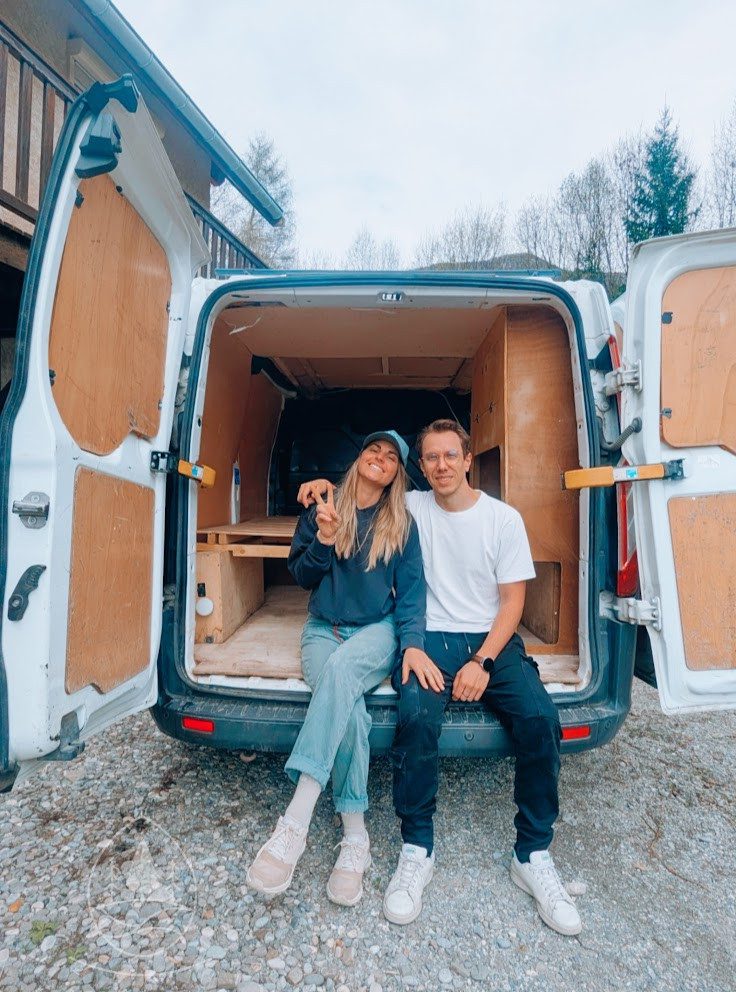
Buying a van when you already had a roof tent may seem a bit contradictory.
Especially when we've been saying for months that a roof tent is practical, comfortable, quick to set up and perfectly suited to the way we travel.
And yet, here we are with a Ford Transit Custom in the yard.
So no, we haven't suddenly decided to renounce the roof tent. Nor are we planning to become full-time vanlifers, waking up every morning facing the ocean and drinking perfectly framed coffee for Instagram. The reality is simpler: the way we travel has evolved, and some roadtrips I've been dreaming of for a long time required a slightly different tool.
We're keeping the roadtrip spirit. We're just changing the tool to make it easier.
A great converted van, I've been dreaming about it since the start
From the start, the idea of the van was in the back of my mind.
And let's be honest: at the start, I wasn't exactly dreaming of a small, discreet van with a comb bed and two removable units.
Me, I was thinking more along the lines of a real super van.. The kind of vehicle you can stand up in, with a shower, toilet, fixed kitchen, storage space everywhere, a clean installation, and that little mini-home-on-wheels feeling that makes you want to leave for three weeks as soon as you've finished looking at the adverts.
Except that Simon, for his part, didn't really see the point..
Not because he didn't like to travel. Not because he was against the idea of going on a roadtrip. But because in his eyes, putting a big budget into a converted van didn't make much sense at the time.
And objectively, he wasn't completely wrong.
We were still finishing the renovation of the house. A house which, in a very glamorous detail, is still on credit for the next twenty years. So obviously, the idea of spending a large sum of money on a leisure vehicle, no matter how pretty, no matter how practical, no matter how “I promise we'll go away a lot this time”, wasn't exactly the most sensible option on paper.
So the roof tent came as a compromise.
A more accessible, simpler, less time-consuming solution. A way of testing our roadtrip appetite without jumping straight into a major purchase. And above all, it's a way of checking whether this type of travel really suits us before investing in a dedicated vehicle.
Looking back, it was probably the best thing to do. Because without this step, I think I would have bought the wrong van.
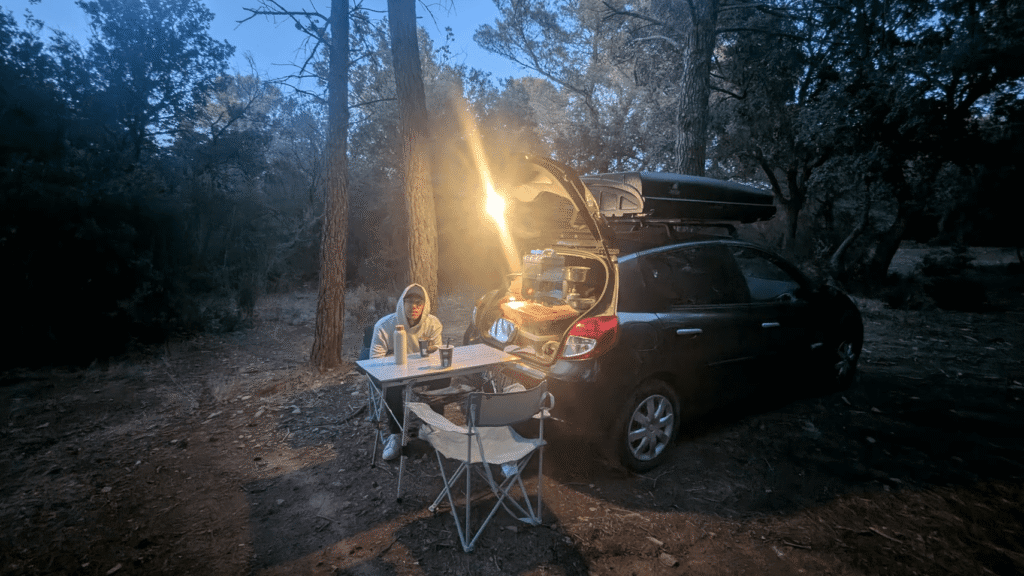
The roof tent: a great first step
I prefer to make this clear from the outset: the roof tent was not a mistake.
On the contrary, it's an excellent gateway to the roadtrip. It made it easier for us to set off, to test our organisation, to understand what we really liked about this type of trip, and above all to see what was essential for us.
And that's important.
Because before I travelled with a roof tent, I thought that an ideal van had to be big. In my head, if you're going to buy a converted vehicle, you might as well have a small flat on wheels.
Except that’in practice, our way of travelling doesn't really look like that.
With the roof tent, we already have all our camping equipment. We've got enough to cook outside. We have a shower tent. We've got organised storage. We've got our own little habits. And above all, we love living outdoors.
Even with a van, we're not going to spend our days cooped up in it. That's not the plan. The van doesn't replace the way we travel. It will correct a specific problem that was becoming frustrating in certain destinations.
In reality, the roof tent has taught us something quite valuable We didn't need a big converted van. Above all, we needed need a discreet bed.
And that changes everything.
What the roof tent taught us about our real needs
The roof tent enabled us to rationalise our desires.
Put like that, it's less glamorous than “living free on the roads”, but it's much more useful when it comes to buying a vehicle.
Before leaving with the roof tent, I probably would have kept looking at much bigger vans. Formats where you can stand upright. Vehicles with a real kitchenette, maybe a shower, a toilet, more advanced electrical installation, and all the things that make you dream when you look at layouts on Instagram.
The famous perfect van, in short. 😌
It's expensive, it takes up space, it doesn't fit everywhere, but it gives the impression of nomadic luxury that will be perfectly Instagrammable for the 3 annual stories.
Except that travelling with the roof tent put our feet back on the ground.
We realised that what we really needed was not to live in the vehicle. It was to sleep more easily, more discreetly, and in places where the roof tent became too visible.
The rest we already have.
Our camping equipment will continue to be used. The way we cook outdoors will continue. And so will our desire to spend time outdoors. And in the end, it's reassuring: we didn't buy a van to change everything, but to simplify a use we already knew.
That's why we opted for a small van rather than a big one. Because a large van, however comfortable, might have created exactly the problem we wanted to avoid: attracting attention, not passing under certain barriers, being immediately identified as a converted vehicle.
And we wanted the opposite.
A discreet vehicle. Compact. All-purpose. Able to fit into a conventional car park. Not an illuminated “cuckoo, we're sleeping here tonight” sign.
The real limit of the roof tent: discretion
When we talk about the limitations of a roof tent, we often hear the same things: you have to go outside to cook, you have to sleep outside, you have to deal with the weather, you have to set up and dismantle the camp.
For us, that wasn't really the problem.
Living outdoors suits us just fine. We're not going on a roadtrip to stay cooped up. We've already got our own organisation, our own equipment, our own habits. Even putting up the tent wasn't a constraint, thanks to our Naïtup roof tent It unfolds in less than 30 seconds, and the sleeping position is extremely comfortable.
In fact, that's probably what I'm going to miss the most.
A 140cm mattress, ready in a matter of seconds, in a tent already set up on the roof, that's a real treat. We're not going to pretend. On this point, the van is going to have to prove itself.
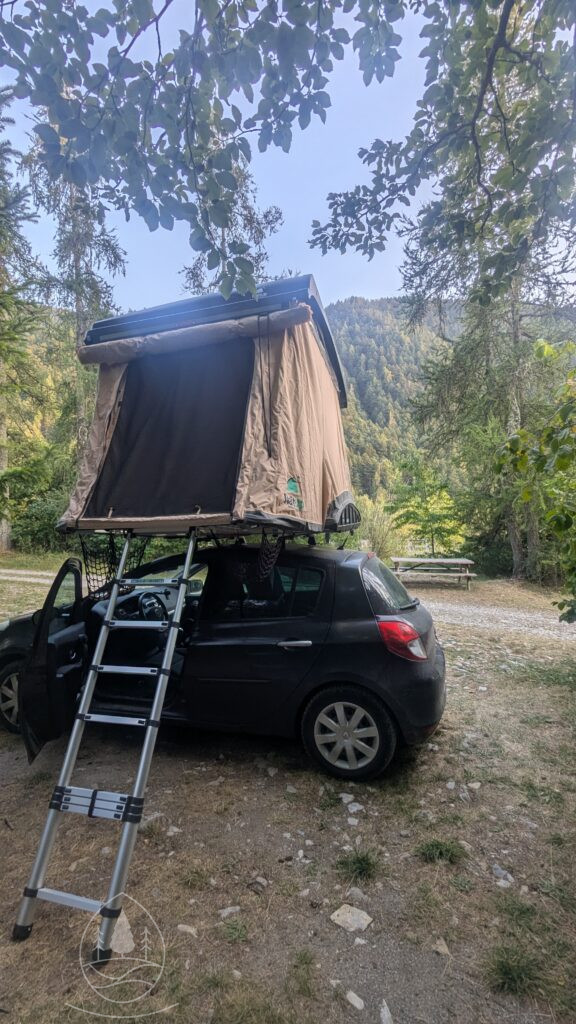
The real limit, for us, was discretion. (in case you hadn't figured it out yet 🤣)
An open roof tent shows. It has to be. Even if you find a quiet spot, even if you arrive late, even if you leave early, visually you can't really pretend that nothing is happening.
And when you don't have a 4×4, this limit becomes even more marked.
With a vehicle capable of off-roading, we could seek out more remote, more isolated, more naturally discreet spots. But with our Clio, we're not going to follow stony roads at random, crossing our fingers. We love adventure, but not so much that we turn every departure into a garage estimate.
In the Hautes-Alpes, in the Vercors, in Burgundy, or in more rural and mountain areas, the roof tent works very well. It's easier to find suitable locations. The landscapes lend themselves to it. There are more possibilities.
But in some areas that are tighter, more touristy and more coastal, it's a different story.
The roadtrip in the Var that convinced Simon
The real catalyst came during our roadtrip in the Var.
I've already written about this trip in the article dedicated to the roadtrip in a roof tent in the western Var.
And this is typically the kind of destination that brought us face to face with the limits of our car + roof tent format.
Not because the tent was uncomfortable. Not because we were ill-equipped. Not because we didn't know how to organise ourselves.
But because in this type of department, everything is much more closely guarded. Access is more complicated, car parks are more visible or even under surveillance, small paths are often blocked and really discreet areas are harder to find. We're not in a mountainous area where you can easily wander off and find a coherent place.
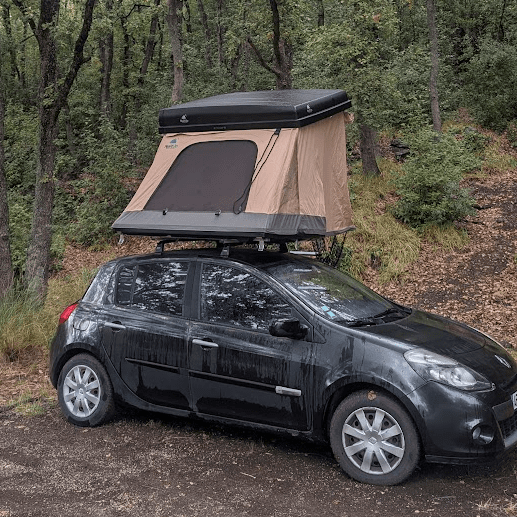
And after a while, the constraints pile up.
That's when Simon really understood what I'd been trying to say all along. It wasn't about giving in to my initial desire to have a big converted van. It was about finding a much simpler solution: to avoid putting aside certain roadtrips simply because the sleeping arrangements became too visible.
What the van will change in concrete terms
The van isn't going to revolutionise everything.
I prefer to say this because people are quick to associate the purchase of a van with a complete switch to vanlife. But that's not the case for us.
We don't plan to live in it all year round: we have our own house that we've renovated and love ❣️On. We don't plan to leave it all behind. We don't plan to turn every move into a documentary series on modern freedom.
For us, the van is a tool for holidays and roadtrips.
Its main advantage is that it allows us to sleep more discreetly. To be able to land more easily when the spots are complicated. To be able to consider destinations where the weather is more uncertain. To have a simpler option if you arrive late, if everything is closed, if you can't find the perfect spot.
It will also allow us to cook indoors in the event of really bad weather. But that's not the main objective. Given the size of the van we've chosen, we'll continue to live outside as much as possible.
And that's just fine.
Above all, we wanted a vehicle that looked like a professional van. Something sober, discreet, not too “leisure”, not too identifiable as a converted vehicle. The idea is simply not to attract unnecessary attention when you need to sleep in a very ordinary place.
Because sometimes, freedom on a roadtrip isn't about a dream spot by the side of a lake. It's just being able to park somewhere, get a good night's sleep, and set off again the next day without having spent the night wondering if someone's going to come along and poke the canvas.
Why we chose a small van rather than a large one
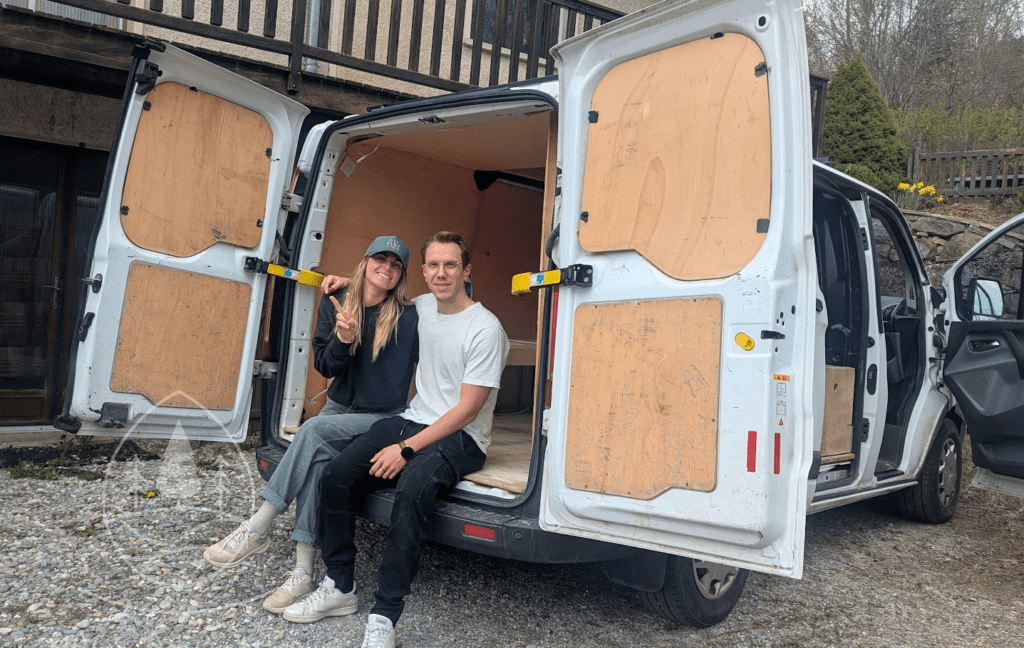
We finally bought a 2017 Ford Transit Custom.
It already contains a removable layout with a comb bed, two storage units and an auxiliary battery already installed. I'll go into more detail about the layout, the insulation, the condition of the van and what we plan to modify in a dedicated article, because otherwise this one risks becoming far too long.
What counts here is the choice of format.
We've gone from “I'd love a great converted van” to “in fact, the smartest thing for us is a small, discreet van”.
And frankly, it wasn't necessarily the most obvious route to take at the start. But it's the one that best responds to our real constraints.
Go almost anywhere. Fit into conventional car parks. Not attract attention. Keep a relatively compact vehicle. And above all, you can sleep in it without having to open anything on the outside.
That's real change.
Not live bigger. Travel simpler.
And what about the roof tent?
For the time being, the roof tent will be removed from the Clio. 🥺
Are we going to sell it? We probably will. Is it already decided at 100 %? Not really, no.
That's still the big question mark.
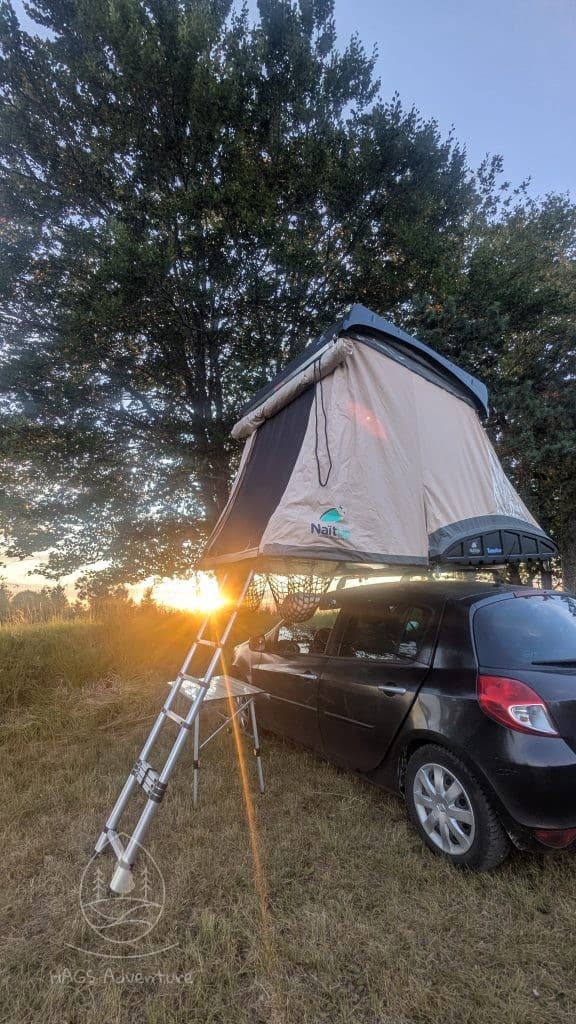
The roof tent allowed us to take our first steps into the world of roadtrips. The funny thing is that everything we bought to travel with it will continue to serve us: the camping gear, the organisation of meals, the shower tent, the storage, the accessories. We're not starting from scratch.
She taught us to travel light, to identify our real needs and not to fantasise about a layout that was too big for our needs. And in a way, it's thanks to her that we chose a van that's simpler, more discreet and probably much more suitable.
Test the van before fitting out
The temptation when you buy a van is to want to redo everything straight away.
Get out the plans, the floorboards, the Pinterest ideas, the YouTube videos, the wiring diagrams, the Amazon baskets, the existential debates about “plywood or panelling? In short, to disappear for weeks in a spiral of furnishing.
But we're going to try to do things in the right order.
Originally, we had planned four roadtrips between May and August with the roof tent. In the end, we're going to do them with the van as it is.
And that's probably the best way of understanding what really suits us.
Because you can imagine a lot of things on a floor plan. But until you've slept in it, put your things away, cooked around it, looked for a spotlight, folded the bed, complained about a piece of furniture that wasn't in the right place or appreciated a detail that you hadn't even anticipated, you don't really know.
These first roadtrips will therefore serve as a full-scale test.
We'll see what works. What annoys us. What we keep. What we change. What's really missing. And what, in the end, might not be so important.
What's certain is that after this test phase, we'll probably dismantle the layout and start again from a cleaner base. There's some dirt that's inaccessible without removing it all, and that, for me, is clearly a problem. We also spotted a few rust spots, obviously linked to seepage from the old roof bars, which we've since removed.
So before we think about decorating, we need to think about the state of the premises.
Clean. Check. Understand existing insulation. See how the van behaves in summer, in hot destinations. Then decide whether to keep what's in place or start again with more complete insulation, with Armaflex for example.
But first things first.
First, we leave. Then we dismantle. Then, we fit it out intelligently.
Well, we're going to try. Because there are always two or three twists and turns between theory and us with a drill.
We're not going vanlife, we're keeping the roadtrip spirit alive
This van does not mark a radical change in plans.
We don't become full-time vanlifers. We're not looking to turn our daily lives into a permanent nomadic lifestyle. We don't want a miniature house on wheels.
We simply want to continue travelling as we like to do, but with less frustration at certain destinations.
The roof tent enabled us to discover a way of setting off that suited us: moving around a lot, sleeping simply, spending time outdoors, enjoying the countryside, the villages, the hikes, the back roads, and keeping a real flexibility in the itinerary.
The van extends that.
It doesn't replace the roadtrip spirit. It allows us to go further with certain projects, particularly those that we had put aside because they seemed too complicated with a visible roof tent.
And that's exactly what I like about this development: we're not changing our philosophy, we're just changing our tools.