

This 10-day road trip through the Ardèche in a campervan It allowed us to explore the department from south to north, taking in charming villages, caves, the Ardèche Gorges, canoeing, swimming and volcanic landscapes. It was our first trip of this length in a campervan, with an itinerary designed to alternate between cultural visits, nature and camping.
And yet, the day before we were due to set off, we were still planning to head to Piedmont. Between the heatwave and the heavy thunderstorms forecast for Italy, we changed our plans at the last minute and brought forward this trip, which had originally been planned for July. With no bookings at all, all we had to do was adjust our itinerary and set off for the Ardèche.
Day 1 – Saint-Montan and the Saint-Marcel Cave
On this first day of our road trip in the Ardèche, we’re starting off at a leisurely pace in the south of the department with two discoveries that already set the tone for the trip quite nicely: a charming village and our very first natural cave.
Saint-Montan, a medieval village rebuilt by thousands of volunteers
Our first stop takes us to Saint-Montan, where we start by enjoying a leisurely meal by the river before setting off to explore the medieval village. As we made our way up its narrow cobbled streets, we were stopped by a member of the Friends of Saint-Montan association. What was supposed to be a simple stroll eventually turned into a proper impromptu history lesson, and to be honest, it was fascinating.
Because the village we see today bears little resemblance to the one of the mid-20th century. The old medieval village, which was gradually abandoned in the 19th century, had become a pile of ruins overgrown with vegetation. The last inhabitants had left it in the 1880s to move closer to their land in the valley.
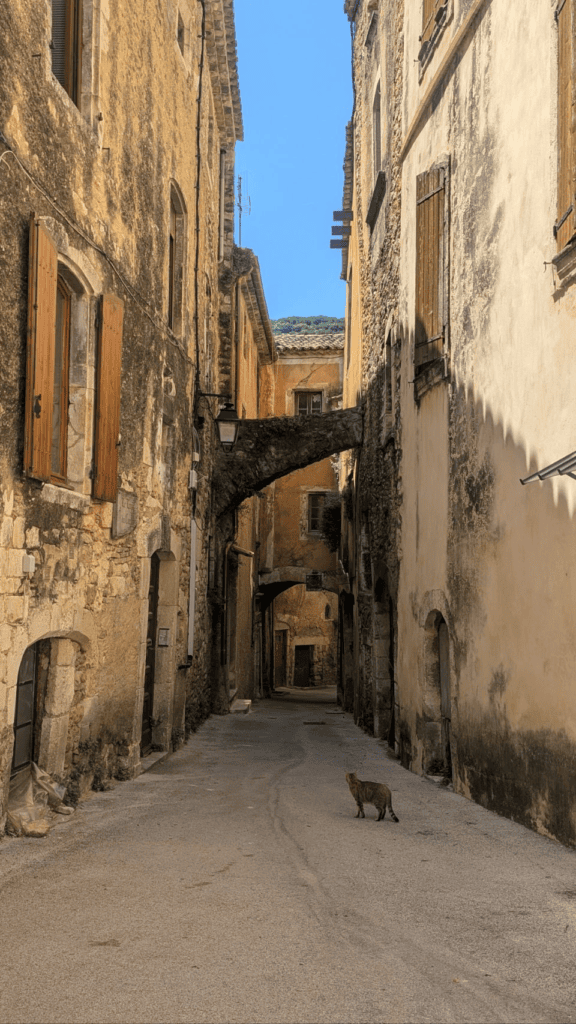
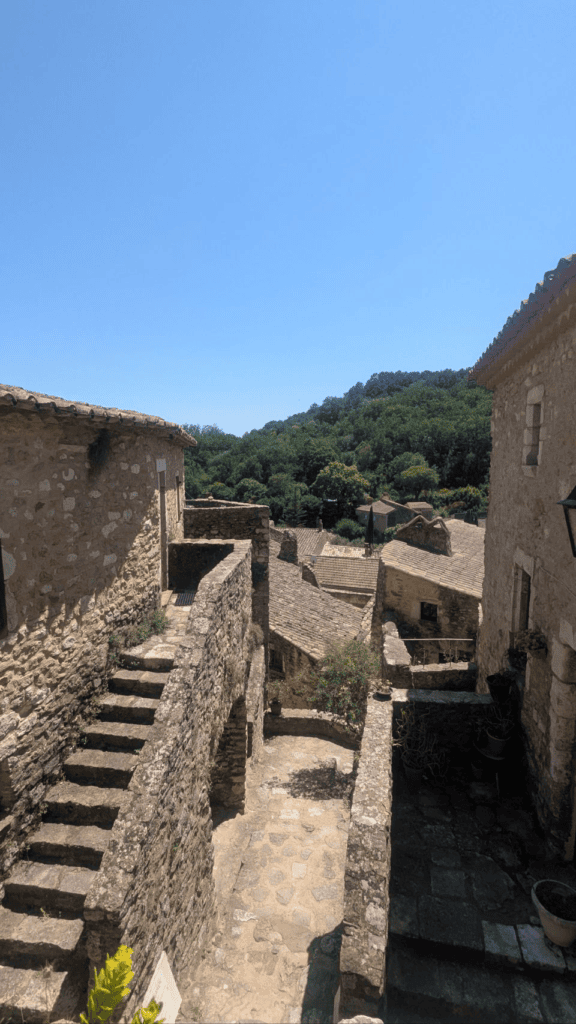
Everything changed from 1970 onwards with the founding of the association of Friends of Saint-Montan. Having started by restoring the Saint-André chapel, the volunteers are gradually turning their attention to the old village, its houses and its castles. More than fifty years later, around 13,000 volunteers, Scouts, trainees and participants in international work camps have contributed to this reconstruction. Some houses that were once completely in ruins are now inhabited once again.
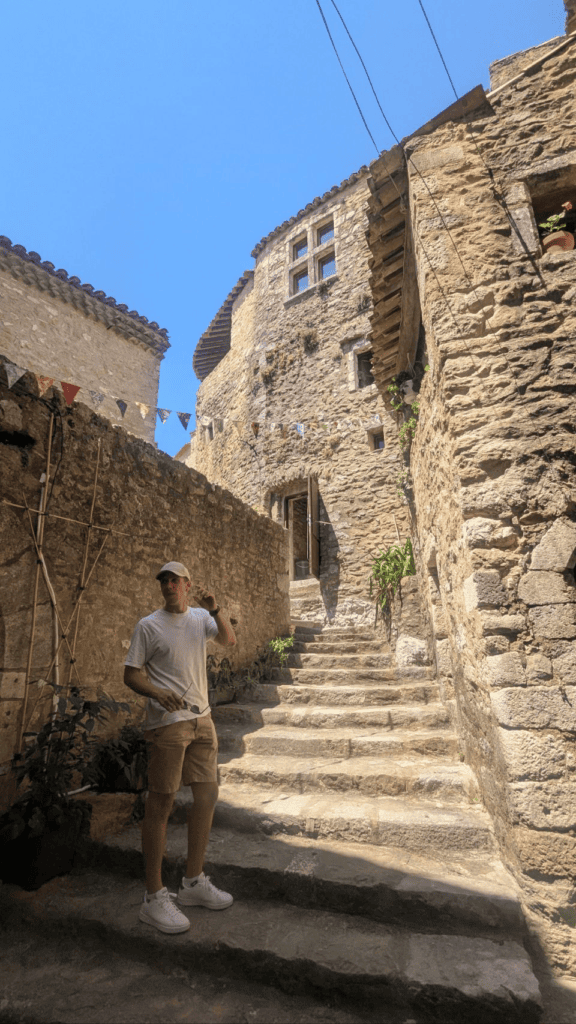
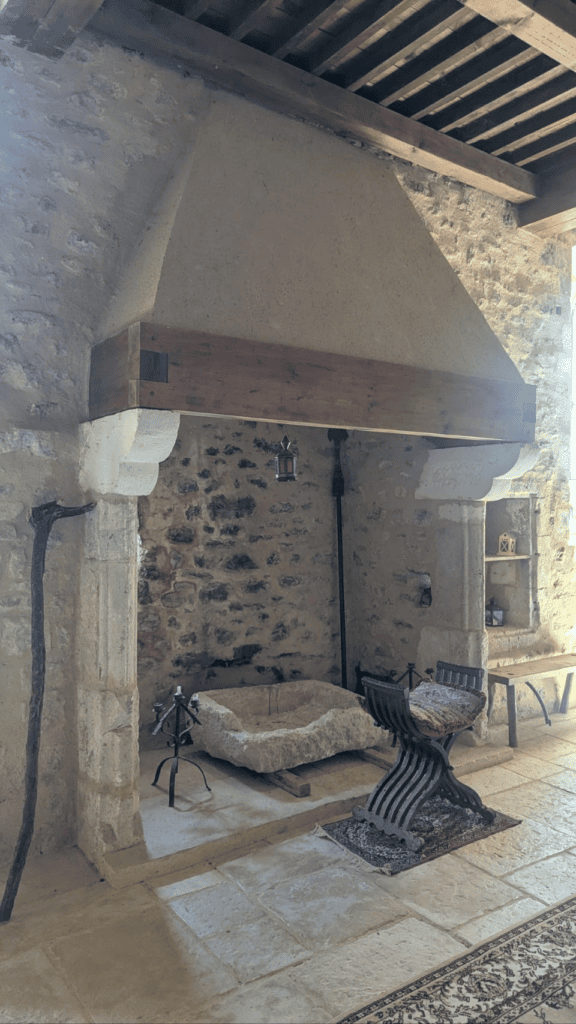
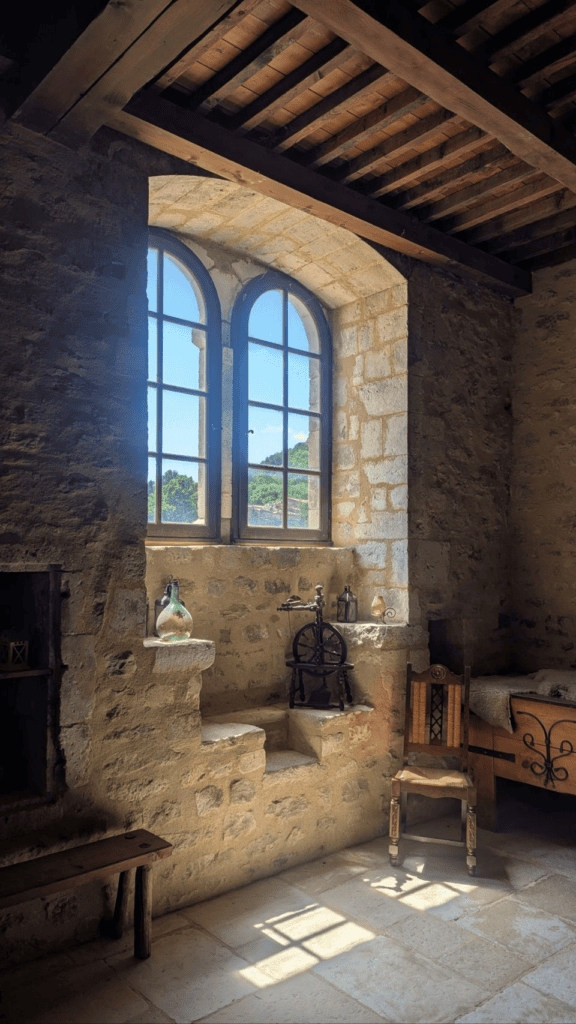
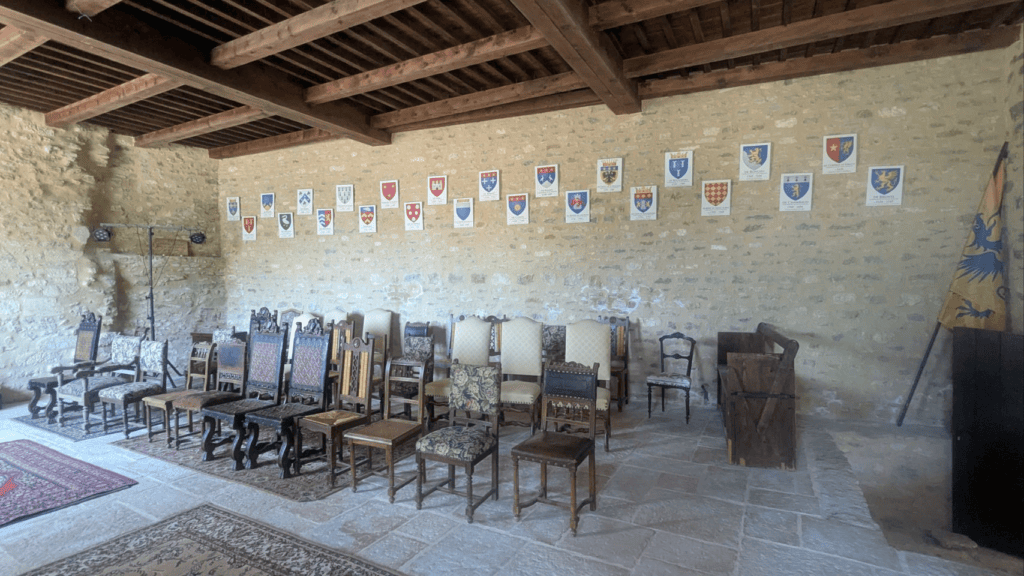
And that is undoubtedly what made the greatest impression on us here. If you visit Saint-Montan without knowing its history, you might simply see it as a pretty medieval village in the Ardèche. But once you realise that much of what you see before you has been rebuilt stone by stone, often by hand, the visit takes on a whole new dimension.
Saint-Marcel Cave: our first proper descent underground
We then get back in the van and head towards the Saint-Marcel Cave, where we arrived just in the nick of time to catch the last tour of the day. And for us, it was a first: we’d never visited a real natural cave before.
It’s fair to say we’re off to a flying start. The Saint-Marcel Cave forms part of an underground network stretching over 60 kilometres and is one of the largest caves in France. It was first discovered in 1836, when a hunter is said to have entered the cave whilst following a wounded rabbit. The first guided tours began as early as 1838, largely to prevent damage and looting.
Nowadays, the tourist route is obviously much more accessible (but also more limited – you only get to see a small part of the cave). You still have to go through it all more than 400 steps on the way down… which you’ll then have to climb back up, amidst vast galleries, limestone formations and pools carved out by water over time.
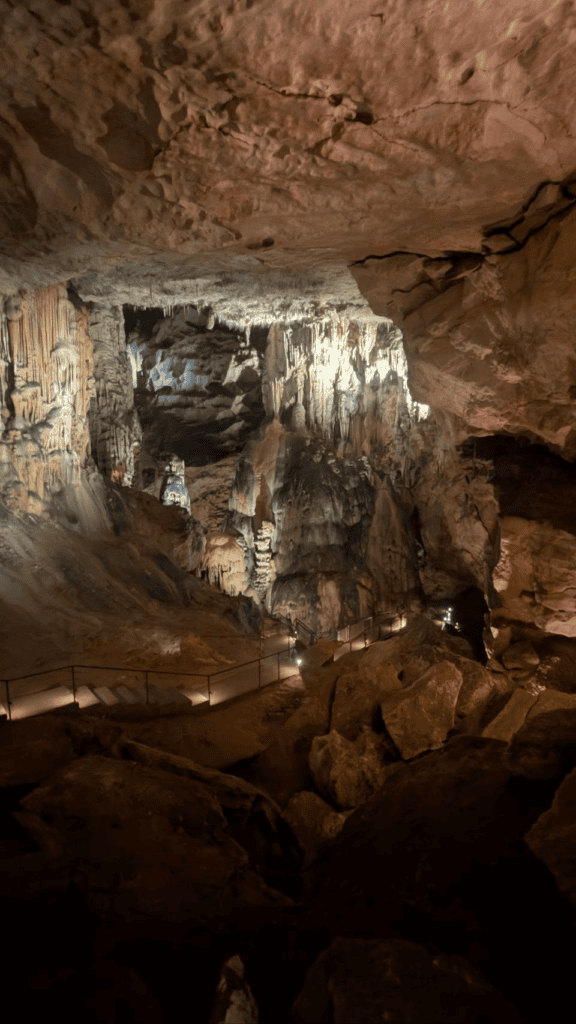
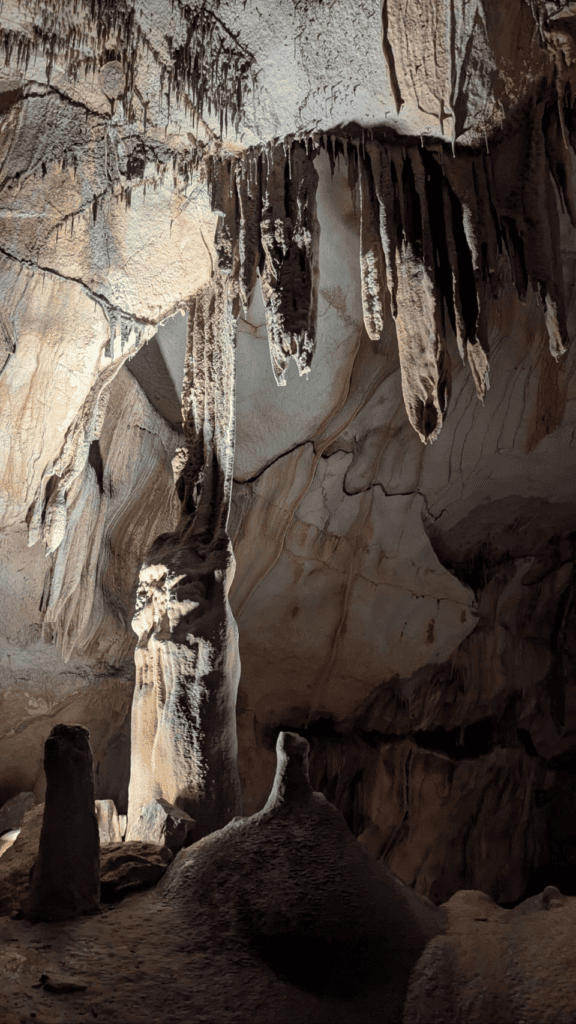
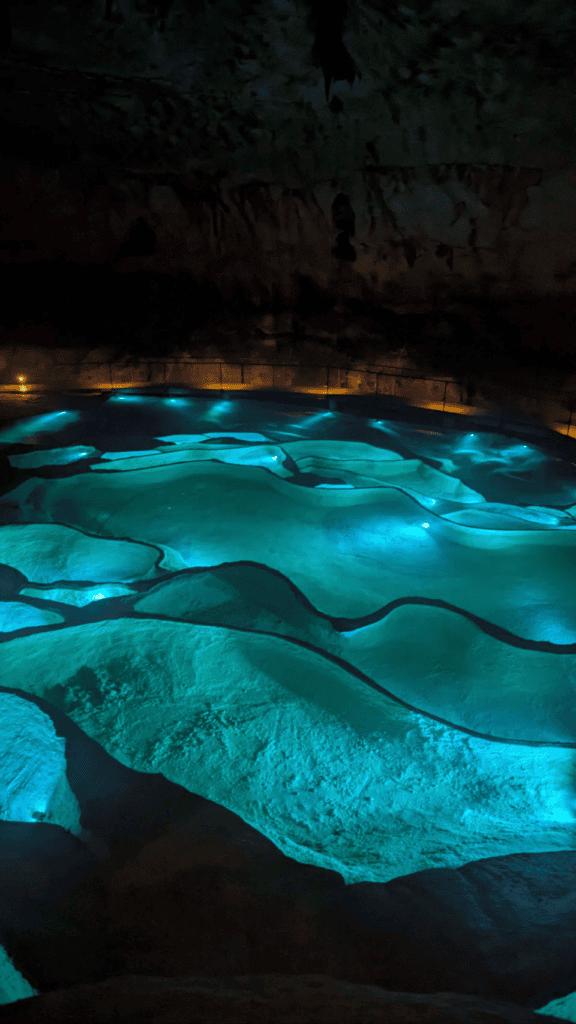
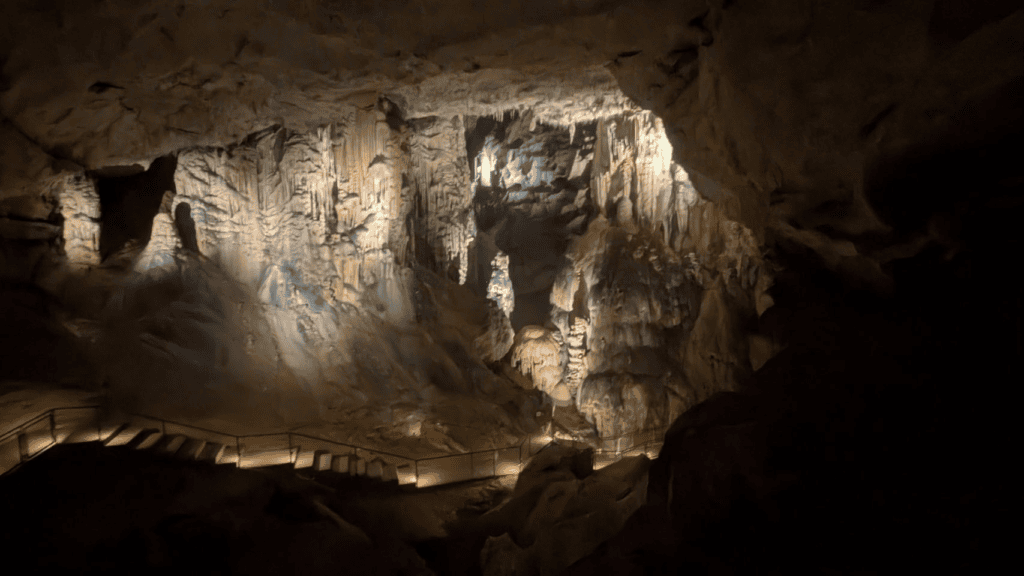
Visitors can also see the traces left by the earliest explorations of the cave, before discovering a much more contemporary exhibition design. Sounds, darkness and lighting effects gradually accompany the tour, beautifully highlighting the cave’s vast spaces and its natural formations. The site now uses this immersive experience to retrace the steps of the first explorers.
For our first underground adventure, it was certainly a sight to behold. It was our first time experiencing this sort of landscape, and we didn’t realise at the time that the caves would end up playing a much bigger part in our road trip than we’d expected.
First night camping
After this first busy day of exploring, it’s time to find somewhere to stay for the night.
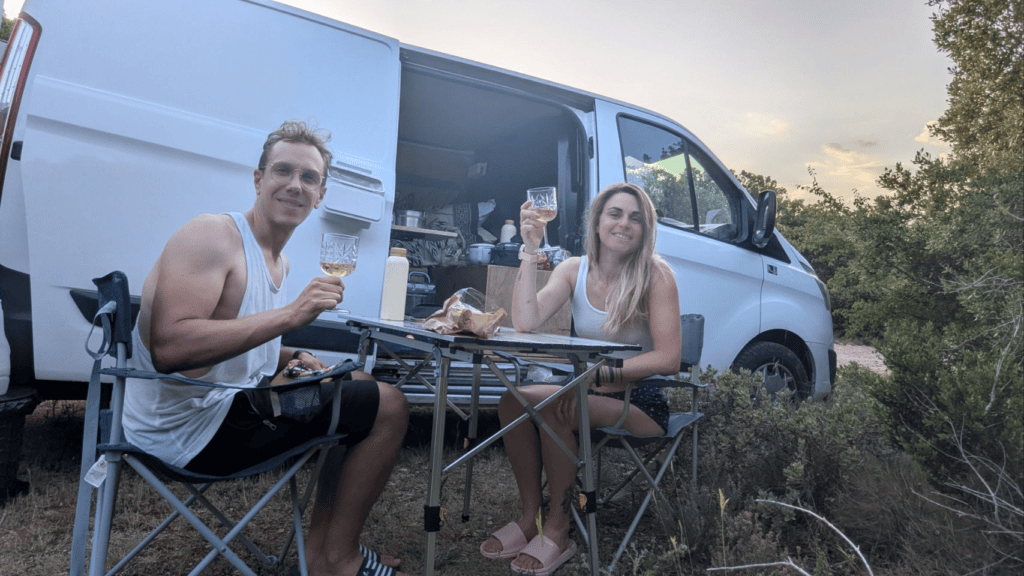
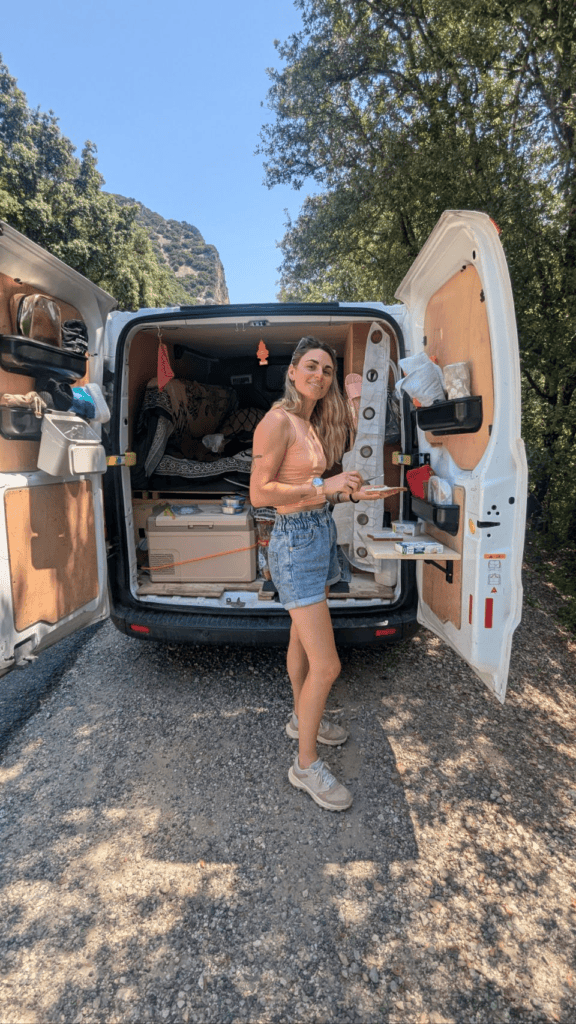
We spot a small forest track, and a few metres further on, a lovely open space where two vehicles are already parked. Naturally, rather than joining everyone else, we prefer to carry on a little further to find a spot all to ourselves. We’re a bit of a free spirit – and we’re proud of it.
Before we bring out the chairs and officially settle down for the night, we’ll still go for a walk of a few dozen metres to see a nearby menhir.
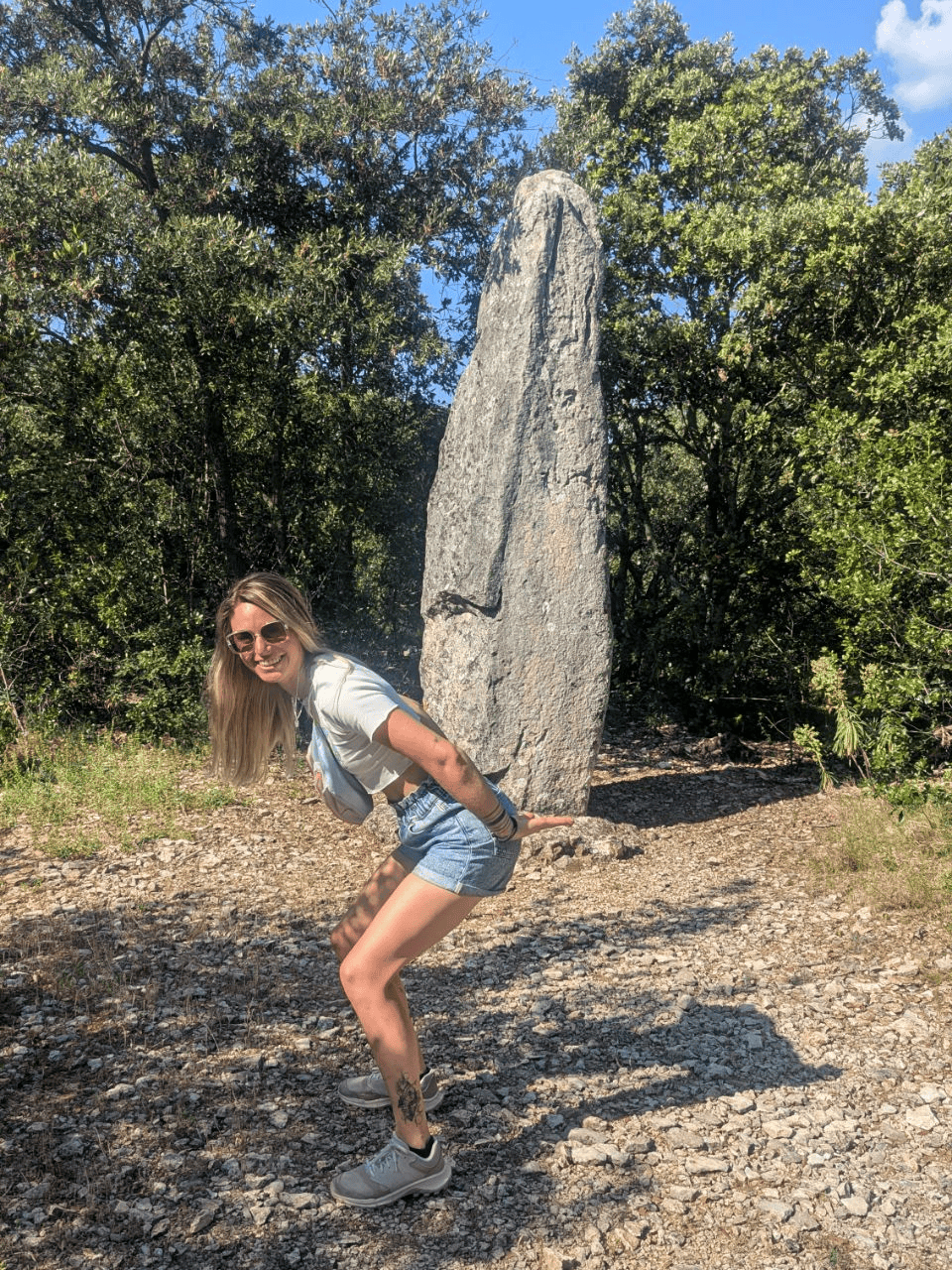
The day before, we’d watched “Asterix and Obelix: The Middle Kingdom”. Needless to say, that was all it took for me to try my best Obélix impression by pretending to carry the menhir. On paper, it was a brilliant idea. In the photo, however, gravity unfortunately decided not to play along.
But at least this first night in the Ardèche ends just as it began: peacefully, in the middle of nowhere, with the feeling already that we’ve really set off on a road trip.
Day 2 – On the way to the Ardèche Gorges
On this second day, we’re starting to realise that our carefully planned itinerary will mainly serve as a starting point. Between the heat, the tips we’ve picked up along the way and the places that make us want to stop simply because they look lovely, we’re already starting to improvise. But isn’t that the whole point of a road trip?
Bidon and the first viewing points in the Ardèche Gorges
We start the day with a short stop at Can, mainly to top up our water supplies before setting off again along the Ardèche Gorges tourist route.
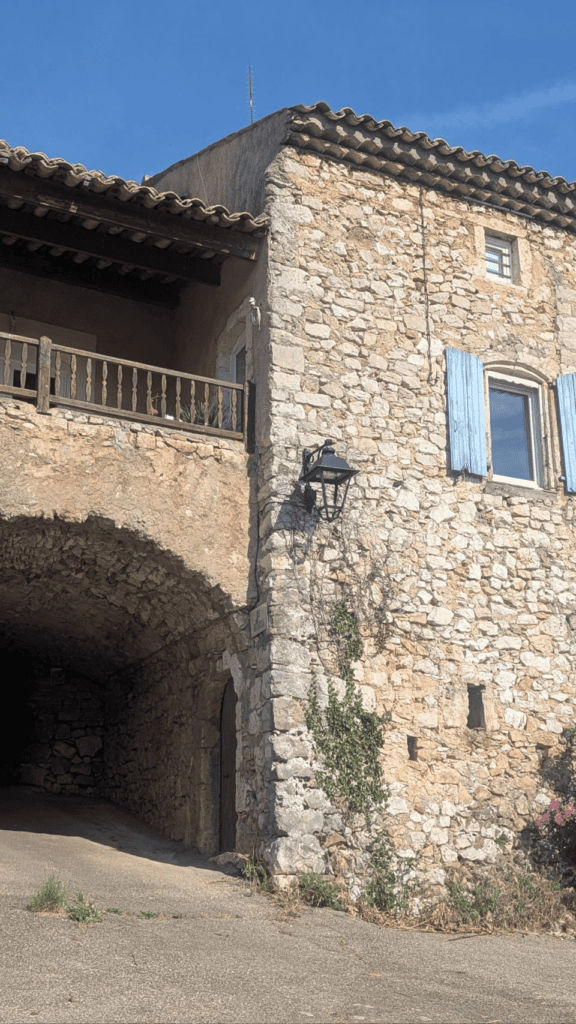
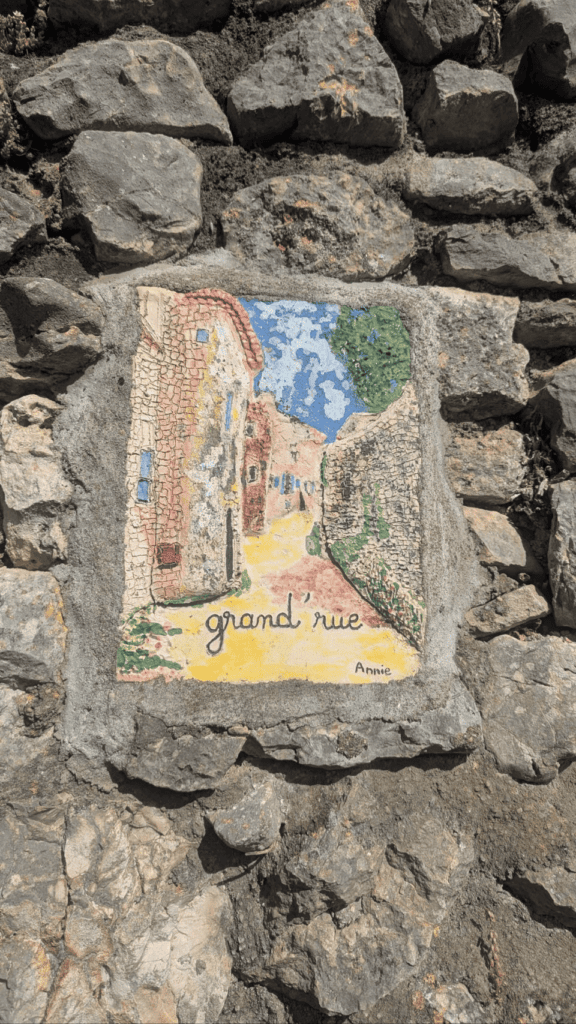
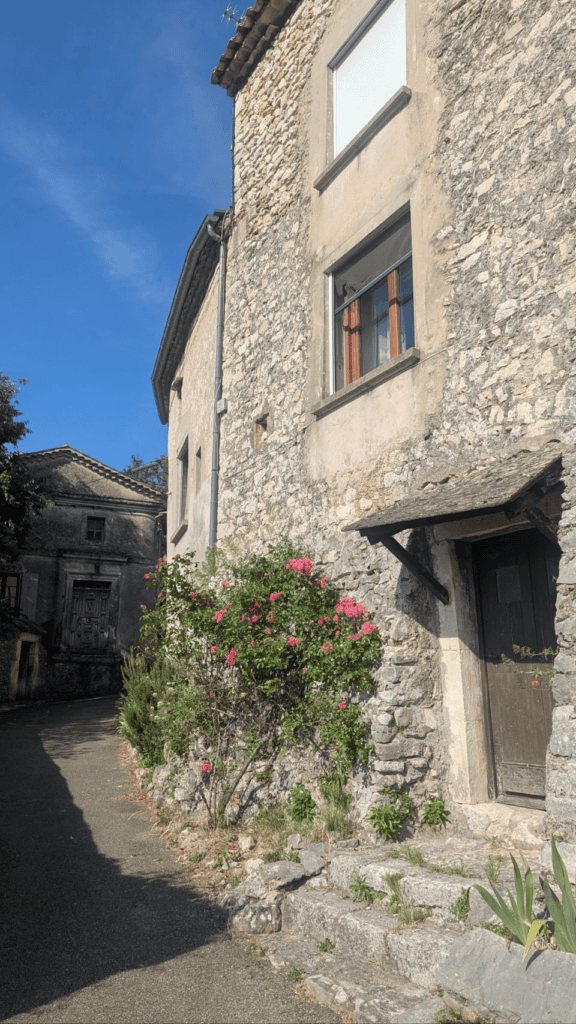
We haven’t really got any major sightseeing planned here: we’re mainly making the most of the journey by stopping off at various viewpoints along the way and gradually taking in the view of the canyon from above.
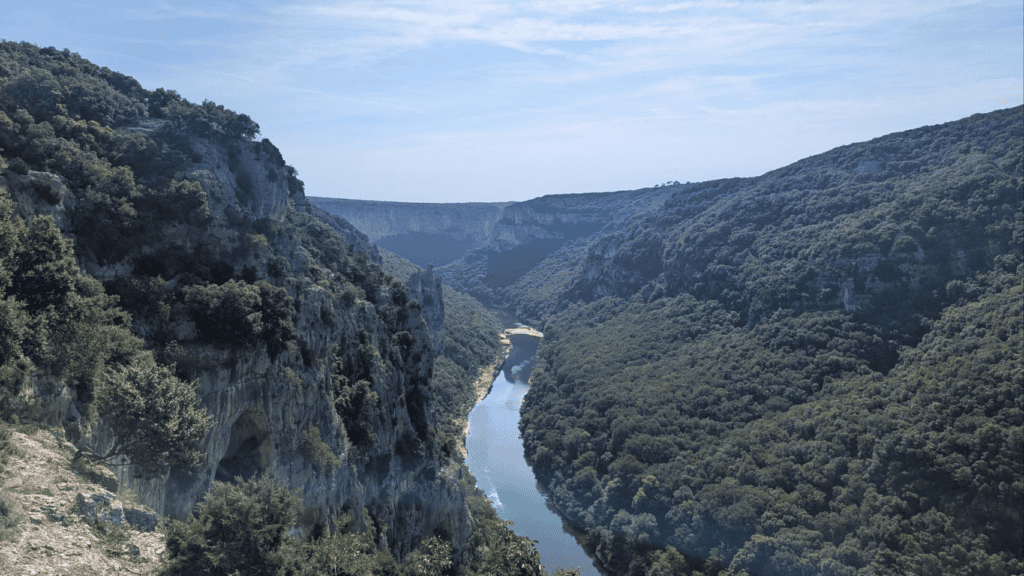
Having explored the Ardèche underground the day before, we’re now setting out to explore it from above.
The Madeleine Cave: the first deviation from the itinerary
Our next stop was completely unplanned. When we arrived at the car park of the Madeleine Cave, we bump into some vanlifers who’d been camped near our spot the day before. We take the opportunity to have a coffee together before the tour we’re going on together.
Originally, this cave wasn’t even on our itinerary. But with the heat, we started to seriously reconsider our plans and finally decided to take the advice of a friend who’d strongly recommended it to us the day before.
And it has to be said that the setting gets off to a great start: even before you go underground, the site offers a superb panoramic view of the Ardèche Gorges from its viewing point, high above the limestone cliffs that tower over the river.
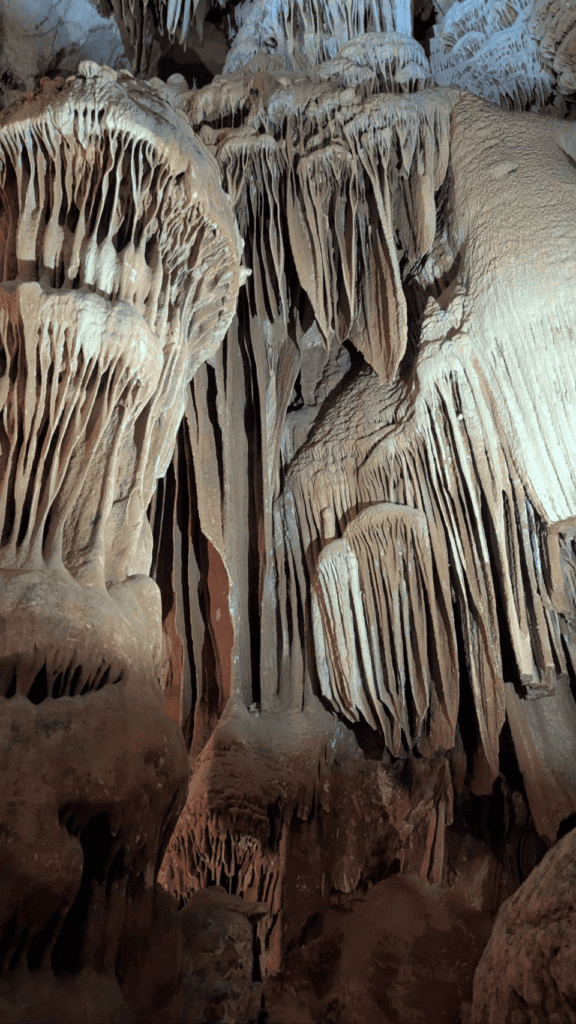
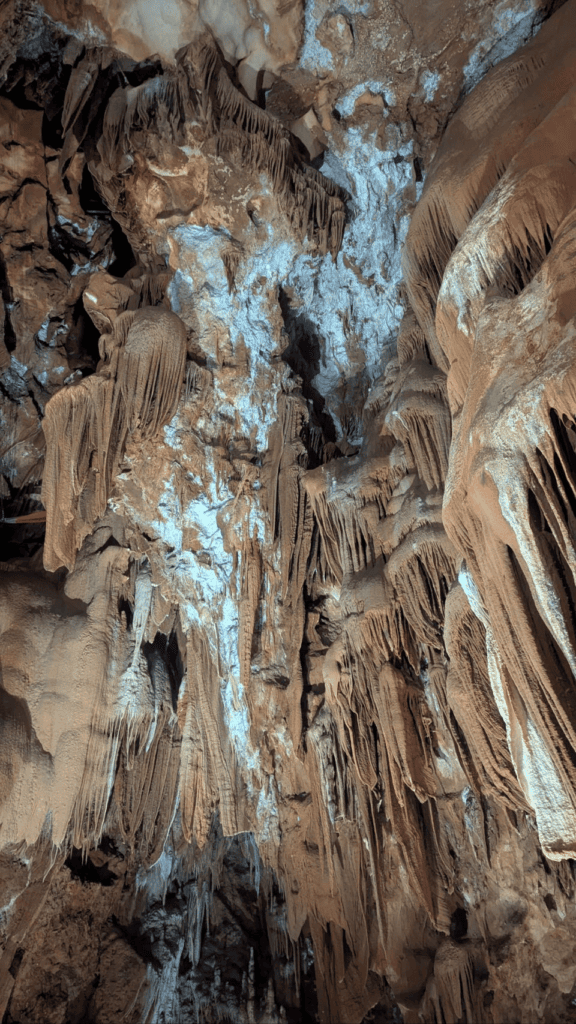
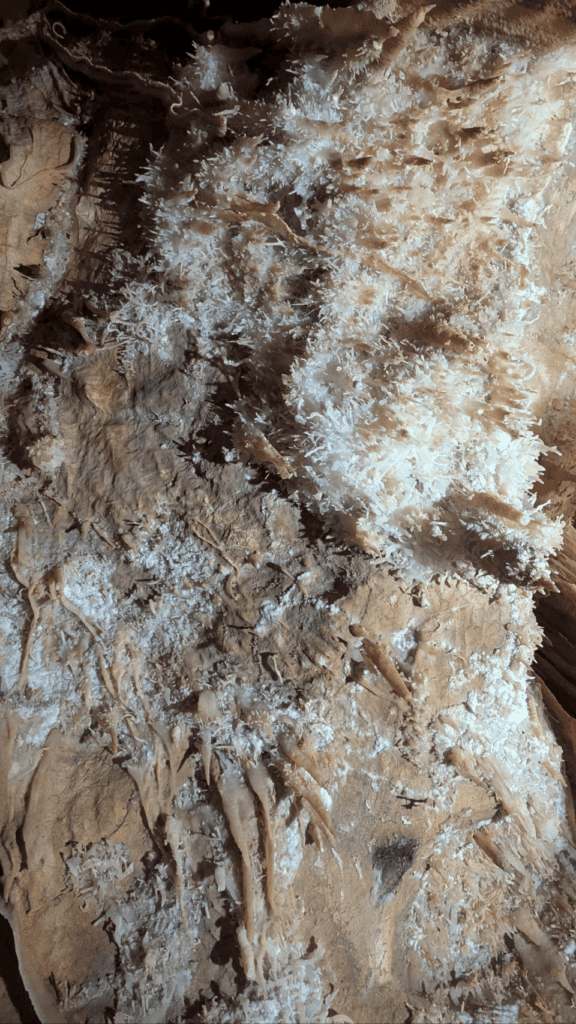
As for the cave itself, it’s hard not to start drawing comparisons with Saint-Marcel, which we’d visited just the day before. But I’m not going to go into detail here: having visited several caves in quick succession during this road trip, I’m planning an article entirely devoted to comparing them and our personal ranking.
Let’s just say that at this stage of the journey, the match is just getting started.
Aiguèze, the detour that was completely unplanned
We then set off again and, from the other side of the river, we spot a hilltop village that looks particularly pretty to us.
This village is Aiguèze.
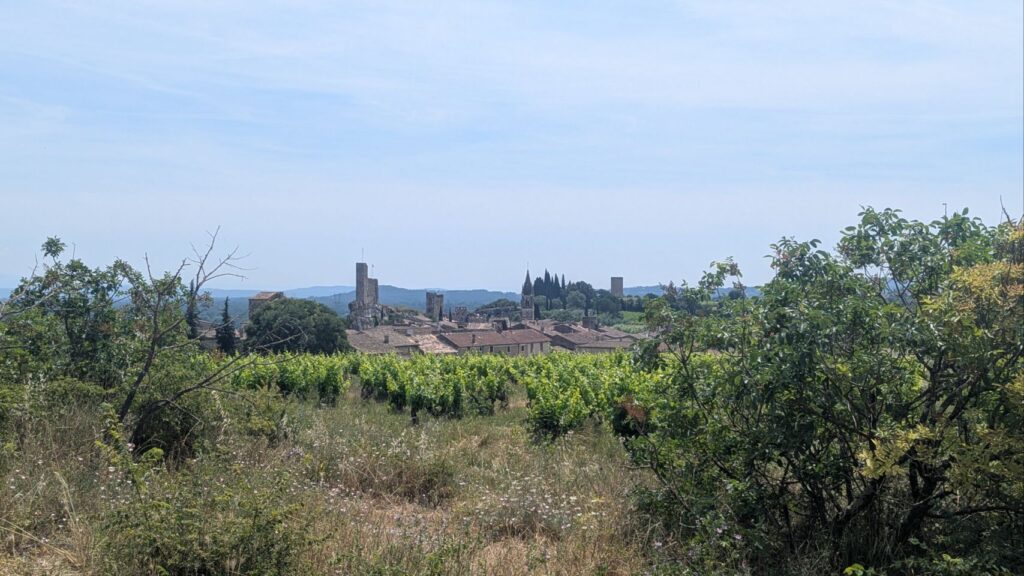
It’s not on our itinerary. It’s not even in the Ardèche, as it’s just on the other side of the river, in the Gard. Naturally, we decide to stop. We start by making the most of a shaded car park and, above all, a perfectly positioned bench where we can unpack our picnic. With the heat we’re having, finding some shade is already becoming a tourist attraction in its own right.
We then set off to explore the village on foot, and the first impression we’d had from the road is fully confirmed. Aiguèze is a medieval village perched high above the Ardèche Gorges, with its old stone façades, cobbled streets and the remains of its former fortress. It is, in fact, one of the “Most Beautiful Villages in France”.
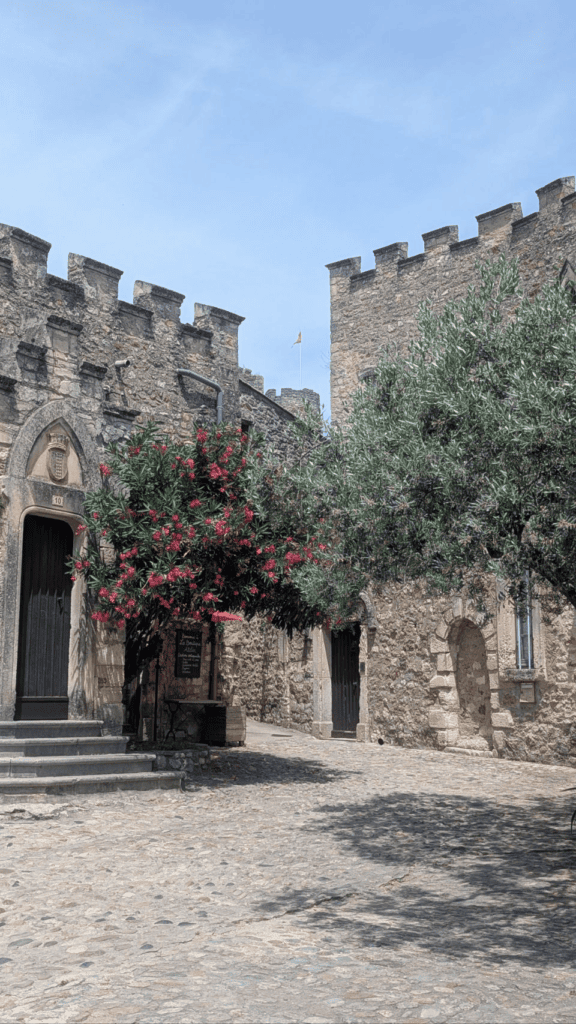
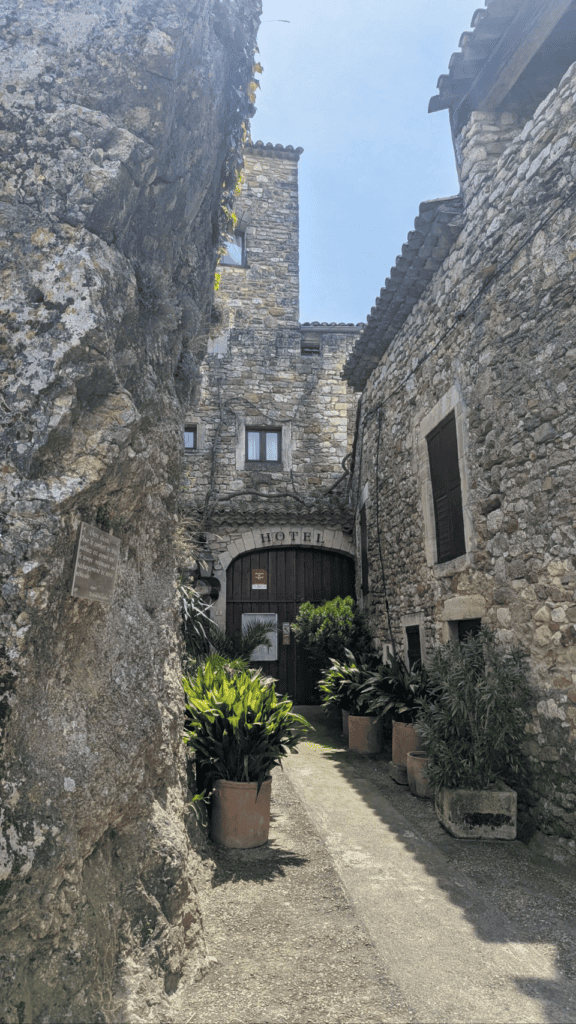
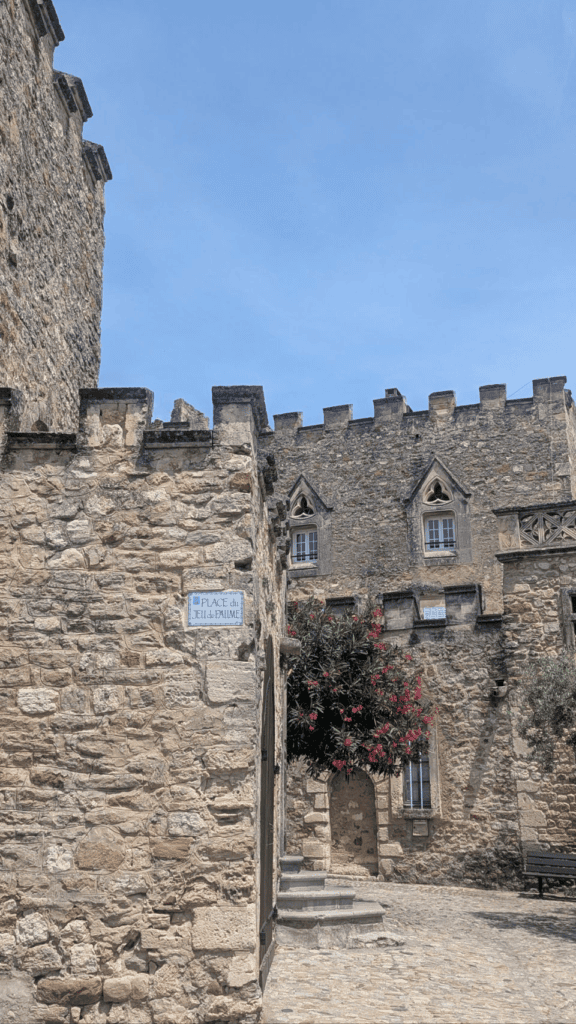
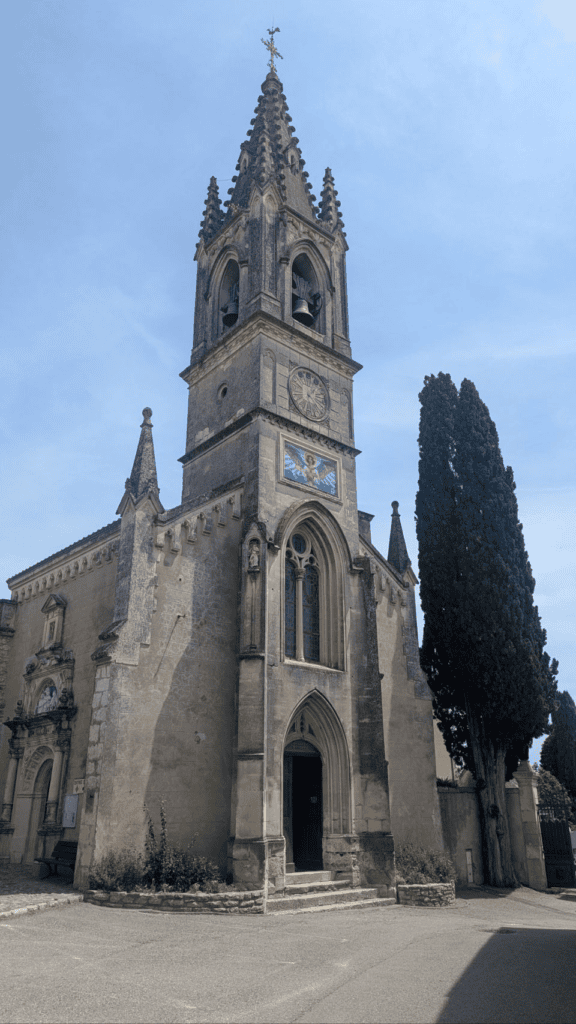
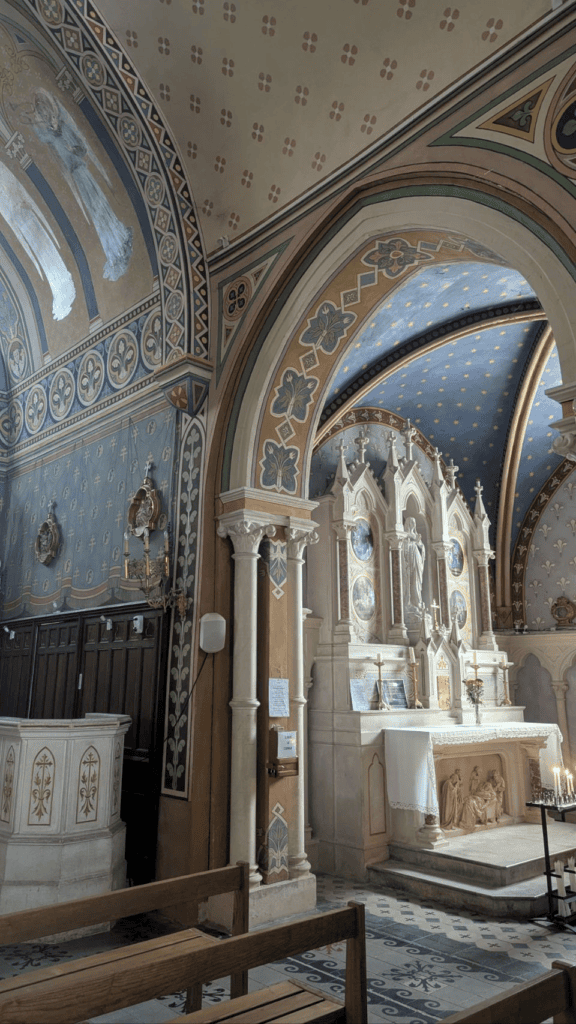
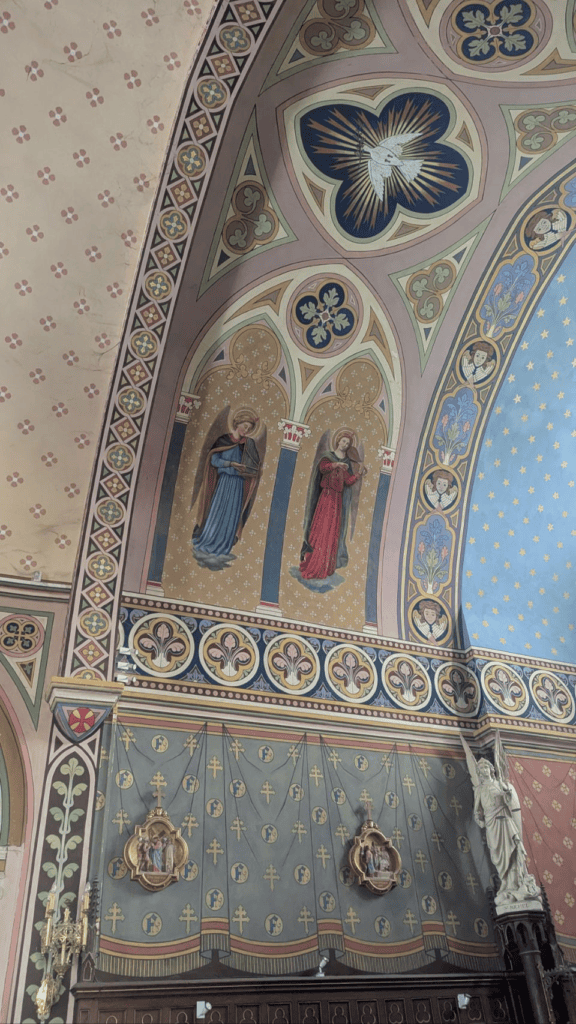
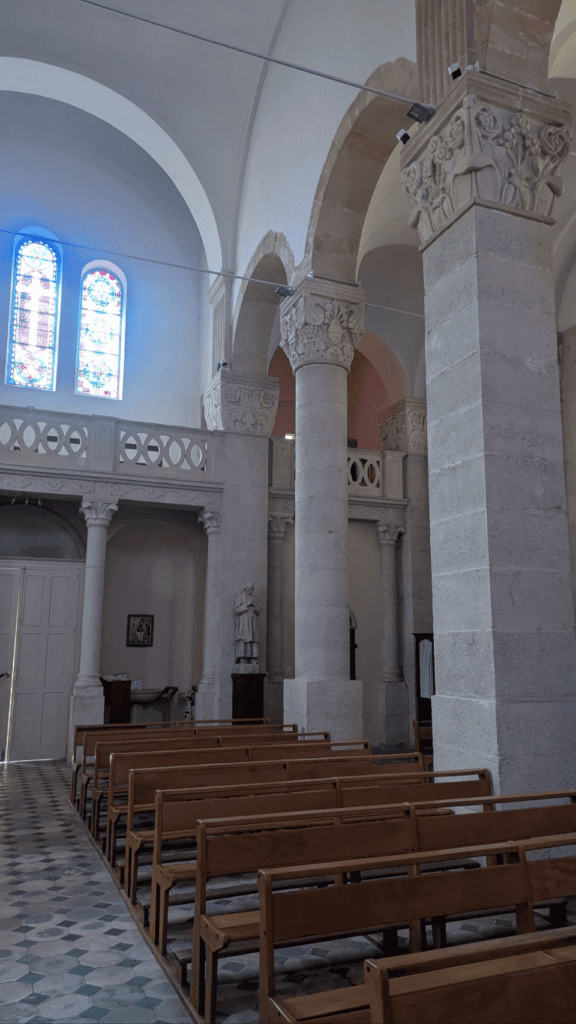
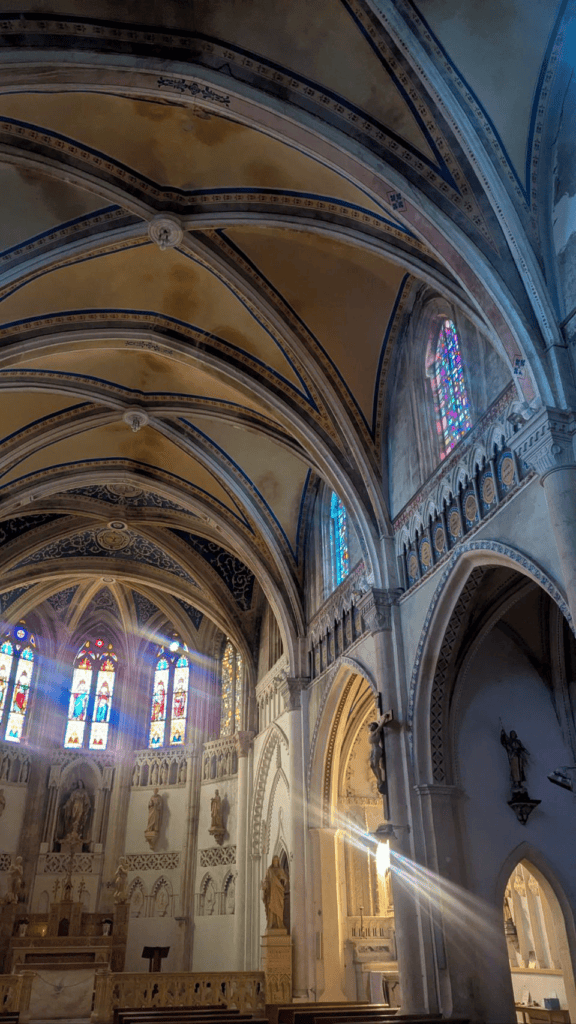
We also take the time to go inside the church. Its interior was extensively restored in the early 20th century, and its painted decorations have since undergone further restoration work. It’s exactly the sort of place we could easily have walked past without stopping if we’d decided to stick strictly to our itinerary.
The Aven d’Orgnac, one of the Ardèche’s must-see attractions
After that impromptu detour, back to the programme with the Aven d’Orgnac. Discovered by the speleologist Robert de Joly in 1935 and opened to the public in 1939, the Aven d’Orgnac is one of the major, iconic caves to visit in the area.
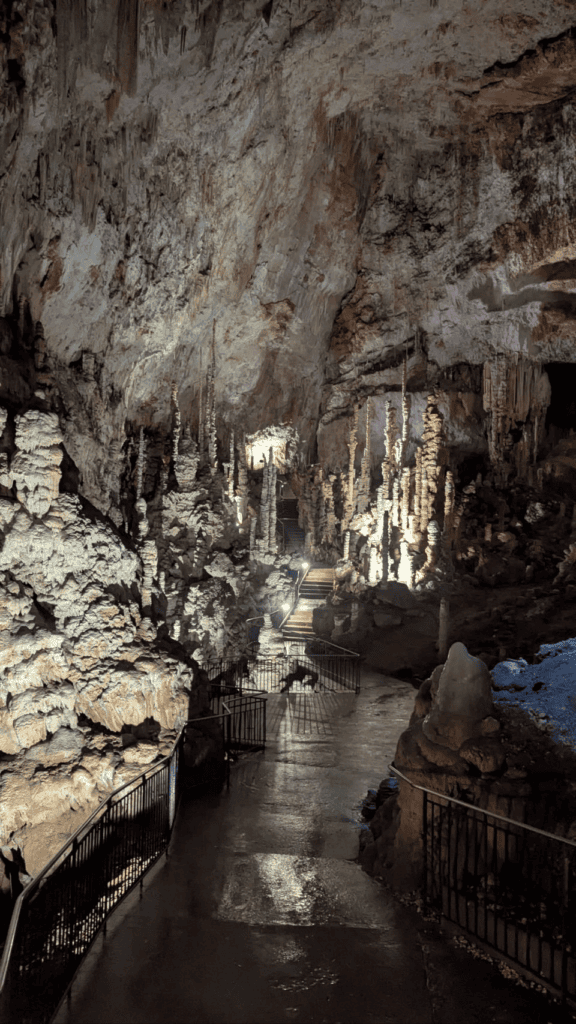
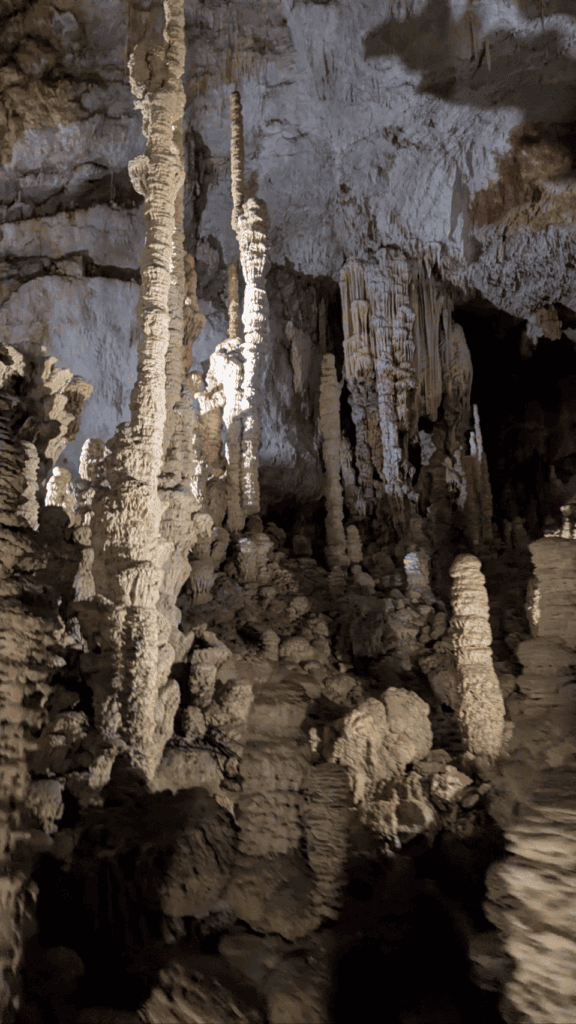
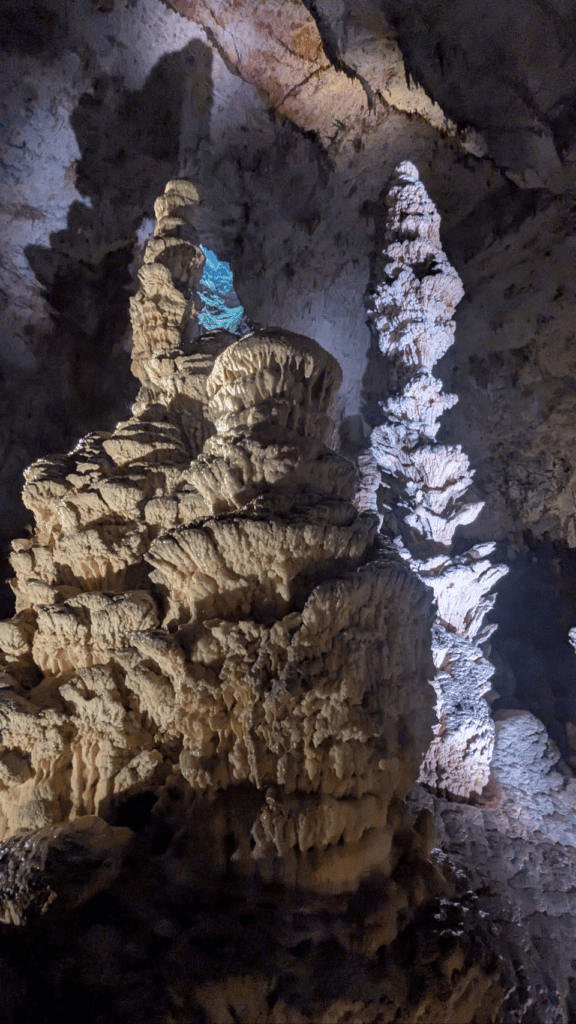
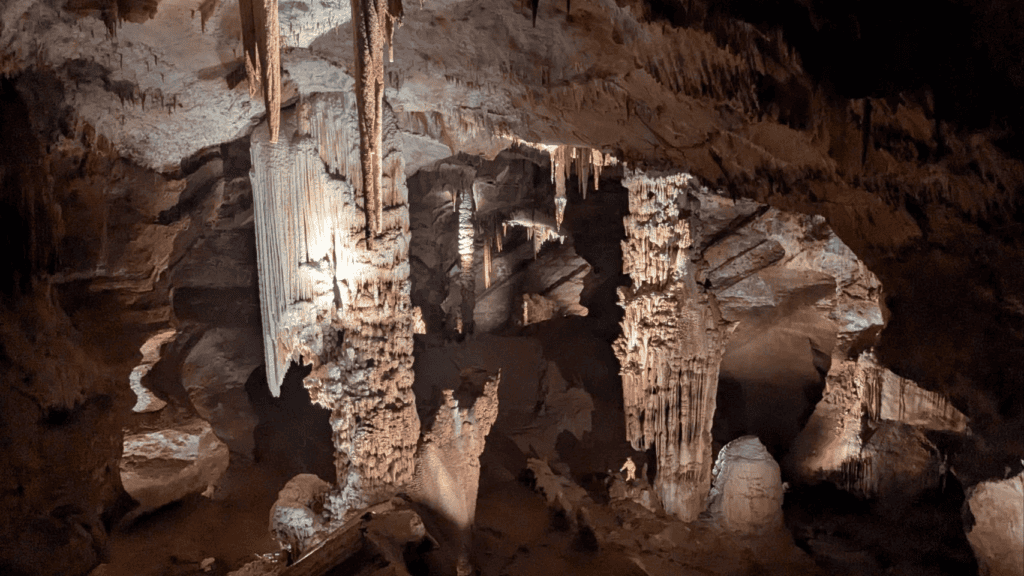
Once again, I’m deliberately not going into detail about the visit, as I’ll be covering the Aven d’Orgnac, Saint-Marcel and La Madeleine in much greater detail in our comparison of the caves we visited during this road trip.
At this stage, one thing is certain: for two people who’d never really visited any natural caves before arriving in the Ardèche, we’re certainly making up for lost time.
A short stop in Vallon-Pont-d’Arc
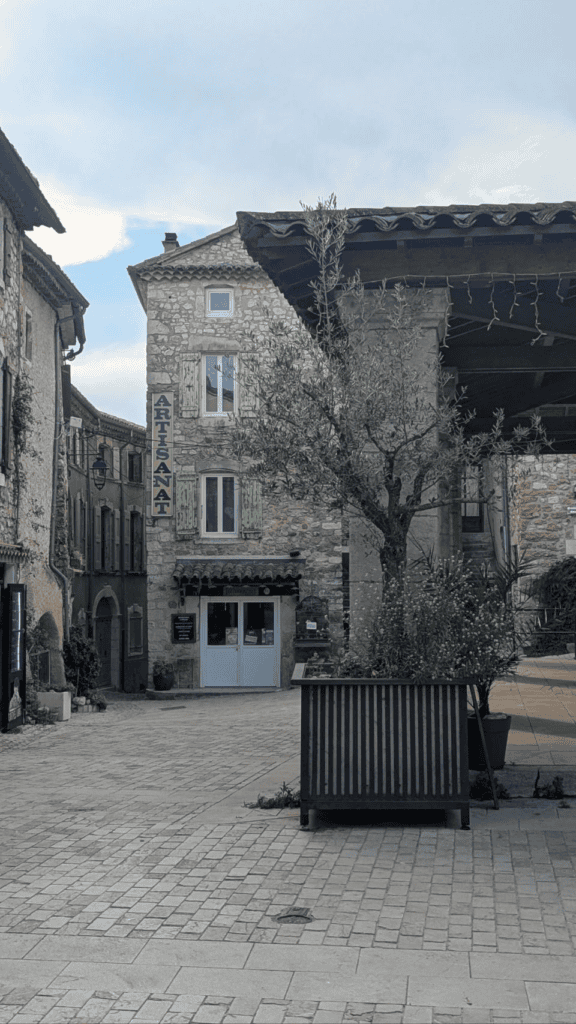
At the end of the day, we head to Vallon-Pont-d’Arc. The village is particularly bustling, so we don’t linger there for very long. Our mission is much more down-to-earth: stocking up at Lidl, then popping into the butcher’s to pick up a proper sausage. Priorities first, TMTC.
We’ve now got everything we need for our big feast this evening. All that’s left is to find somewhere to sleep.
Camping on the banks of the Ibie… and an evening without mobile reception
Finding the spot is proving a bit more complicated than expected.
First of all, we find a spot with a rather nice view. It’s not exactly breathtaking, but it’s more than good enough for the night. Except that the ground is covered in large stones, and we’ve no desire to start our road trip with a flat tyre in the middle of nowhere. So we decide to move on and carry on towards the Ibie Valley, where we’d spotted several potential spots by the water’s edge. And then, another problem: no mobile signal at all. That makes it rather tricky to look for a spot on your phone.
So, in the end, we end up using a particularly sophisticated technique: we look around, find a spot that suits us and… we stop.
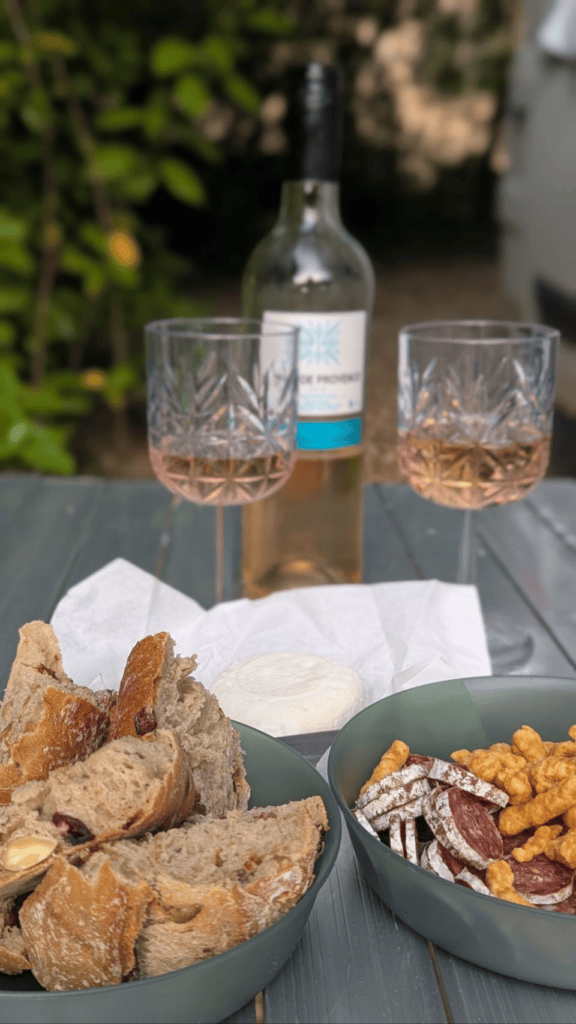
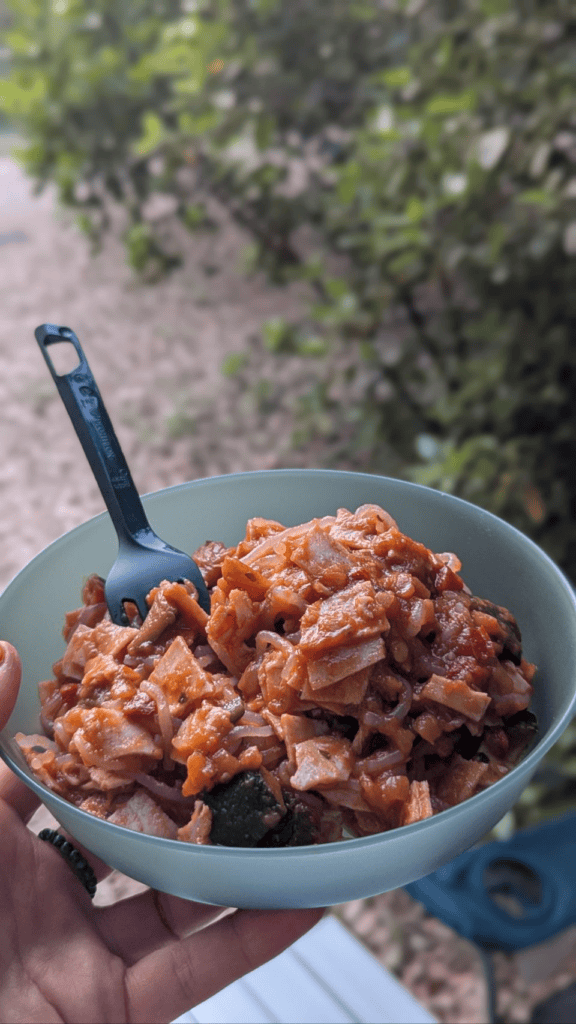
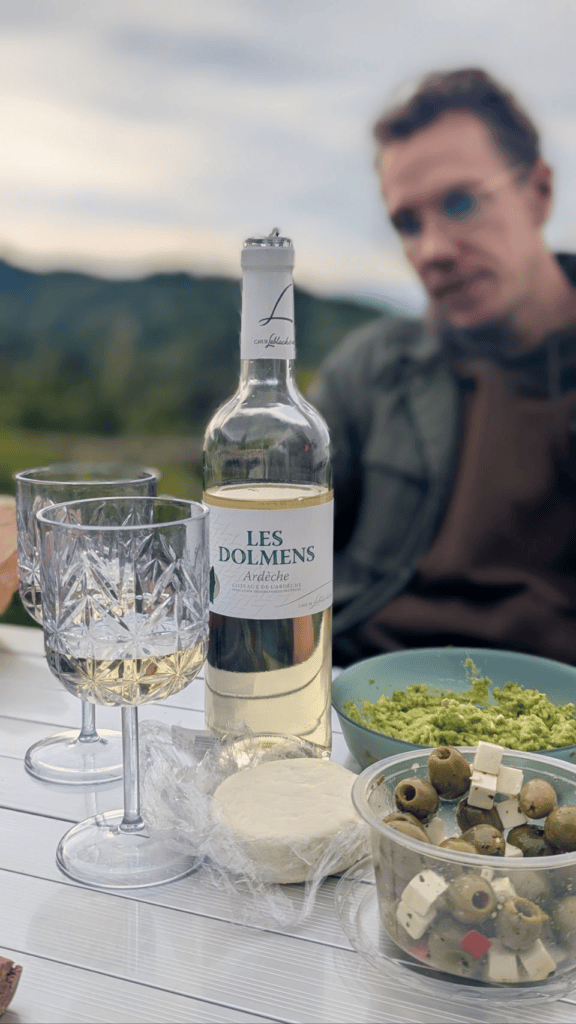
And since we’d gone shopping especially for this, we decided to pull out all the stops for the aperitif: goat’s cheese, lovely fruit bread and a sausage we’d bought a few hours earlier.
No need to go to a restaurant. We’re having a lovely meal.
Day 3 – From the Pont d’Arc to the Chauvet 2 Cave
The next morning, before setting off again, we even took the opportunity to fill our filter flask straight from the Ibie.
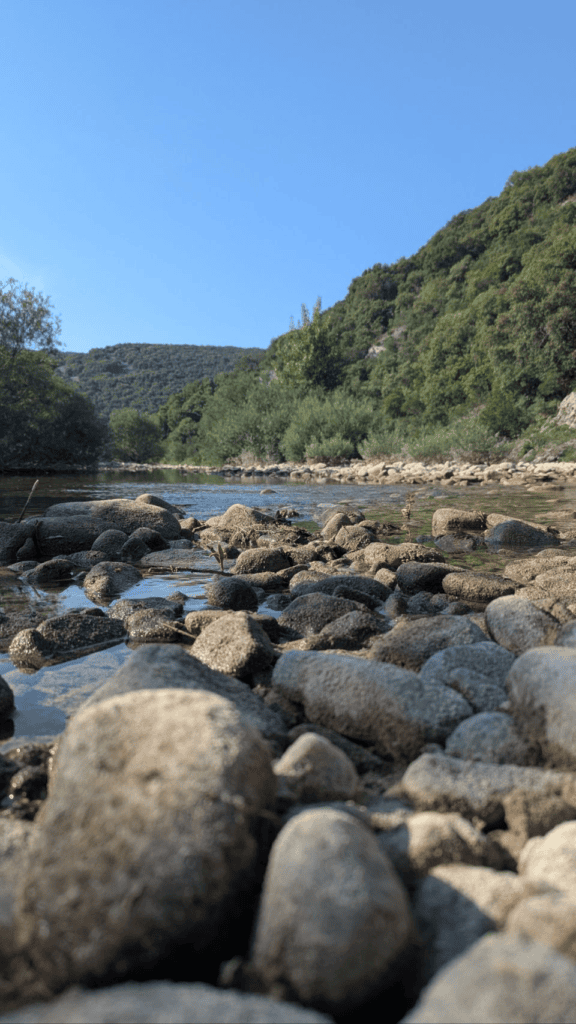
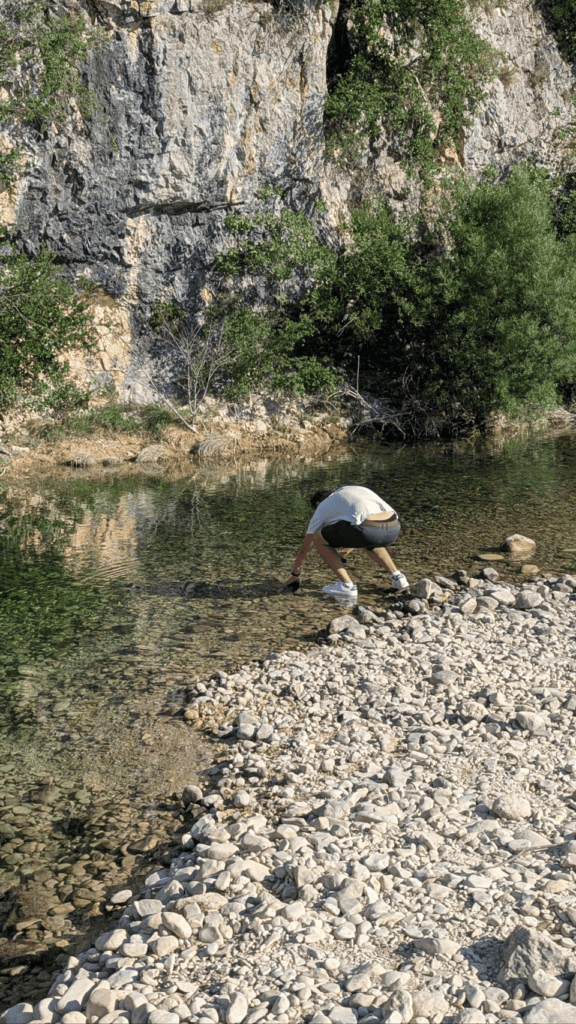
Personally, I’ve no problem with it… Simon, on the other hand, is already wary when offered a drink from a fountain if the word “DRINKING” isn’t explicitly written in capital letters next to it. So drinking water straight from a river, even with a filter bottle… Let’s just say he looked at that first sip as if he were taking part in a scientific experiment without having properly read the terms and conditions. 😂
The Moon Hole
As we spent the night in the Ibie Valley, we start the day with a short detour to the Moon Hole, which we’d spotted as a point of interest near our spot.
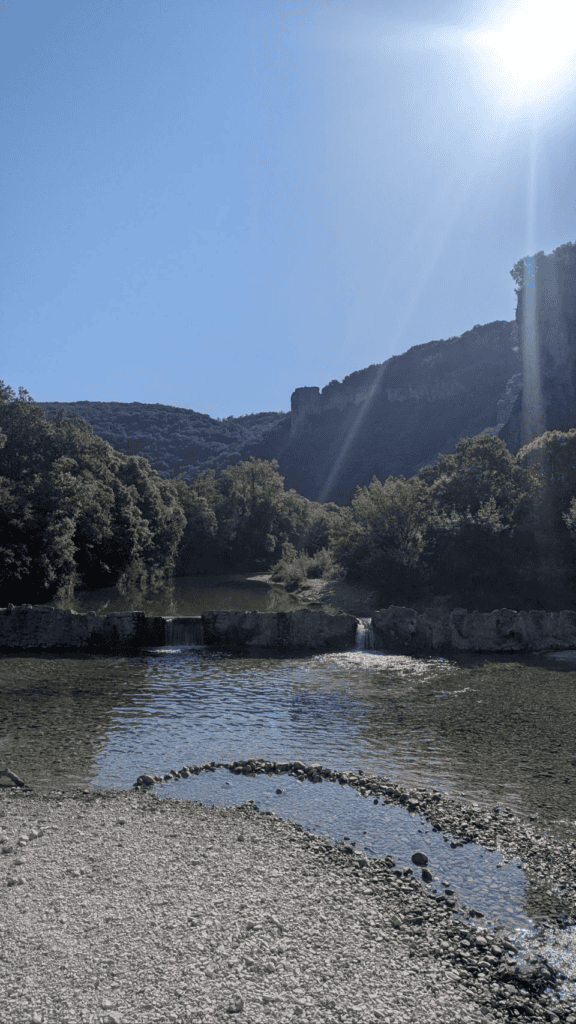
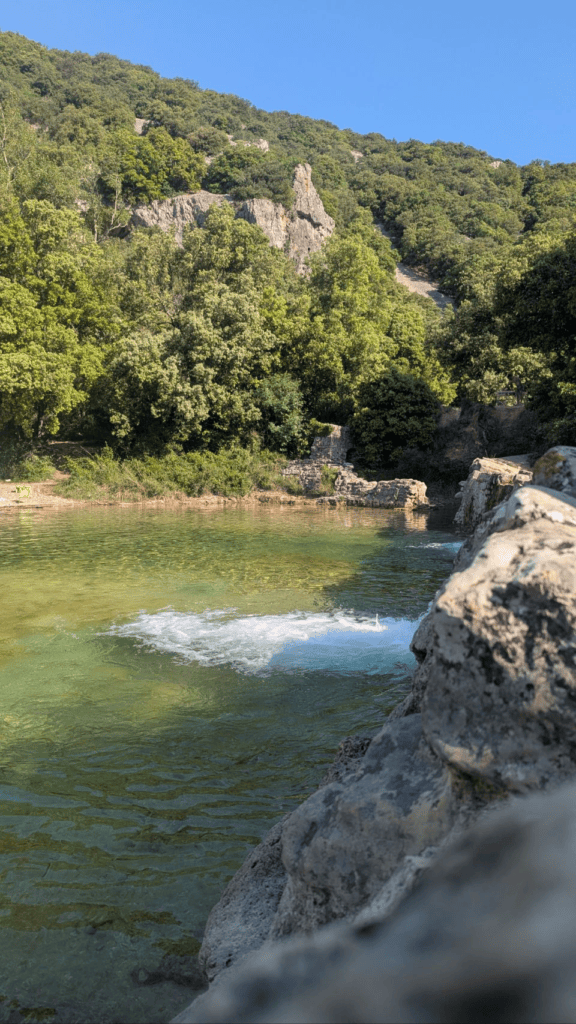
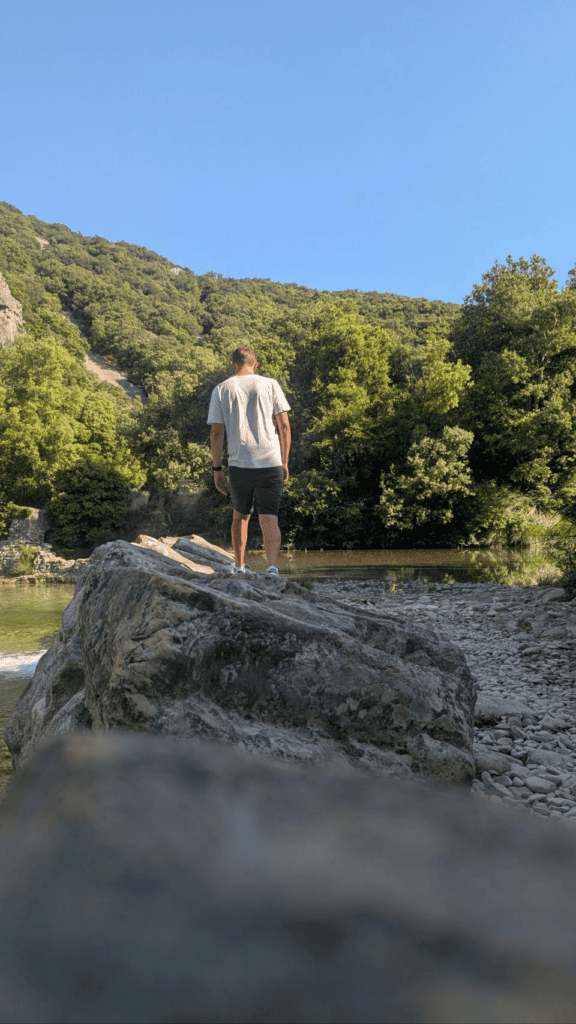
We’re just popping down to have a look at the spot without going for a swim. We’ll save the swimming for a few kilometres further on, as we’re then heading towards the Pont d’Arc.
Swimming and a picnic at the Pont d’Arc
You can’t spend several days in the Ardèche Gorges without visiting the Pont d’Arc, this 54-metre-high natural arch that spans the river directly.
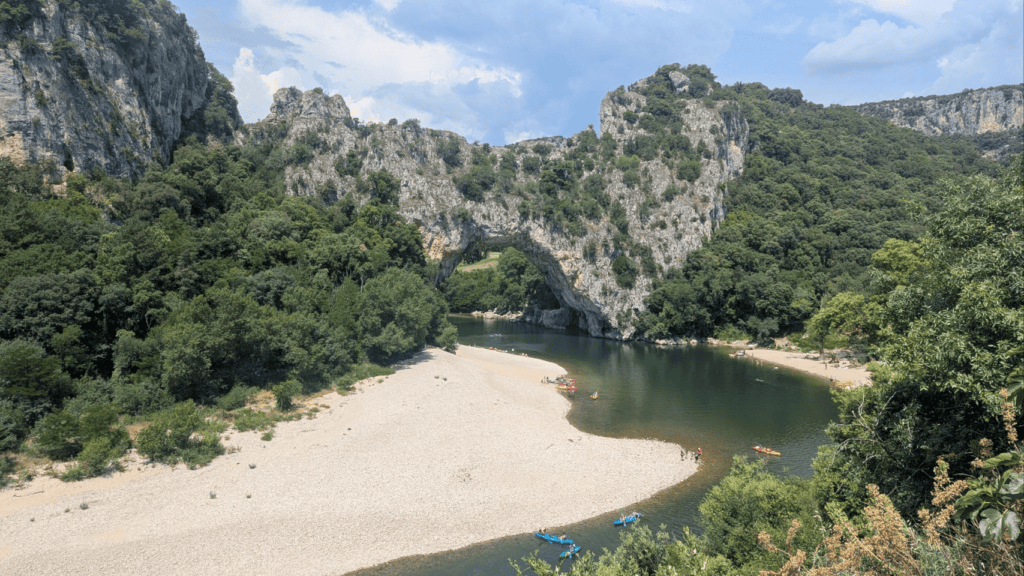
This time, it’s not just a matter of looking at it from the road: we head down to the beach for a swim and a picnic, with the Pont d’Arc right in front of us. As for parking, there are paid car parks nearby, but as it was the off-season, we drove along the road for a bit until we found a space on the hard shoulder!
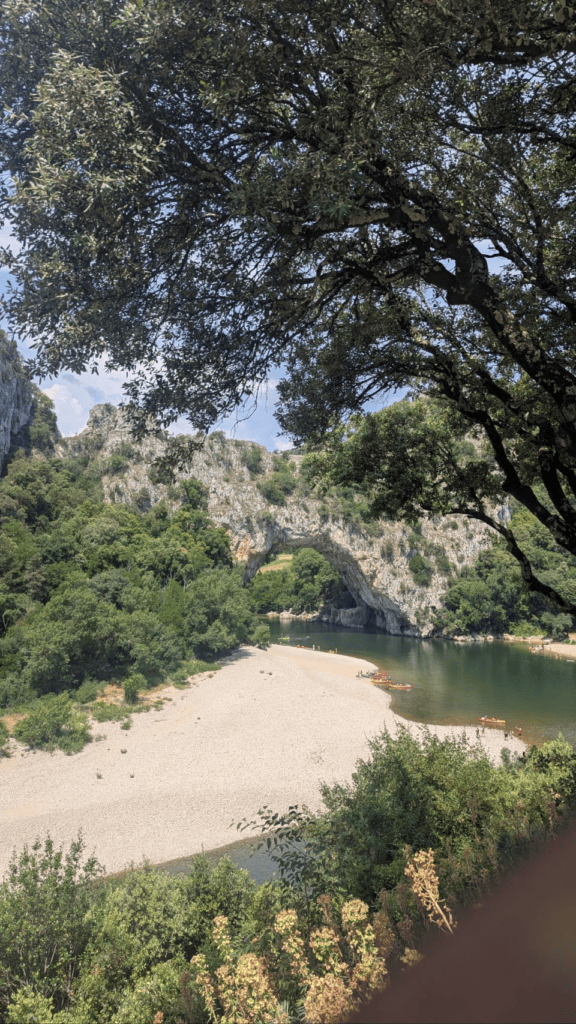
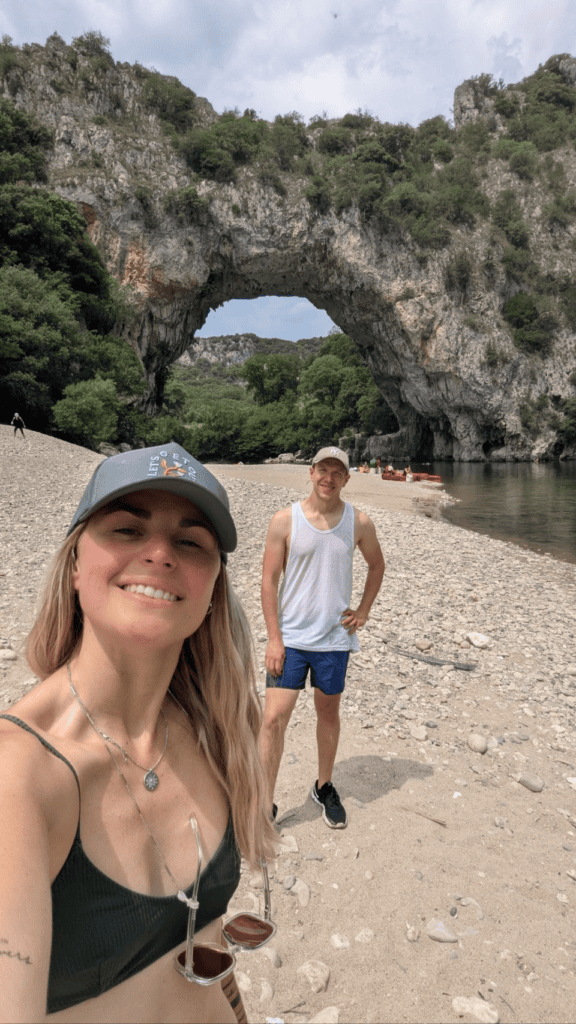
We had time to enjoy the river at our leisure before the weather decided to change completely. The rain eventually arrived and drove us off the beach, but it was late enough that we’d managed to do everything we’d wanted to do whilst we were there.
So we pack our things away and, as the next activity is fully covered, the timing actually works out rather well.
Chauvet Cave 2: Discovering the art of the Aurignacian people
Next, we head to the Chauvet Cave 2.
The first thing to bear in mind is that this is not the actual Chauvet Cave. In fact, the real one does not has never been open to the public. Since its discovery in 1994, access has been extremely restricted and is mainly reserved for researchers and scientists in order to preserve the soil, the artefacts and the cave paintings.
Chauvet 2 is therefore a replica of the original cave, which has been open to the public since 2015. The replica covers approximately 3,000 m² of the original cave’s 8,500 m², featuring its walls, reliefs, concretions and, of course, its paintings.
And even though you know you’re visiting a replica, it works really well.
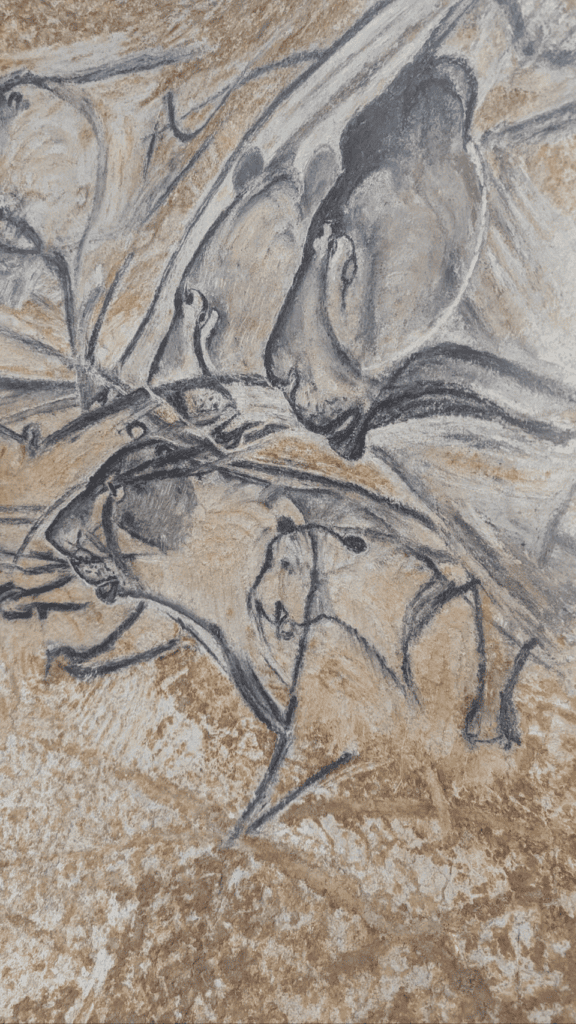
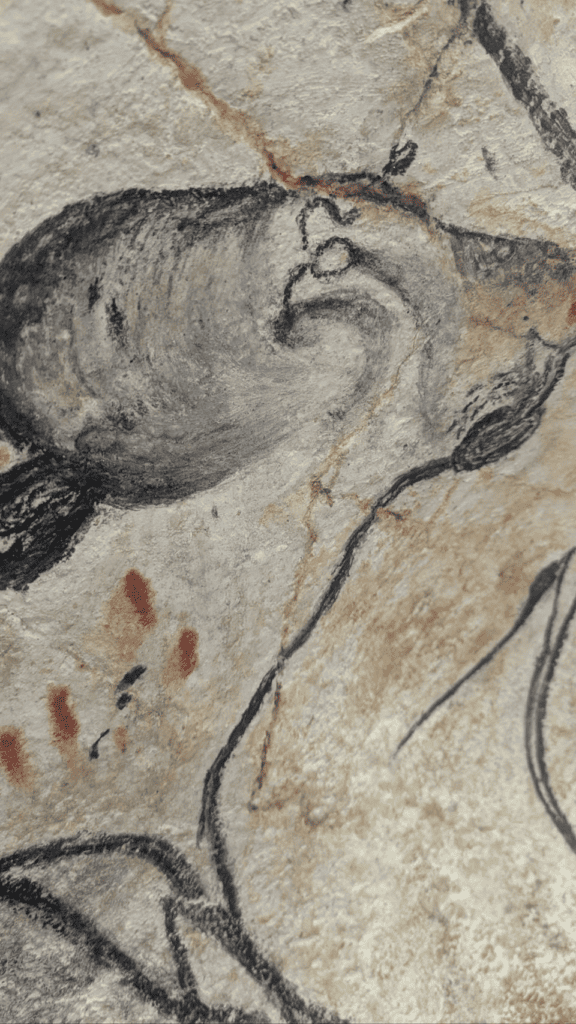
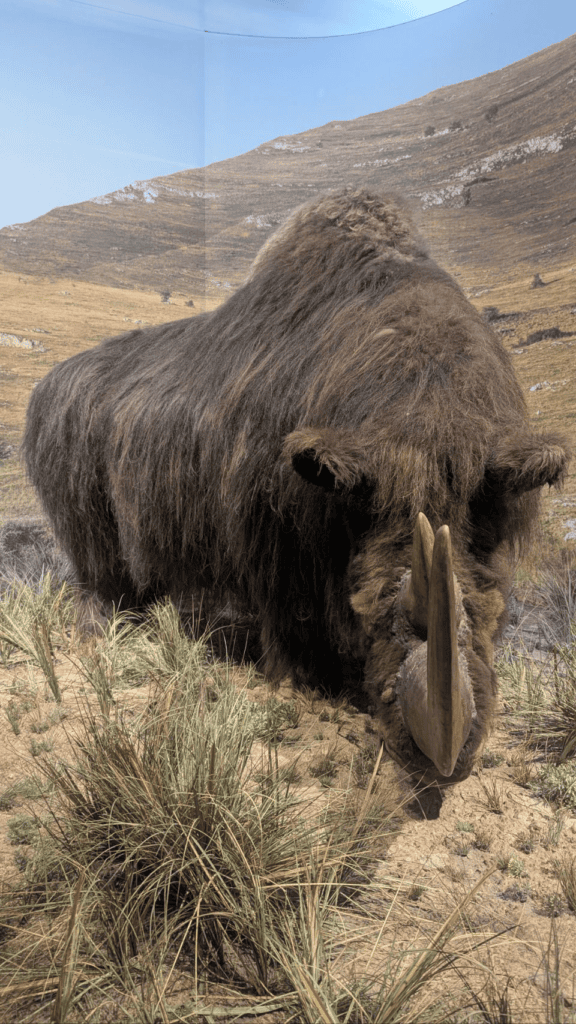
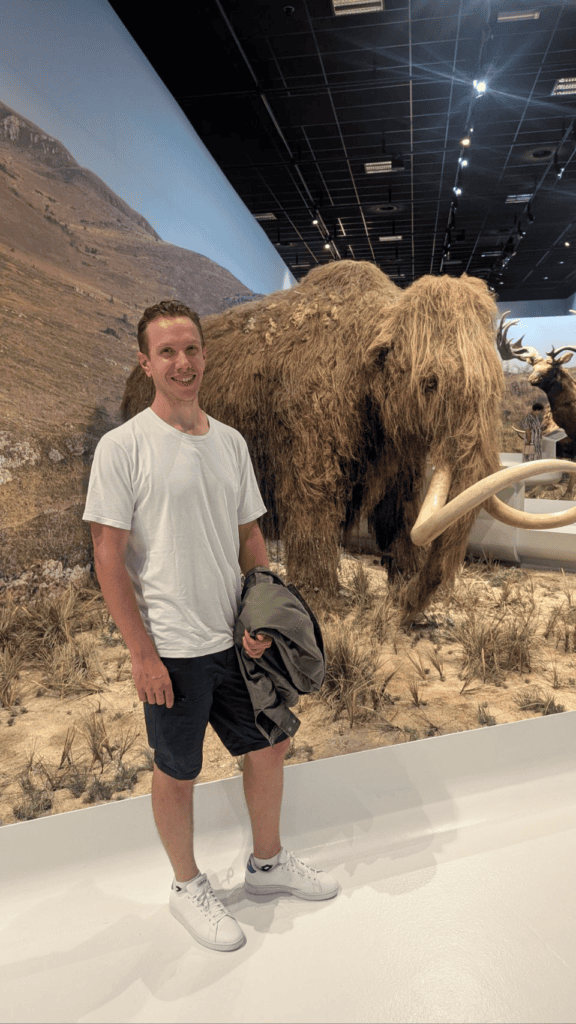
What impresses us most, of course, are the works themselves. The oldest date back to around 36,000 years and are attributed to the Aurignacian people. They include, in particular, depictions of lions, rhinoceroses, horses and even mammoths, with a sense of volume and movement that frankly took us by surprise.
When we think of prehistoric art, it’s easy to picture a few very simple figures drawn on a rock face. Here, it’s quite the opposite. Some of the compositions are extremely intricate, featuring superimposed animals, perspective, movement and particularly precise anatomical details.
And that’s probably what made the biggest impression on us during the visit: We’re talking about drawings made around 36,000 years ago, and when looking at some of these depictions, one realises that we wouldn’t necessarily be able to do any better today. The guide’s explanations help you to understand the techniques used and to spot certain details more clearly that you would probably have missed on your own.
After the cave, the tour continues through the other areas of the site dedicated to the Aurignacians, their environment and their way of life. You should allow several hours to explore the whole site: in fact, the site currently recommends allowing more than 3 hours 30 minutes for the tour.
This was a very different kind of visit to the natural caves we’ve explored since arriving in the Ardèche: here, it’s mainly the human history and the cave art that interest us.
Overnight stay directly at the canoe hire company’s premises
That very morning, we’d made our provisional booking for the canoe trip planned for the following day.
After chatting at length with the chap on site, he eventually suggested something particularly handy: sleeping right in their car park. That way, the next morning, we wouldn’t have to pack up camp, hit the road again and look for somewhere to park before we set off. We’d already be there: a large, shaded area, grassy ground and, best of all, access to a small beach right next door. What a treat!
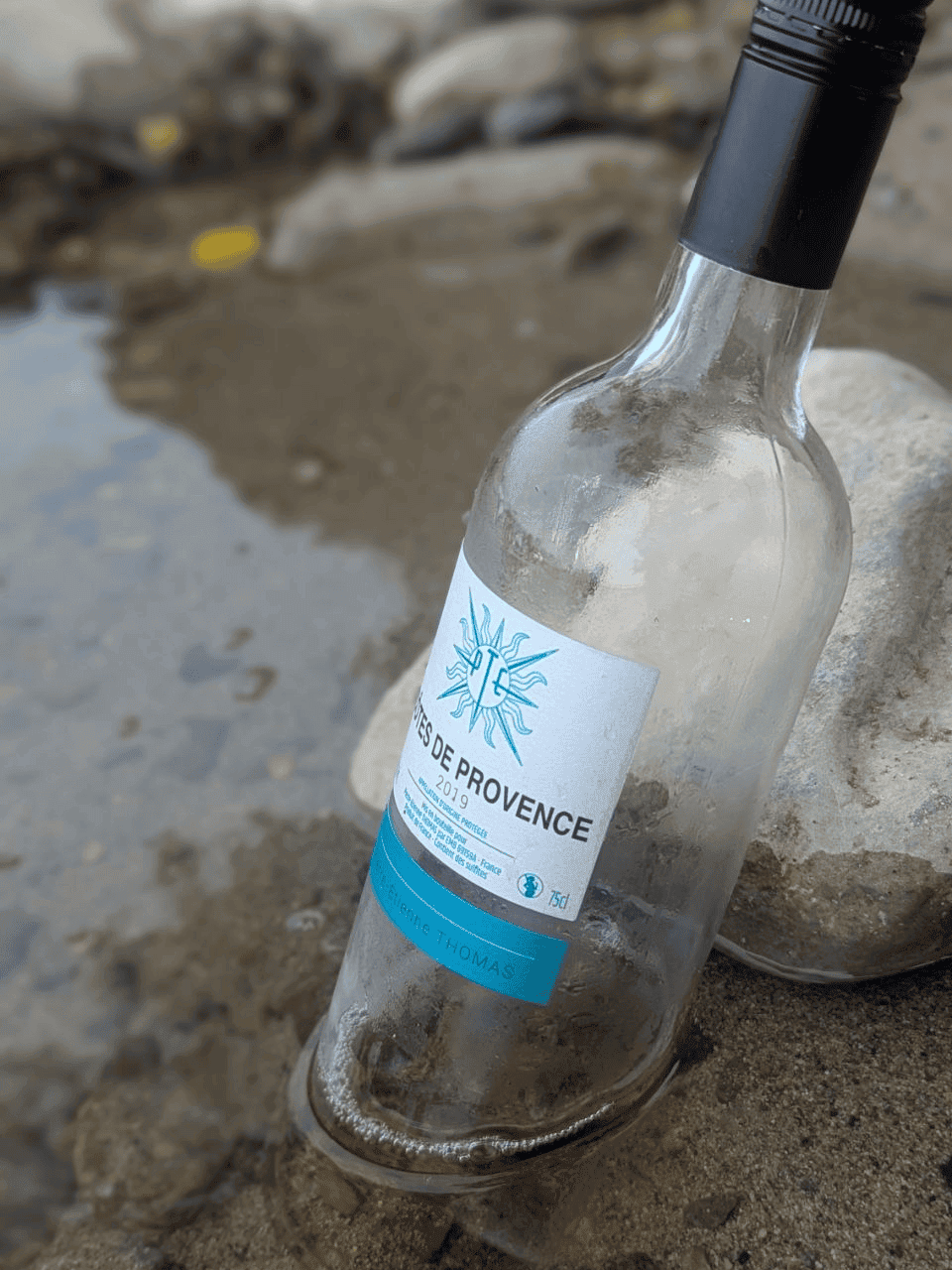
So we set up the van for the night and, quite naturally, our drinks also end up by the water’s edge.
For once, there’s no need to hunt for a spot or sort out any network issues: tomorrow morning, all we’ll have to do is get up and go for a paddle.
Day 4 – A 24-km canoe trip through the Ardèche Gorges
Our first canoe trip… covering 24 km
Today, there’s no village, no cave and hardly any road: We spend the whole day canoeing. As we really wanted to make this the main activity of the day, we chose a descent of 24 km through the Ardèche Gorges.
Just a quick note: We’d never been canoeing in our lives.
Looking back, starting straight away with a 24-kilometre trip was probably not the most sensible decision we made during our stay. At the start, we chatted to a few people who were also setting off on the same route. That reassured us on at least one point: we wouldn’t be the only ones spending a good part of the day on the water.
The car hire company we chose: Canoe Adventures.
Why? We’d had a great experience the day before; they don’t pressure you into spending money (we wanted to cycle 32km, but they suggested we stick to a maximum of 24km, knowing we’d never done that distance before). And on top of that, we were able to sleep in their car park ❣️
24 km of learning on the job
Technically, we’re starting from scratch.
We don’t really know how to paddle effectively, let alone how to keep the canoe perfectly straight. The result: our first few kilometres looked more like a series of zigzags than a controlled course (we were this close to calling the rental company to come and pick us up after barely 10 minutes 😂). And, inevitably, there were a few more challenging stretches too.
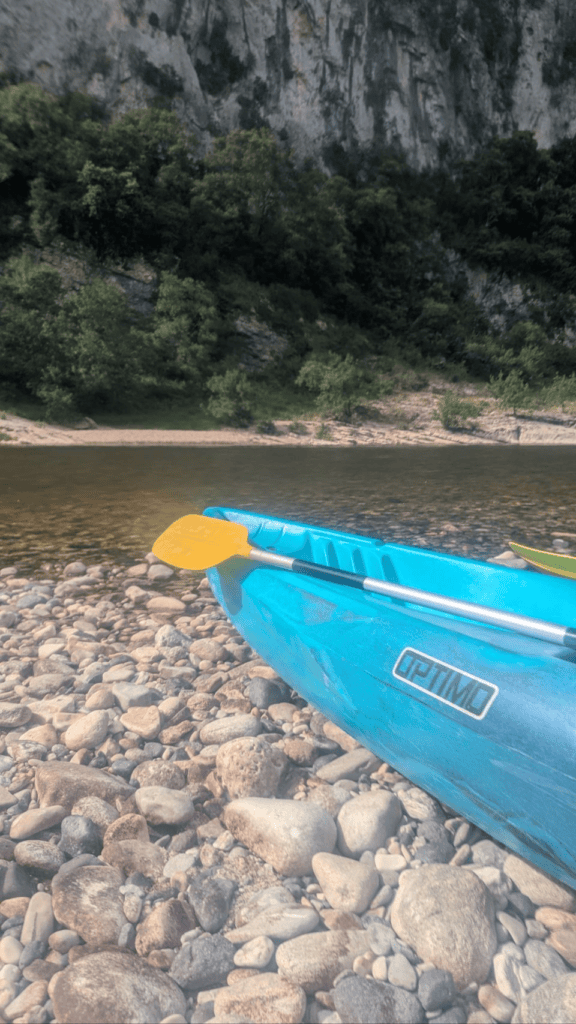
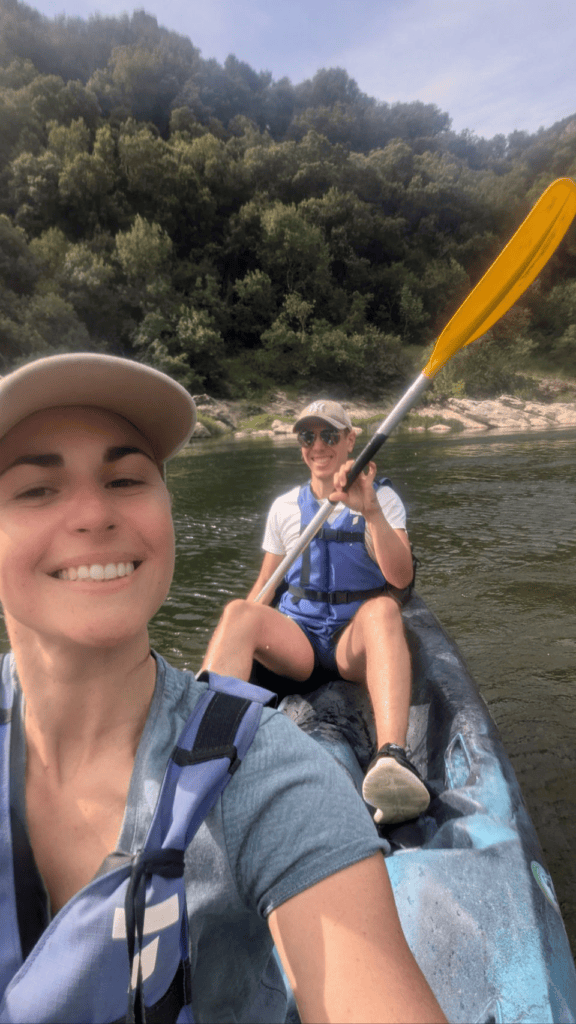
We’re capsizing twice during the descent. The first one was manageable. The second, far less so: for a few moments, we were genuinely afraid we wouldn’t manage to get our footing back properly and recover the canoe. Needless to say, our sense of calm took a bit of a hit for a moment. Despite that, we carried on. Kilometre after kilometre, we eventually covered the entire 24 km. We reach the end completely knackered, but also genuinely proud that we’ve done it.
Would we do this distance again? No.
Are we glad we gave it a go? Yes.
A perfect day for coping with the heat
Apart from our technical difficulties, the conditions were really good that day.
Just like the day before, we’re staying the night right in the car park of the canoe hire company. After paddling 24 km, the thought of getting back in the van to look for another spot doesn’t appeal to us at all. At this stage, we’re mainly completely knocked out.
Day 5 – Les Vans, the Cocalière Cave and Banne
Les Vans under an increasingly threatening sky
We start the day at the Vans, in the south of the Ardèche. We would have loved to have timed our visit to coincide with the the famous Saturday morning market, but in terms of scheduling, it didn’t work out. It’s a shame, because it clearly plays a big part in the village’s reputation: established here since the 15th century, it stretches across much of the centre and can accommodate up to 300 stallholders in peak season. Without the market, we simply enjoy the old town centre and its narrow streets for about an hour.
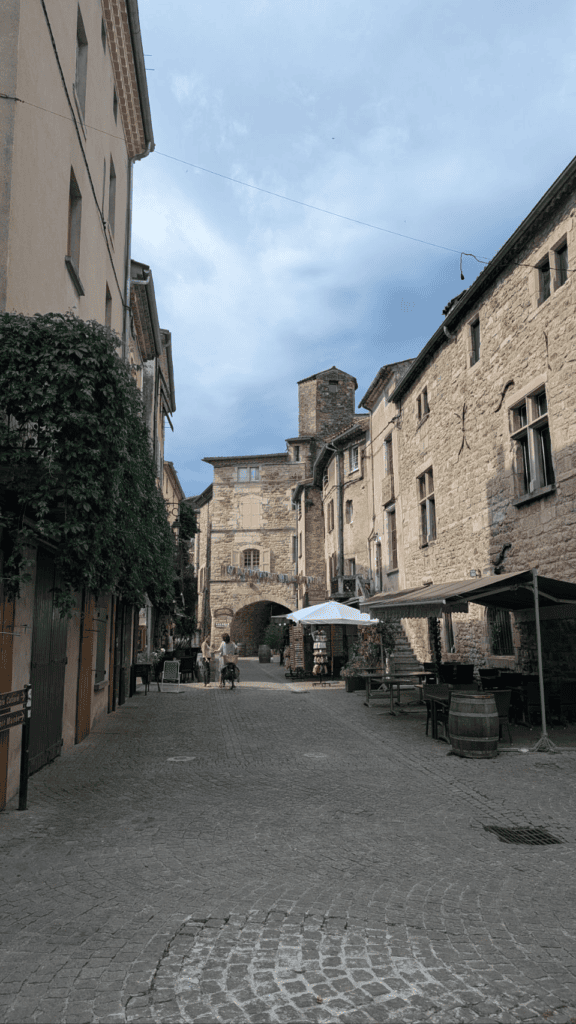
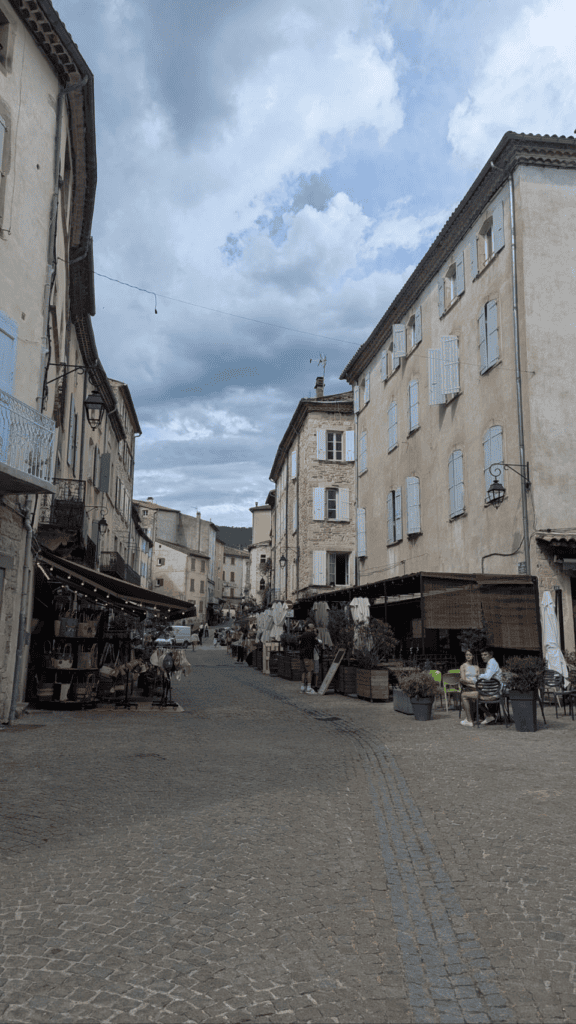
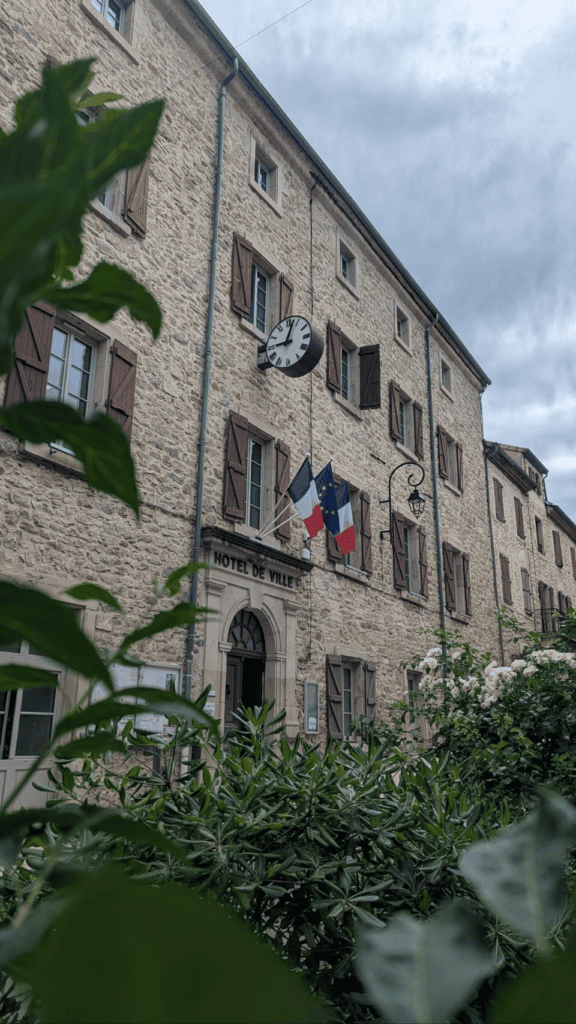
As for the weather, it’s really starting to take a turn for the worse. Rain is on the cards, so we don’t hang around: a quick trip to stock up on supplies, and we’re back in the van, aiming to find somewhere to have a picnic.
An afternoon at the Cocalière Cave
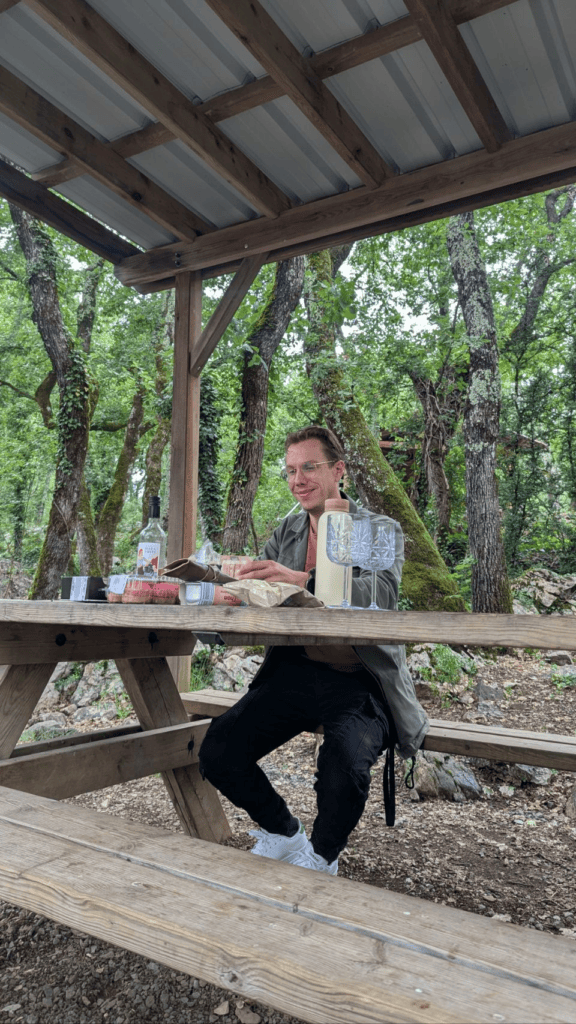
Of course, the rain chooses to start just as we’re having our picnic. We’re already on our way to the Cocalière Cave, so we end up there straight away. A nice surprise: there are sheltered tables available near reception. So we can eat in peace without turning our meal into a race against the rain.
As our visit wasn’t due until mid-afternoon, we settled down at the café for a coffee whilst we waited for our slot. The weather forecast was predicting rain for the rest of the afternoon anyway, so we already knew we’d be spending a good part of the day here.
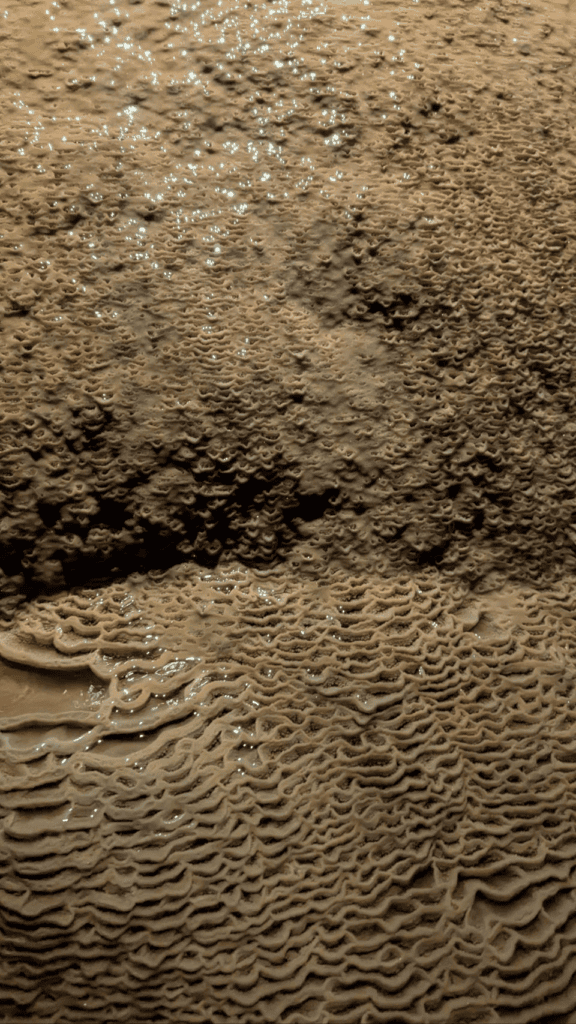
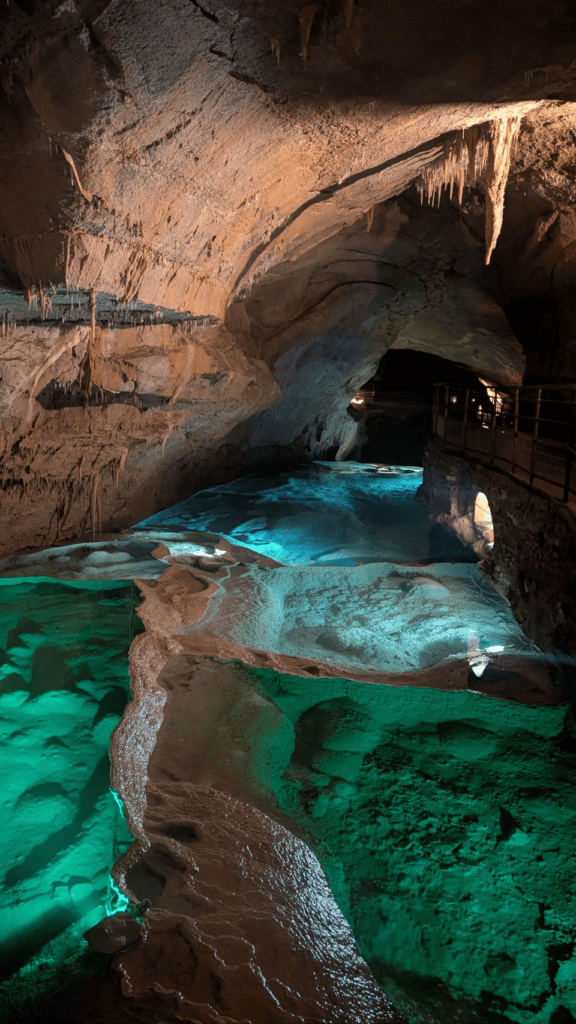
As for the cave itself, the same applies as for Saint-Marcel, La Madeleine and Orgnac: I’ll save the details for our forthcoming comparative article. La Cocalière forms part of a vast underground network stretching some thirty kilometres, situated on the border between the Gard and the Ardèche.
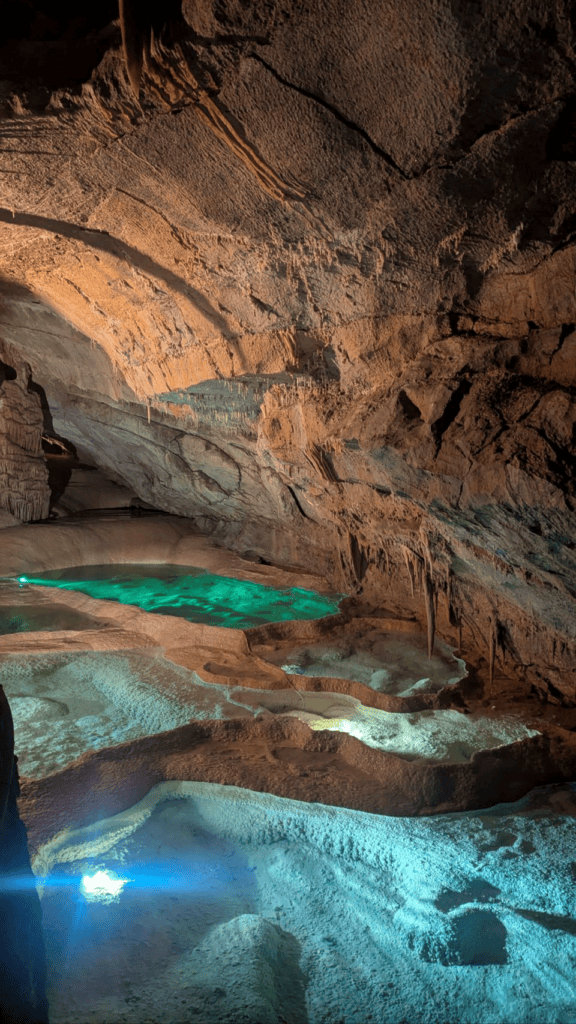
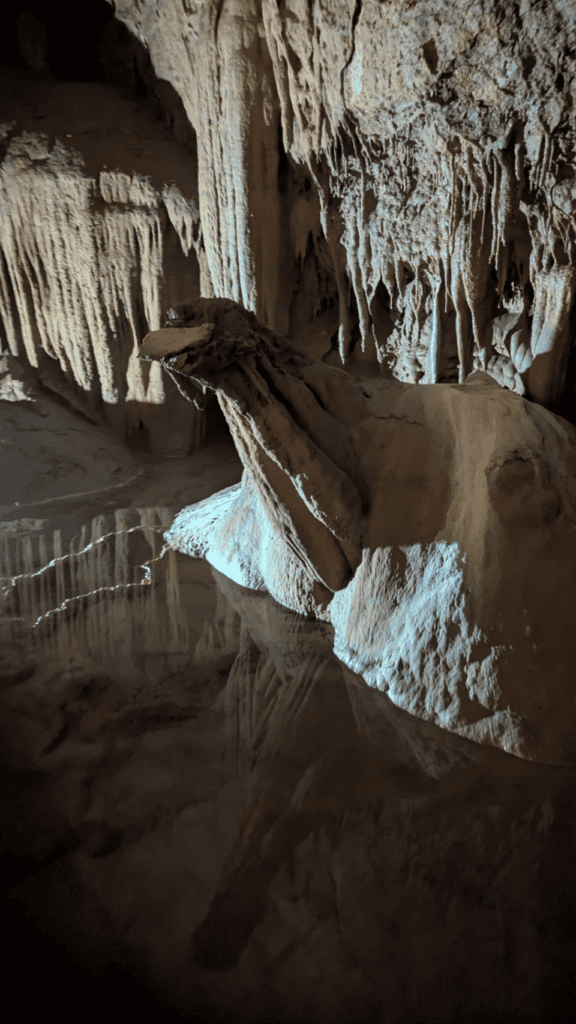
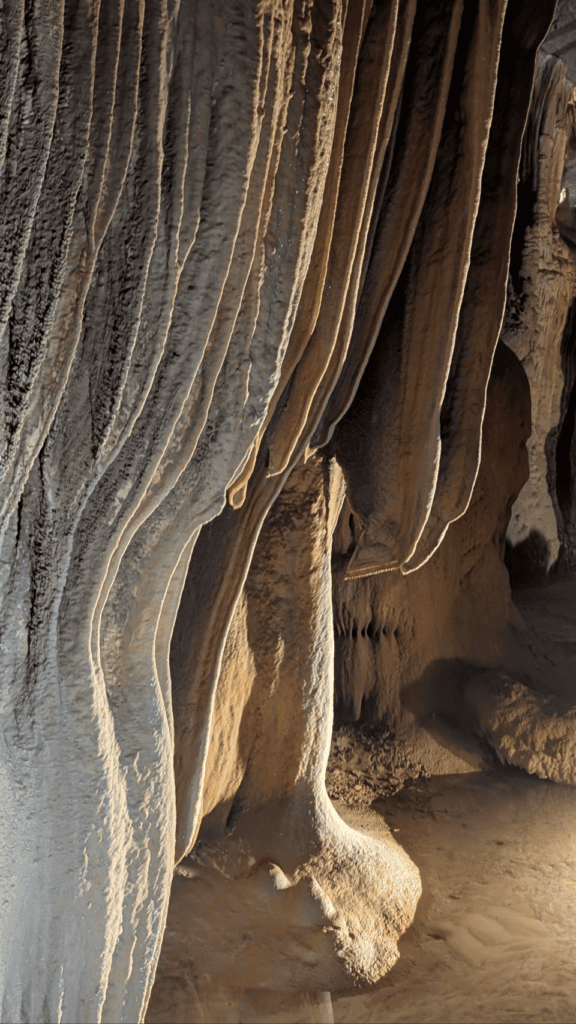
Once the tour was over and the rain had eased off a bit, we also made the most of the free nature trails around the cave. The site offers two short circular walks of around 35 minutes through the karst landscape and the Cévennes scrubland, featuring, in particular, surface caves, a dolmen and the remains of old agricultural structures.
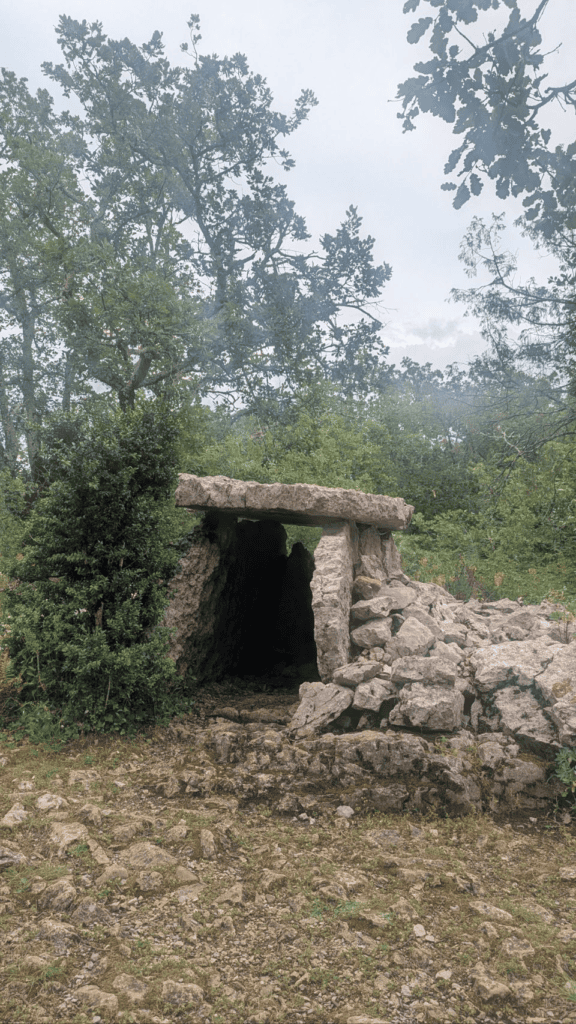
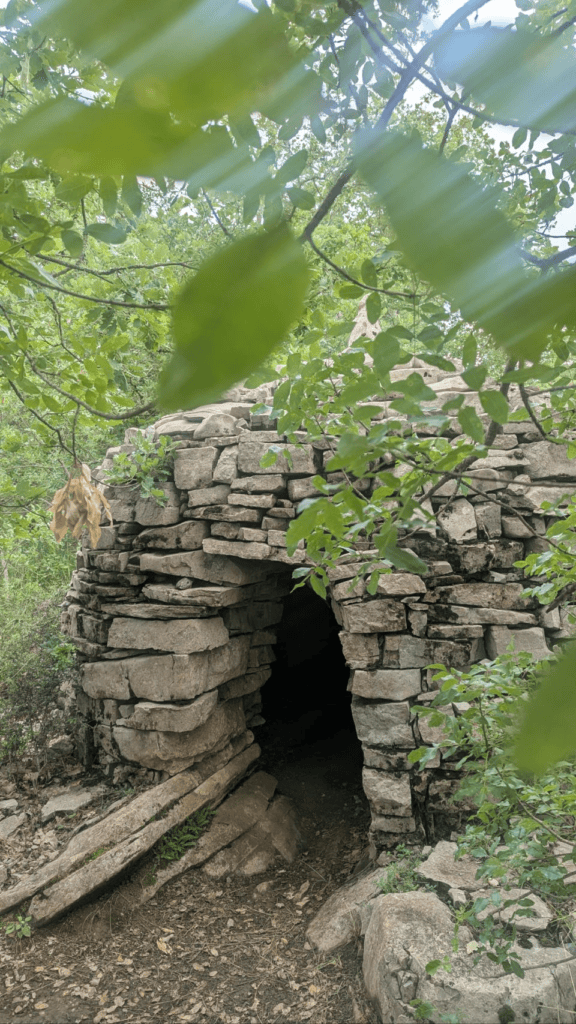
We’ll do both walks back-to-back, one of which takes us to the outskirts of the Païolive Wood. It gives us the chance to walk a bit, despite today being much more humid than the previous days, and to enjoy a lovely view of the Cévennes countryside.
Banne and our first night at a motorhome site
For the night, this time, no fiddly searching. We open Park4night and spot a free car park in Banne, so we simply decide to give it a go. There aren’t many people around when we arrive and, best of all, we’ll finally be able to get the wheel chocks out to level the van properly.
Up until now, when sleeping in a car park or a wild spot, we’ve avoided setting anything up outside the vehicle whilst we’re asleep. In principle, a motorhome or campervan can be parked on public roads just like a car, subject to local restrictions, but taking out wheel chocks, a table, chairs or an awning can shift the classification from simple parking to an arrangement equivalent to wild camping. At a designated site, you can therefore feel much more at ease.
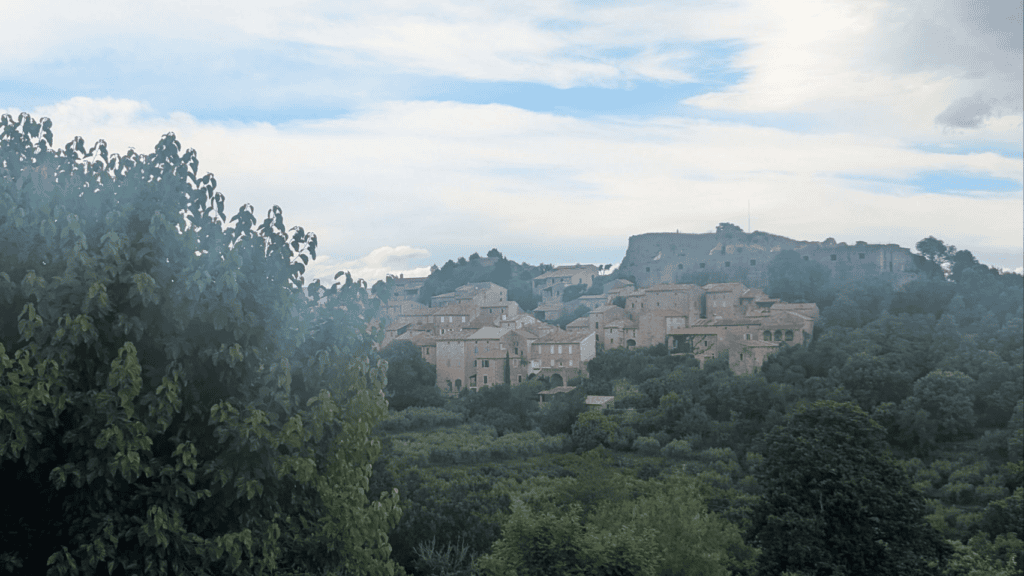
Once we’ve settled in, we set off to explore Awning, which is one of the ‘Villages de caractère’ of the Ardèche. The village is divided into several neighbourhoods and dominated by the ruins of its former castle. Its history is, in fact, more complex than what we had read whilst there. In July 1792, the castle served as a base for the Count of Saillans during a counter-revolutionary uprising. After the movement failed, it was set alight and its stones were gradually taken away, leaving the former fortress in ruins.
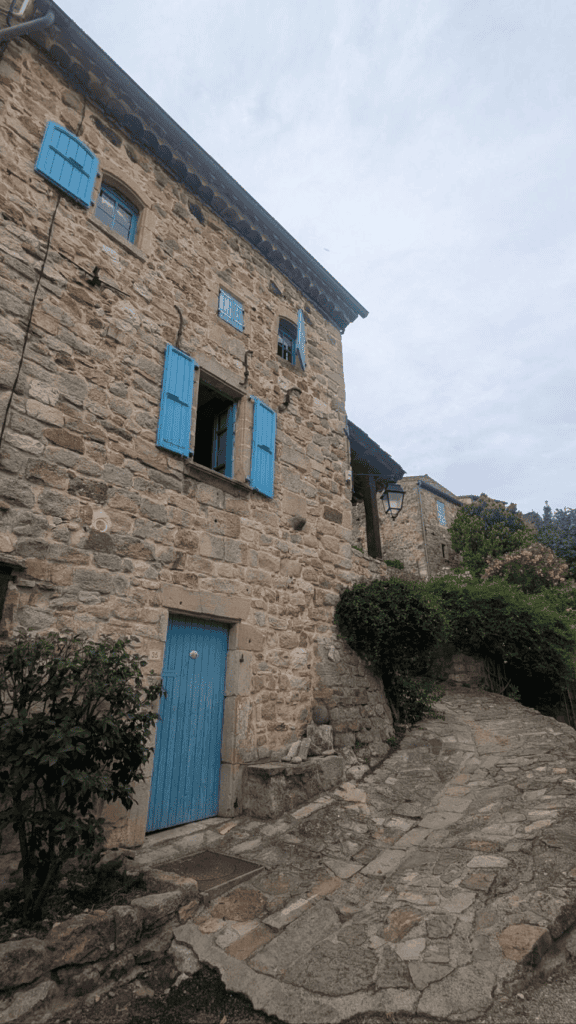
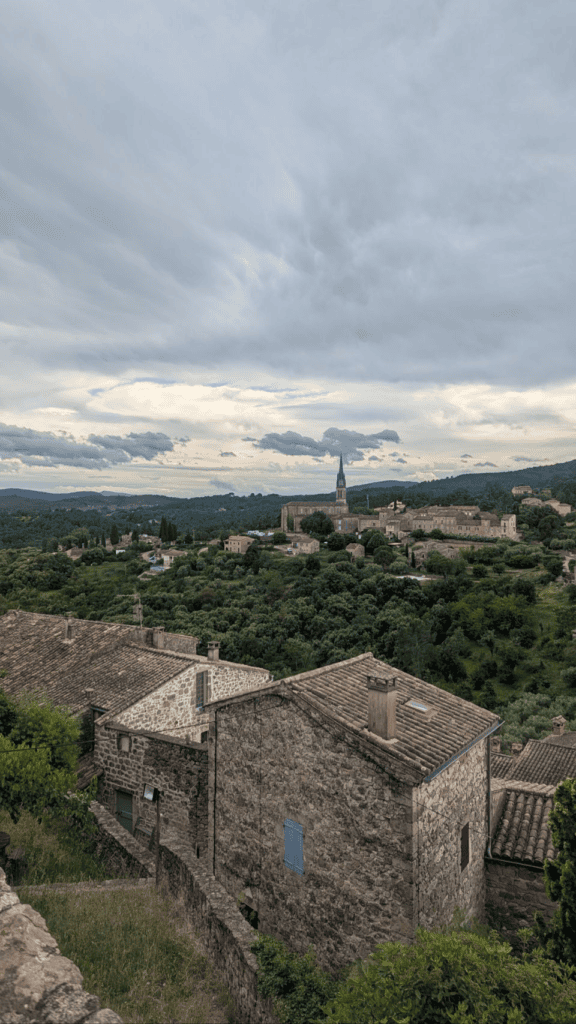
Today, a local charity continues to play a part in preserving the site. The Friends of Banne In particular, they organise volunteer work camps to maintain the ruins and support conservation work. In June 2026, just a few days after our visit, 27 volunteers were still taking part in a clean-up operation at the castle.
The village is very pretty, but when we were there, it was above all extremely quiet. The inn was closed. So was the restaurant. We came across very few people. So we took a leisurely stroll round the village and the ruins before heading back down to the lay-by. Our plans for this evening are very simple: park the van properly, get out the aperitifs and enjoy the peace and quiet.
Day 6 – Joyeuse Market and charming villages
The Joyeuse Market
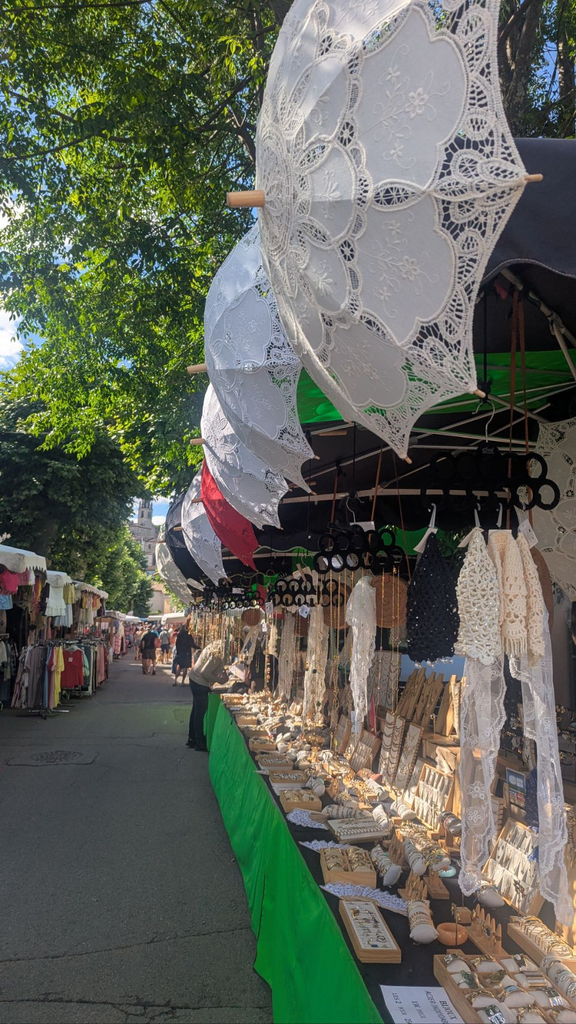
This day begins with Merry, where we finally managed to time our visit to coincide with market day. In fact, it turned out to be the only market we came across during the whole road trip. The atmosphere is rather unusual: lots of stalls clearly aimed at tourists, with prices that are sometimes frankly over the top, but also a few producers and traders where we found plenty to seriously top up our stock of local produce.
In particular, we’re coming away with some sausage, a selection of local cheeses and even a wine bread, because apparently ordinary bread lacked a bit of originality. Special mention must also go to the stall playing Serge Lama right in the middle of the market. It’s hard to imagine a more unexpected soundtrack for buying salami.
Labeaume, Balazuc and Vogüé: ‘Villages of Character’ Day
We then spend the rest of the day on several charming villages in the Ardèche, starting with Labeaume. And we take an instant liking to this one. The village sits on the riverbank, with its stone houses nestled between the cliffs and its narrow streets, where we take our time strolling before looking for somewhere to have lunch.
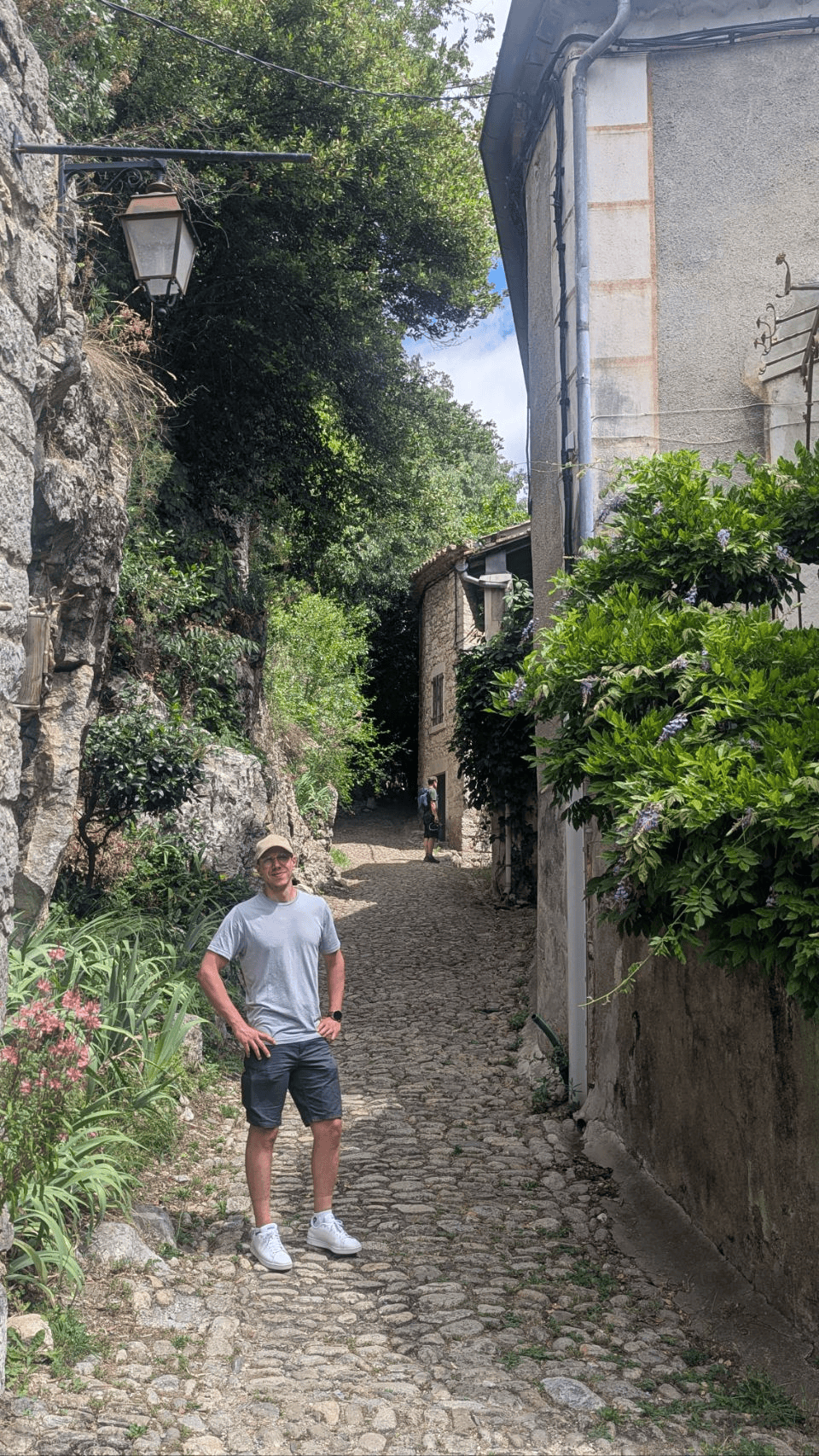
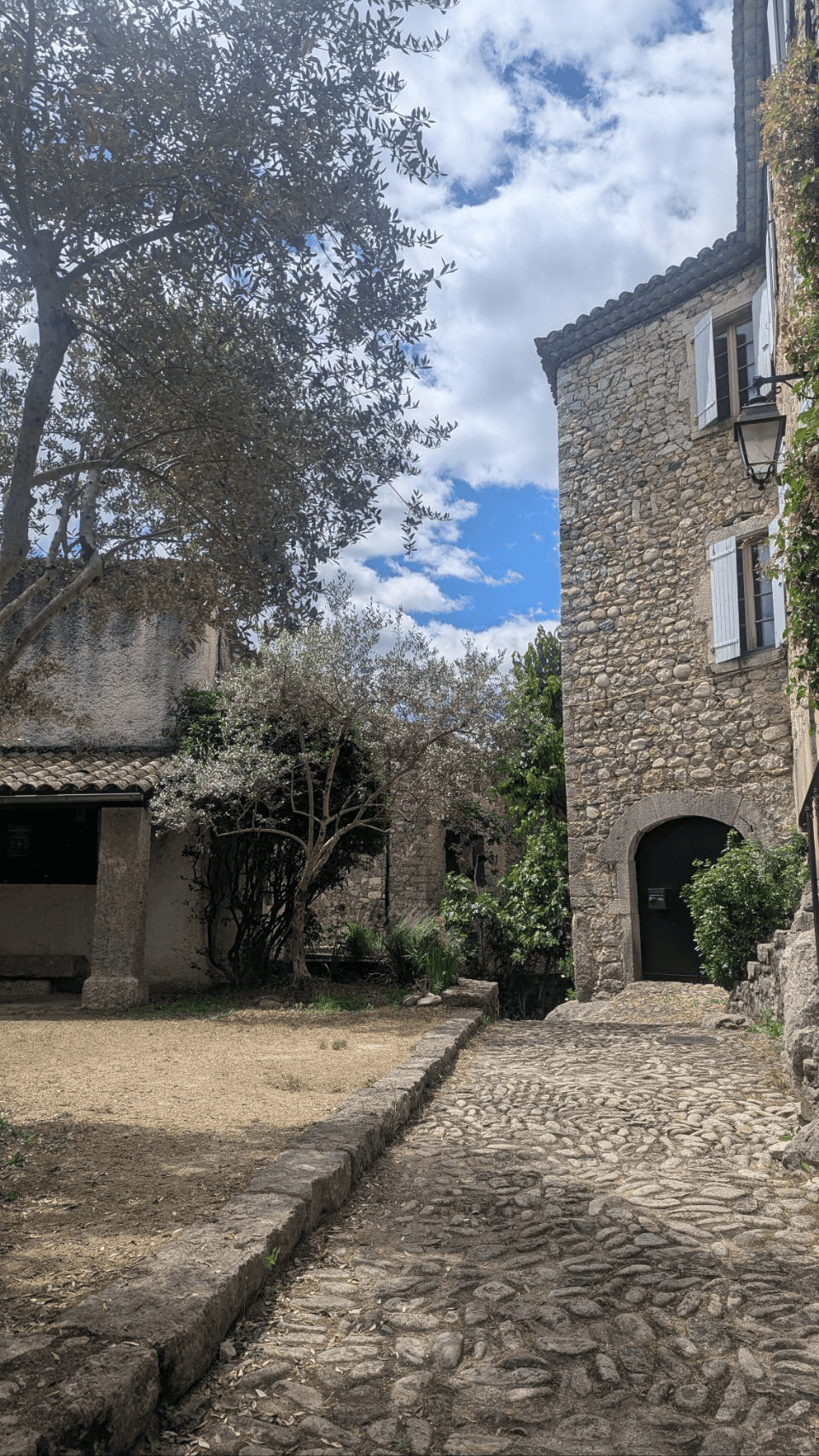
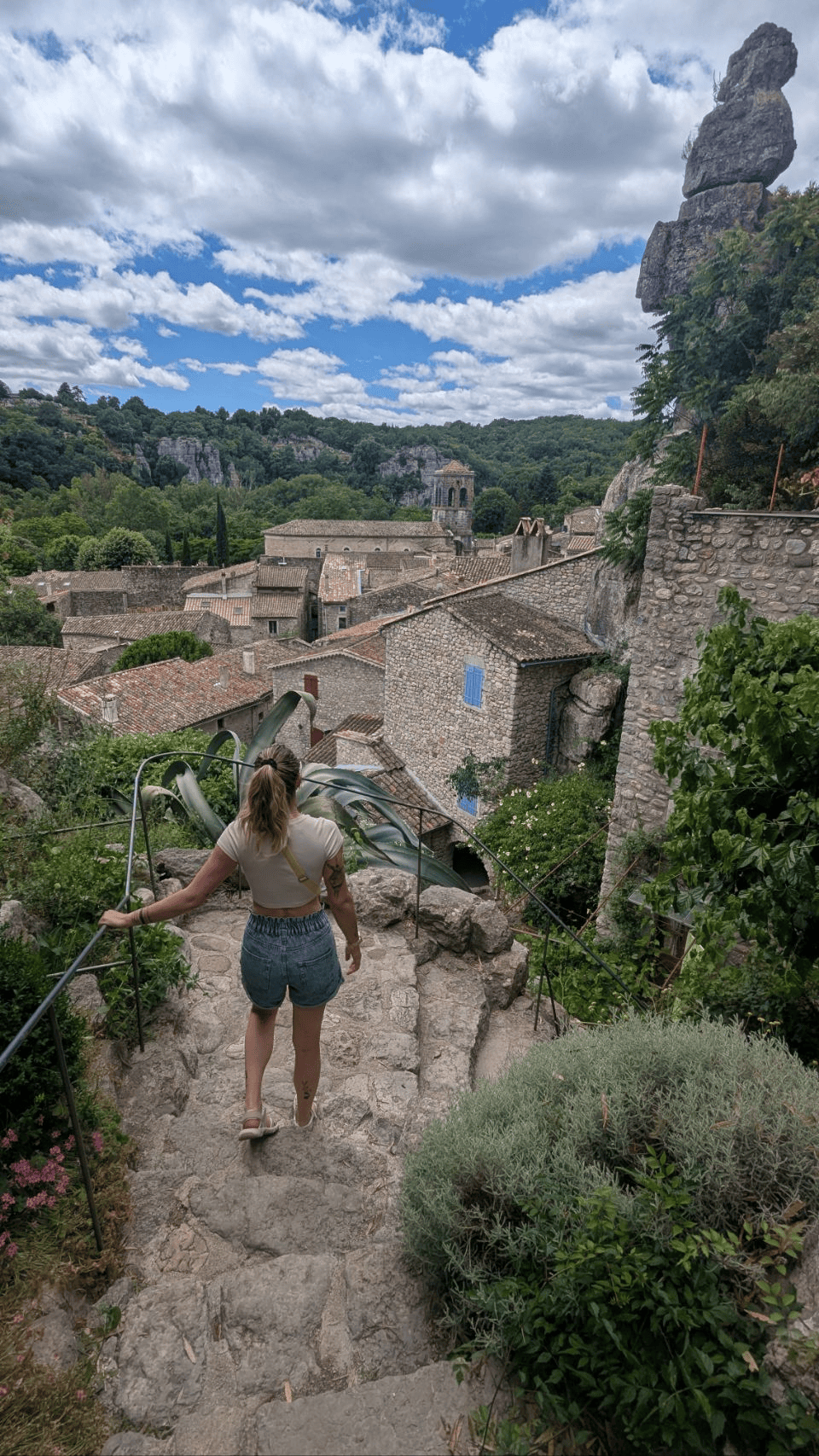
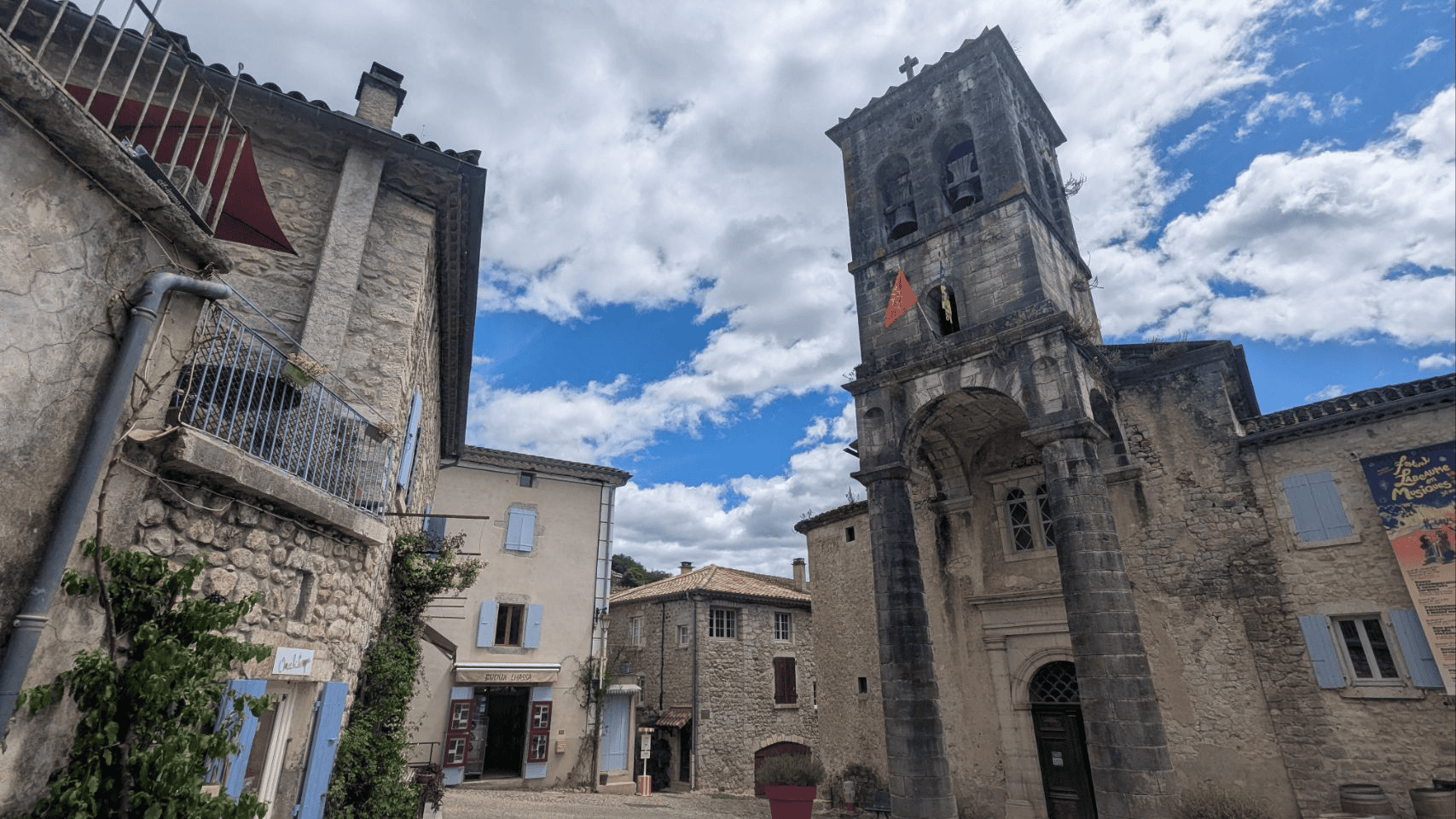
We then set off again for Balazuc, another charming village perched high above the Ardèche. Here too, we wander through the narrow streets on foot before setting off again.
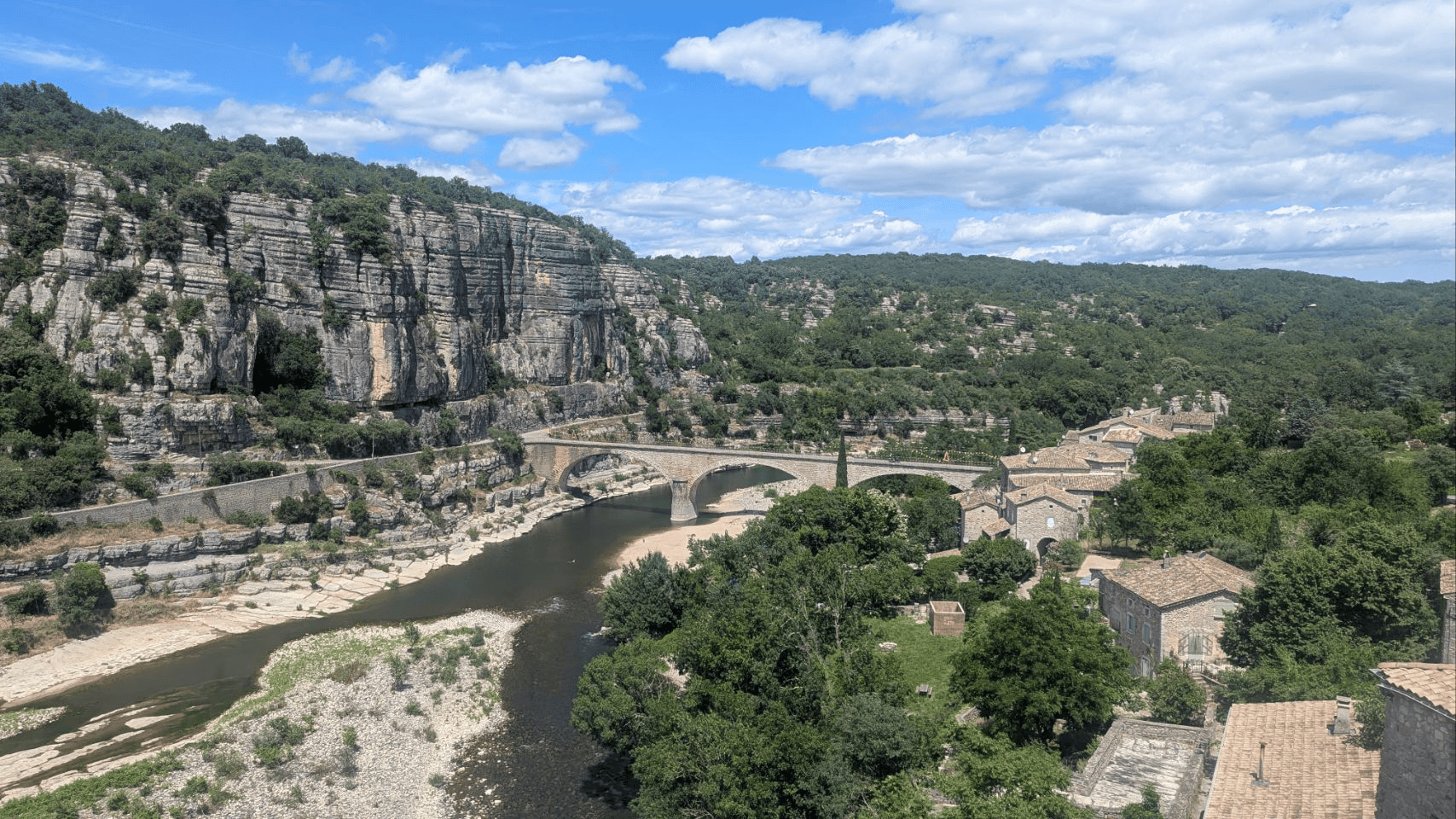
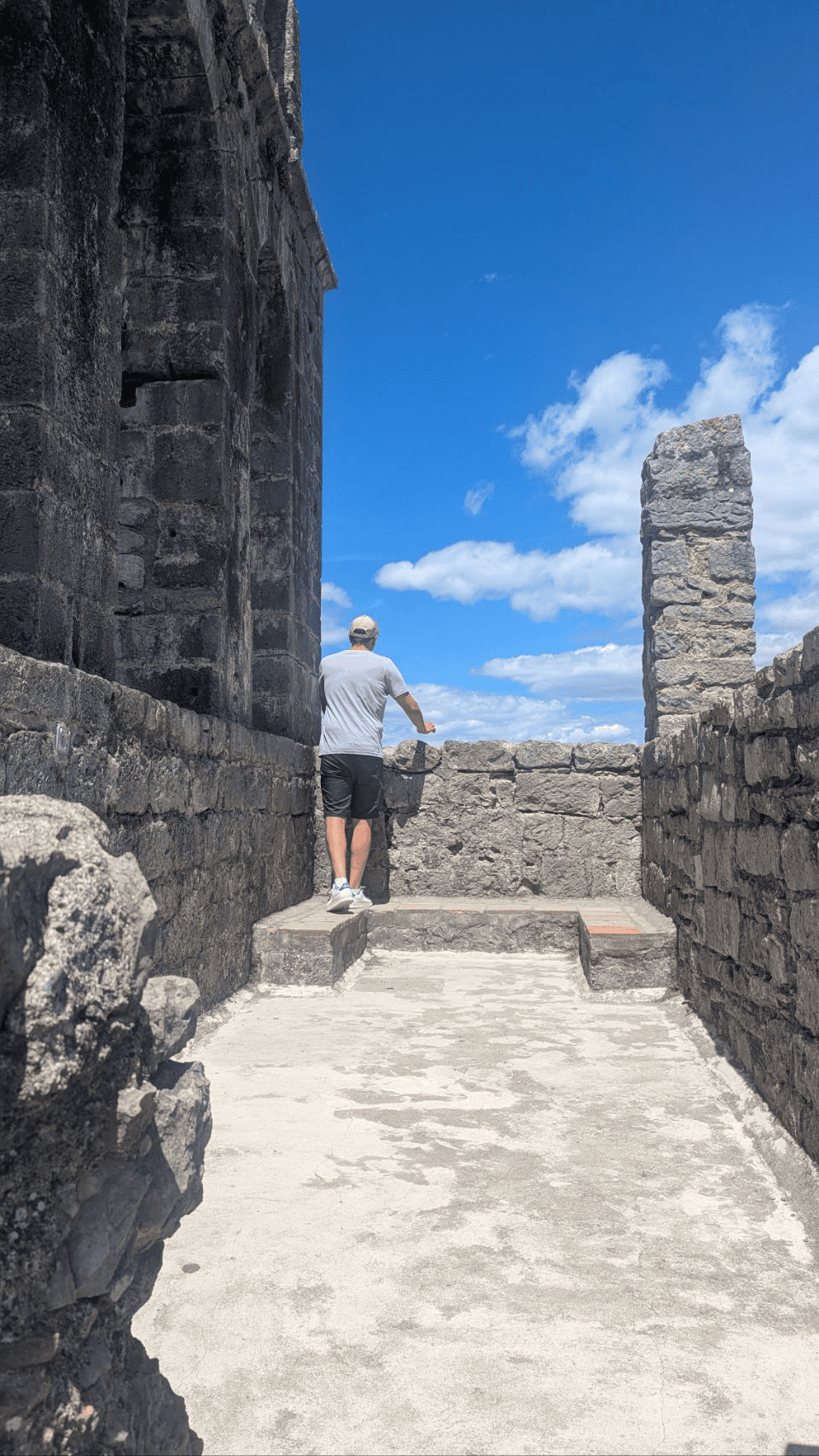
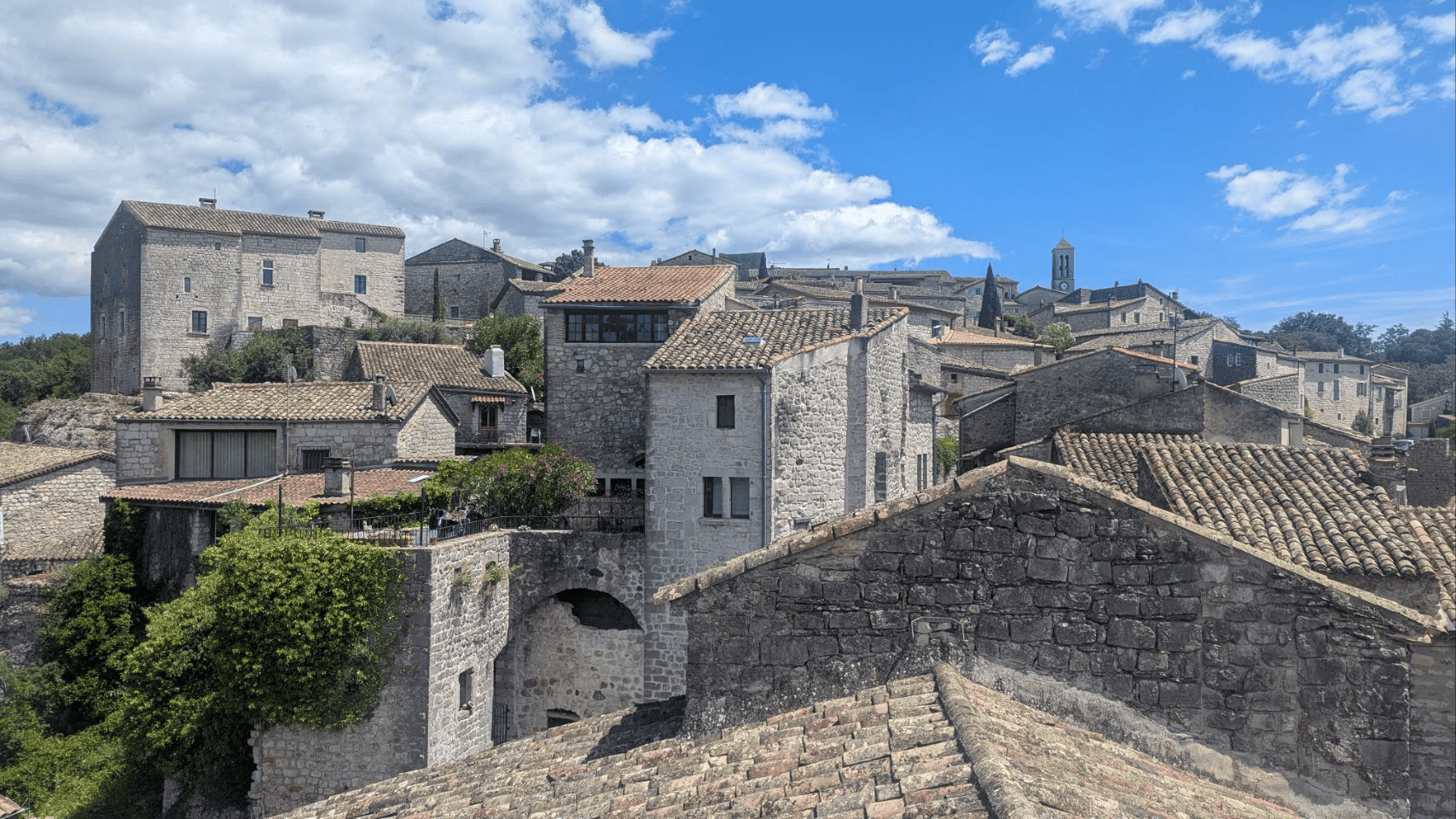
We’ll round off this series with Vogüé. At this point in the day, we’re starting to notice a certain charm: stone houses, vaulted passageways, narrow alleyways, a village clinging to the rock…
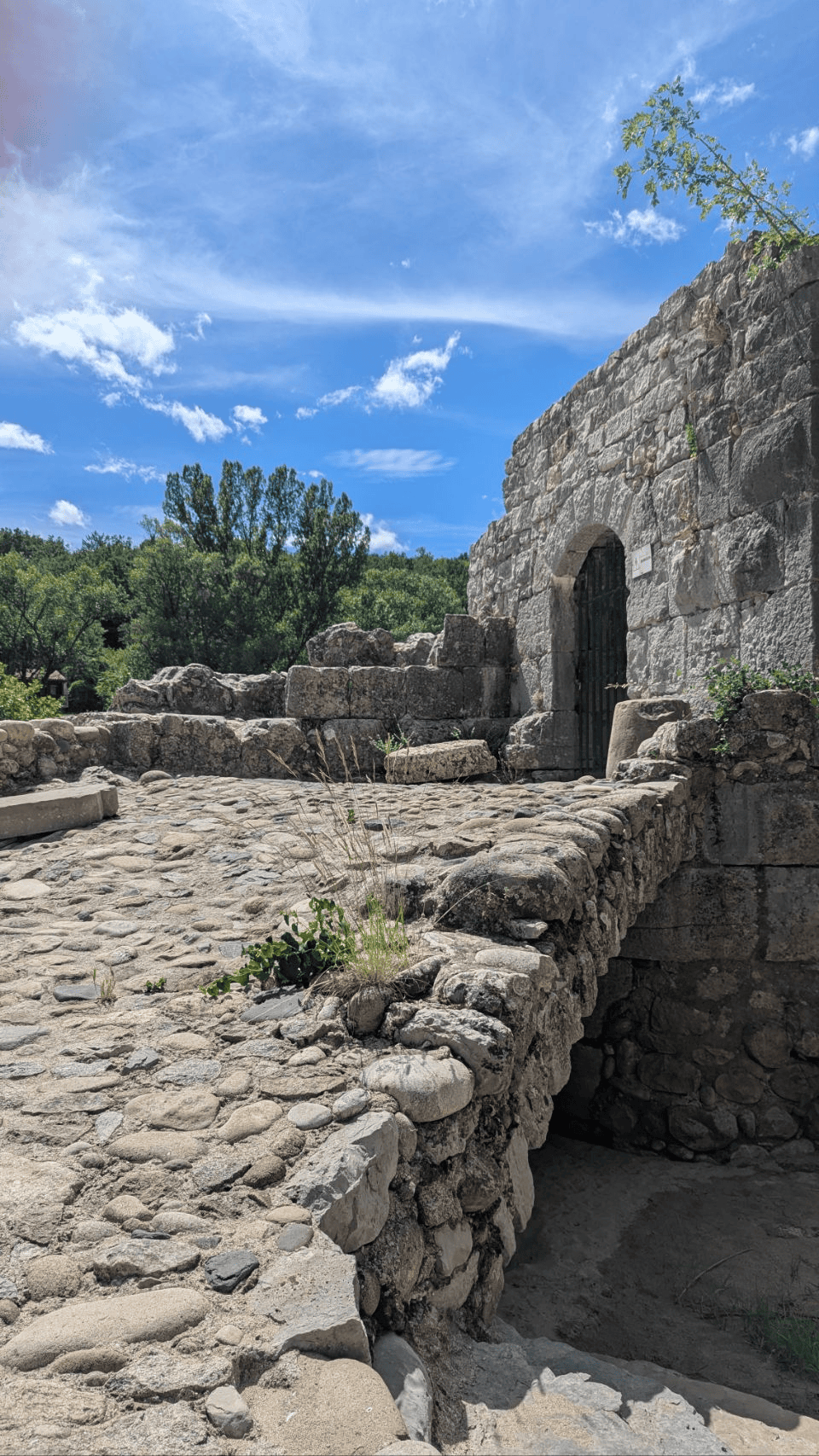
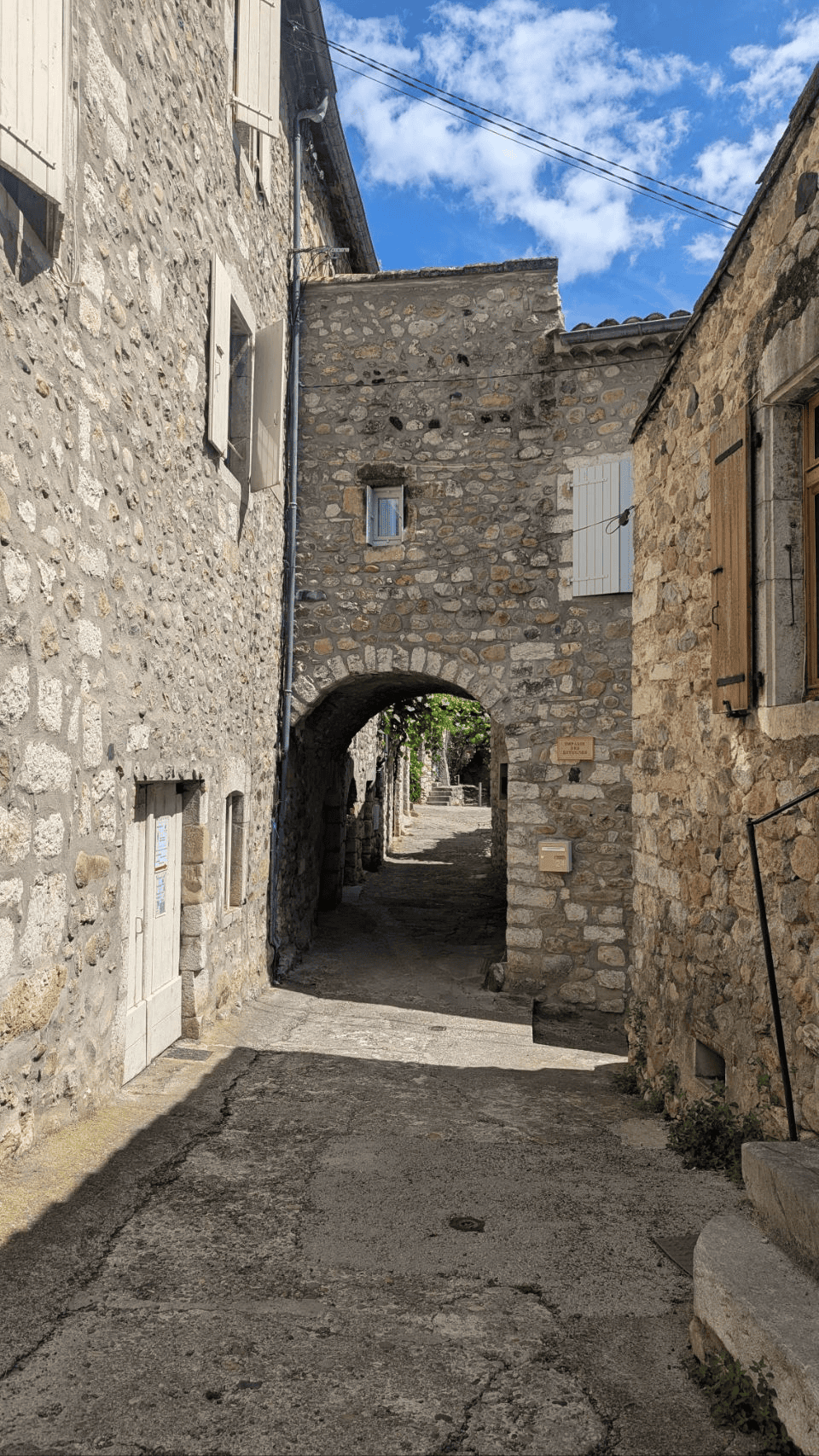
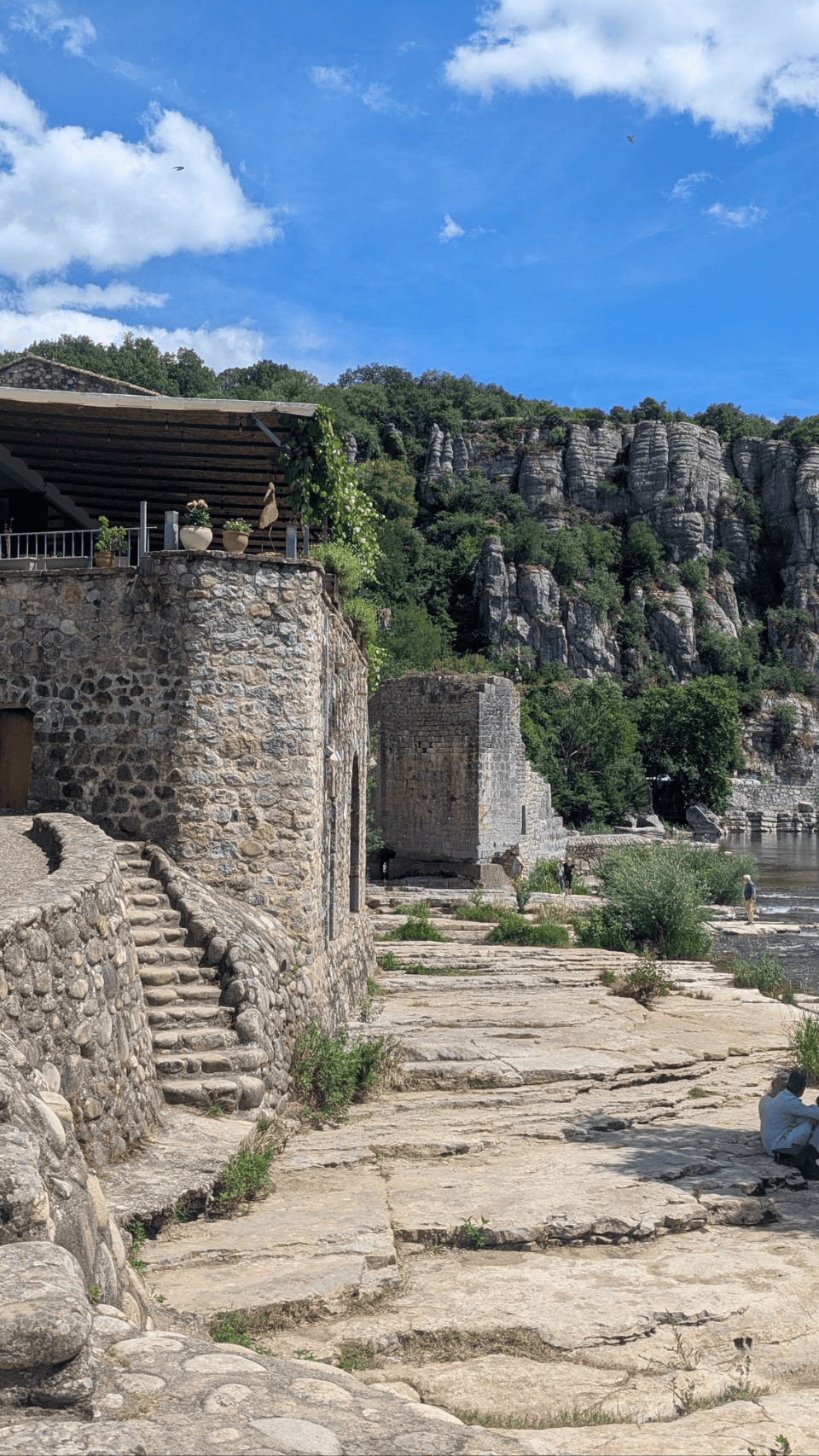
They’re all very pretty, but after visiting several in a row, you definitely start to mix them up.
Mirabel will have to wait
We’d planned to go via Mirabel, but the detour adds more than 25 minutes to the journey and, above all, we’ve had enough.
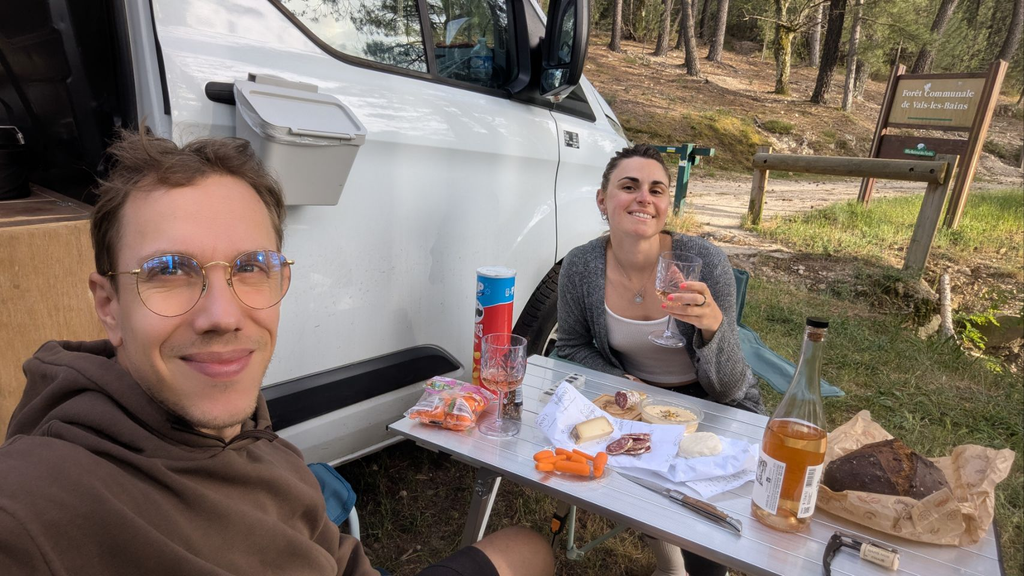
After spending the whole day walking from one village to the next, we decided to skip this final leg. Our priority became much simpler: to get to Aubenas, pop into Leclerc and find an ice cream that doesn’t cost as much as a dessert in a tourist restaurant. Mission accomplished. We then set off again towards our spot for the night, which we’d spotted in edge of the Vals-les-Bains communal forest. After the car parks, motorhome sites and riversides of the previous days, this time we found a much more secluded, peaceful campsite on the edge of the forest.
Day 7 – A day at the Vals-les-Bains thermal baths
We’d made good plans for the weather that day: rain was forecast from mid-morning onwards and, for once, the forecast turned out to be spot on. It rained almost non-stop all day. That’s precisely why we’d chosen our spot the day before, right next to the Vals-les-Bains thermal baths, where we’d planned to spend a good part of the day.
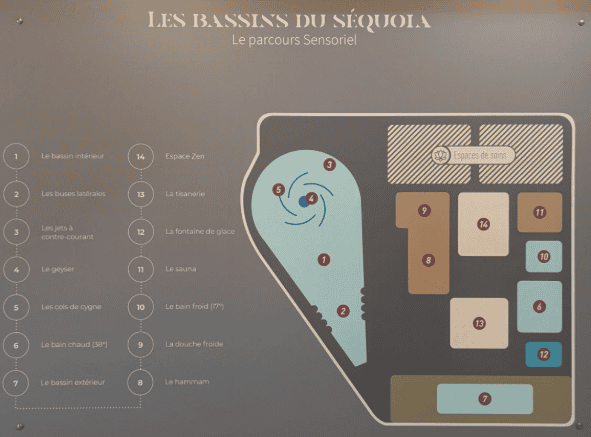
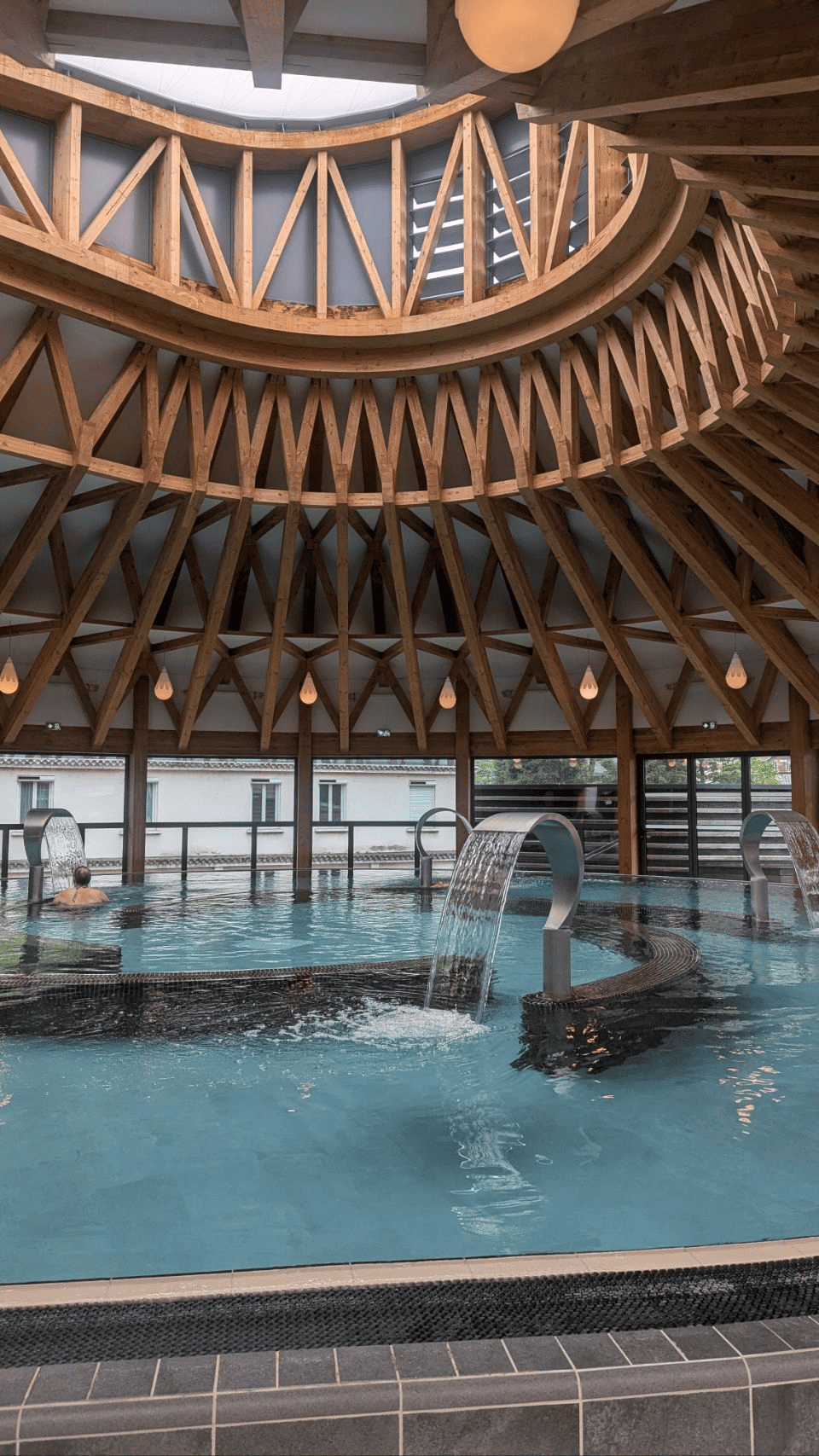
We start by following the suggested route in 14 steps, with a range of facilities, including an alternation between hot and cold baths. The cold pool is still 17 °C, so it’s not exactly an experience on a par with an ice-cold dip in Scandinavia, but after several minutes in the hot water, the contrast really wakes you up. We take the time to try out the circuit at a leisurely pace in the morning, without trying to rush through anything.
At lunchtime, as there aren’t any places to eat right at the thermal baths, we have to go back outside to find somewhere to eat. There are certainly several restaurants nearby, but as we’ve already got something for lunch in the van, we get fully dressed, go back to eat in the dry in the van, and then return to the thermal baths for the afternoon.
This time, we’re keeping it much simpler: we’ll mainly be staying in the pool to 38 °C. After several days spent visiting one village after another, exploring caves, climbing stairs, walking for kilometres on end and, above all, our 24-kilometre canoe trip downstream, we’re really starting to feel the strain. This much quieter day therefore comes at just the right time and gives us a chance to recover a little before continuing our road trip.
Pizza in Mercuer to escape the rain for a bit longer
By the end of the day, it’s still raining. We hadn’t planned to eat out that evening, but Simon fancies a pizza and the forecast suggests the weather won’t improve until around 10 pm. Rather than spend several more hours cooped up in the van, we decide to look for somewhere warm to have dinner.
We end up at All About Pizza, in Mercuer, in a little restaurant where we had a lovely meal. In fact, it turned out to be the only restaurant we visited during the whole trip: up until then, we’d mainly eaten in the van, had picnics or enjoyed food bought at markets and from local shops.
We ended up staying in Thueyts, where we’d planned a walk for the following day.
Day 8 – From Thueyts to Mont Gerbier de Jonc: discover the volcanic Ardèche
After spending several days exploring the gorges, caves and charming villages of southern Ardèche, we’re in for a complete change of scenery. This day marks our arrival in the volcanic Ardèche, with much more mountainous landscapes, temperatures dropping sharply and an itinerary now more focused on nature and short walks.
Thueyts and the Devil’s Bridge via the King’s Ladder
We got up quite early that morning for a very practical reason: we’d ended up spending the night in the car park of a small nursery, and we’d rather have been out of there before the children and parents arrived. So, first stop: a coffee in town – mainly to use the bar’s loo, let’s be honest. A nice surprise – it’s also the day of the weekly market. We take the opportunity to pick up a few more small fresh cheeses and continue our particularly rigorous market research into Ardèche cheeses, which we’d started a few days earlier. 😂
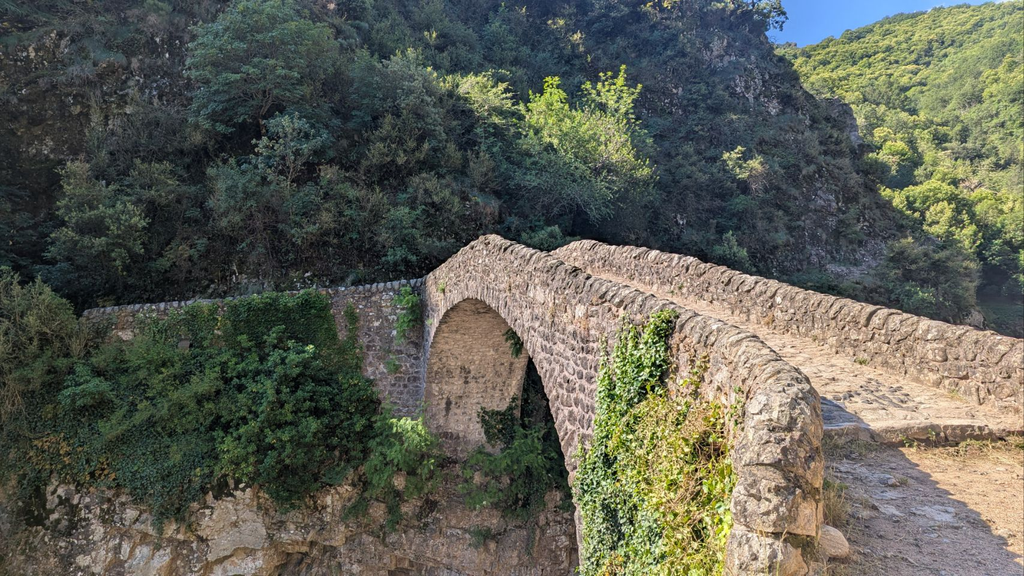
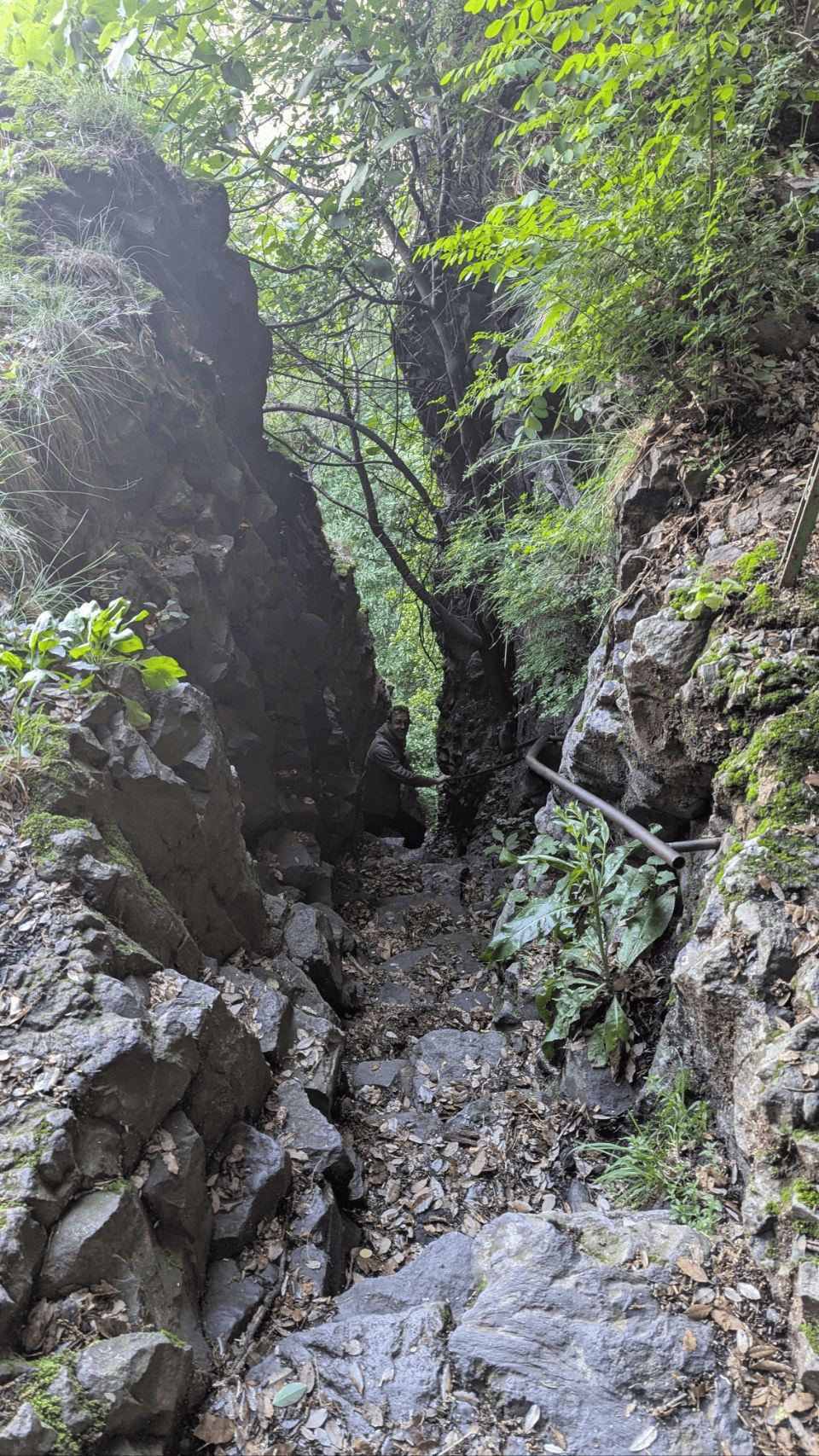
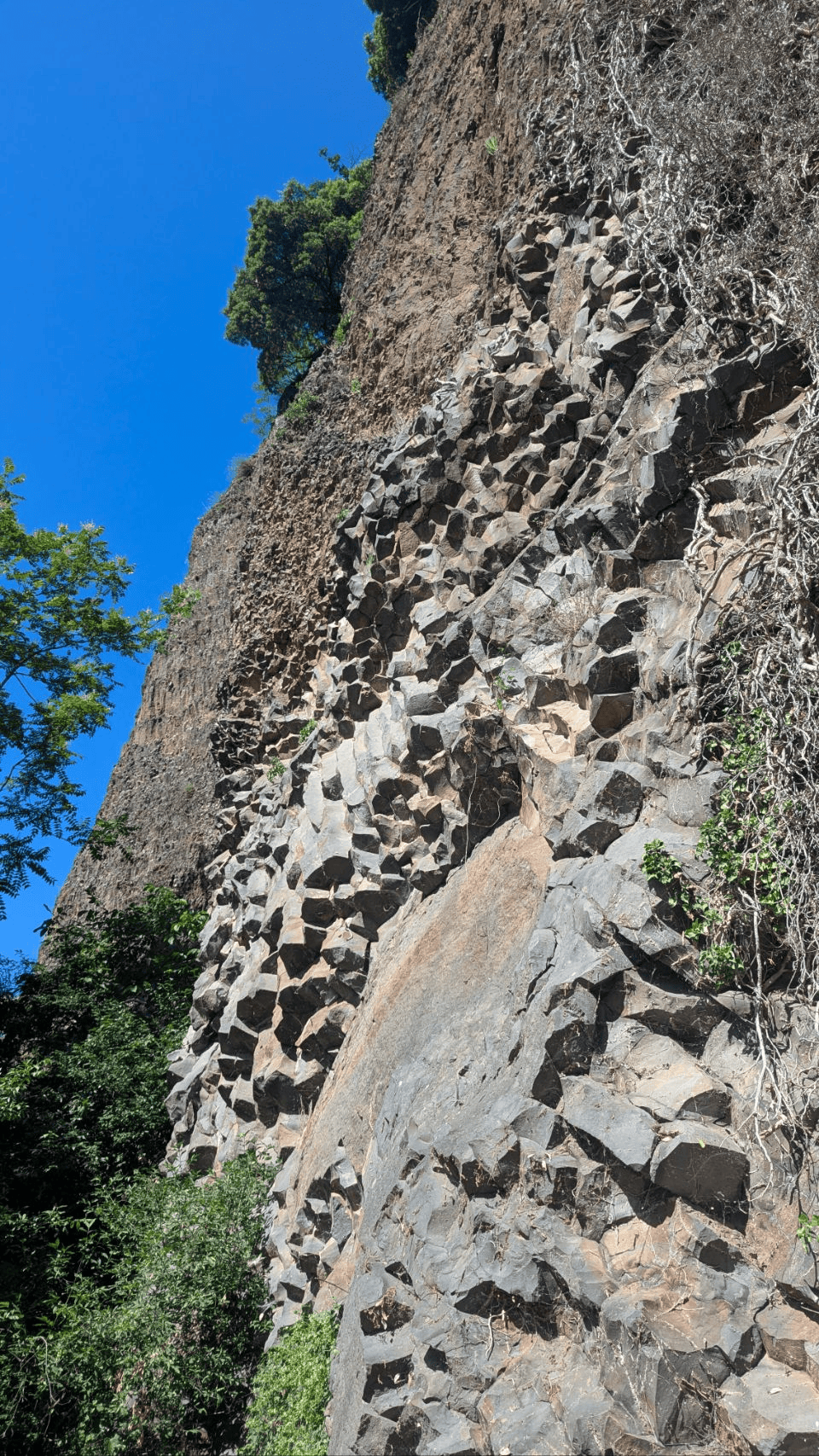
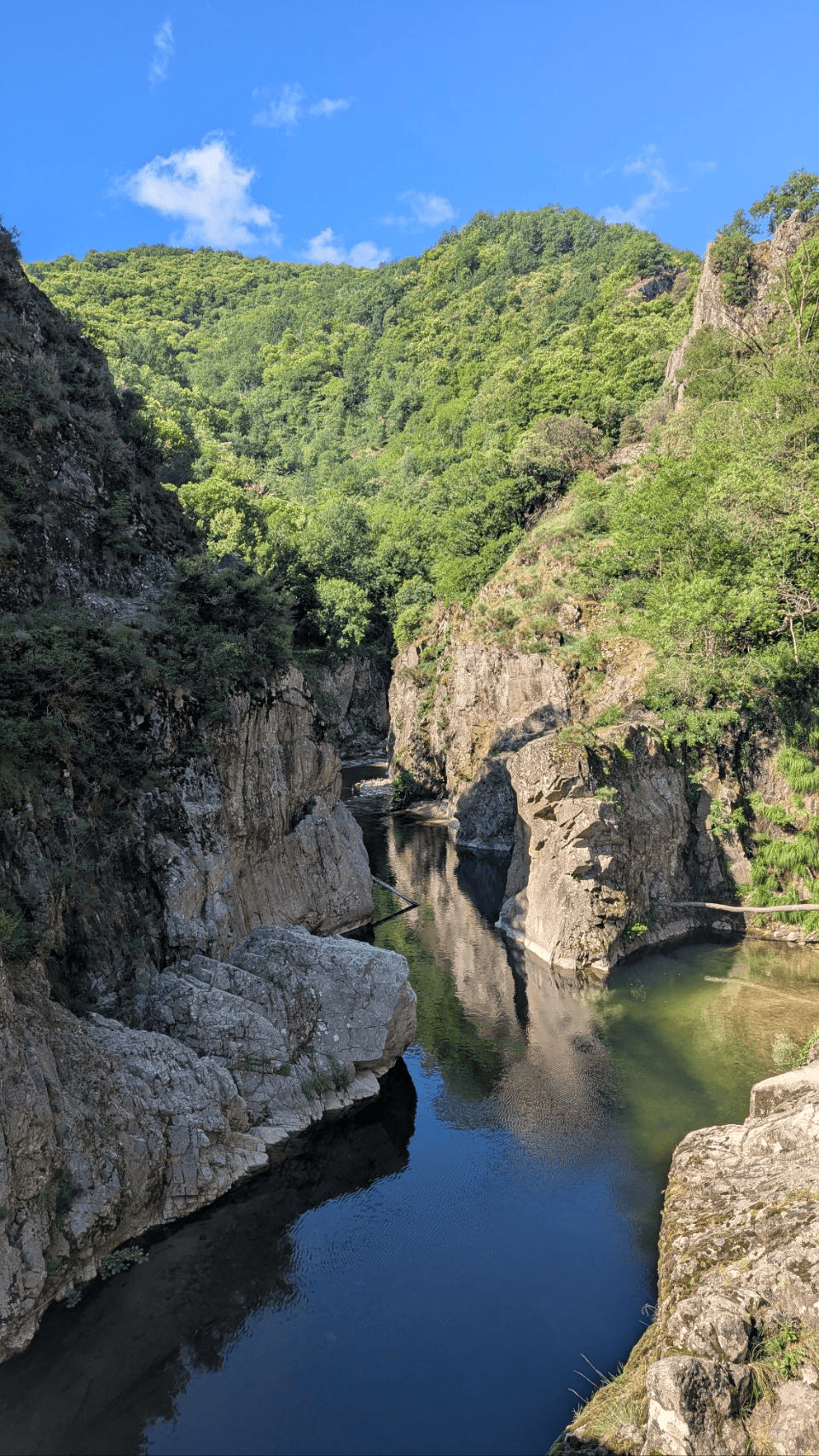
We then set off on foot towards the Devil's Bridge, about 90 metres further down, taking, in particular, the King’s Ladder, a flight of steps carved into a natural fissure in the Thueyts basalt flow. It’s quite an elegant name. Personally, having descended it, I would have called it “the Stairway to Hell” instead. The passage is narrow, steep and hemmed in by the rock faces, with a slight “dramatic passage from The Lord of the Rings” feel to it. This whole area was shaped by the volcanic activity of the Gravenne de Thueyts, whose lava flows have profoundly altered the landscape. You can also see the different rock layers very clearly on the slopes of the site, with the basalt having covered the older terrain. The walk isn’t very long, but it’s enough to show us that we’ve just entered a part of the Ardèche that’s completely different from the one we saw in the first few days.
Coucouron: a sudden change in temperature
We then carry on towards Coucouron. The village itself didn’t make much of an impression on us. The architecture is quite different from the stone villages we’d been visiting up to that point, but what struck us most of all was the temperature. We left our previous stop with the temperature at around 16 °C and arrived in Coucouron with only 8 °C. Suffice to say, we’re freezing and our acclimatisation to the Ardèche’s high altitudes is getting off to a rather abrupt start.
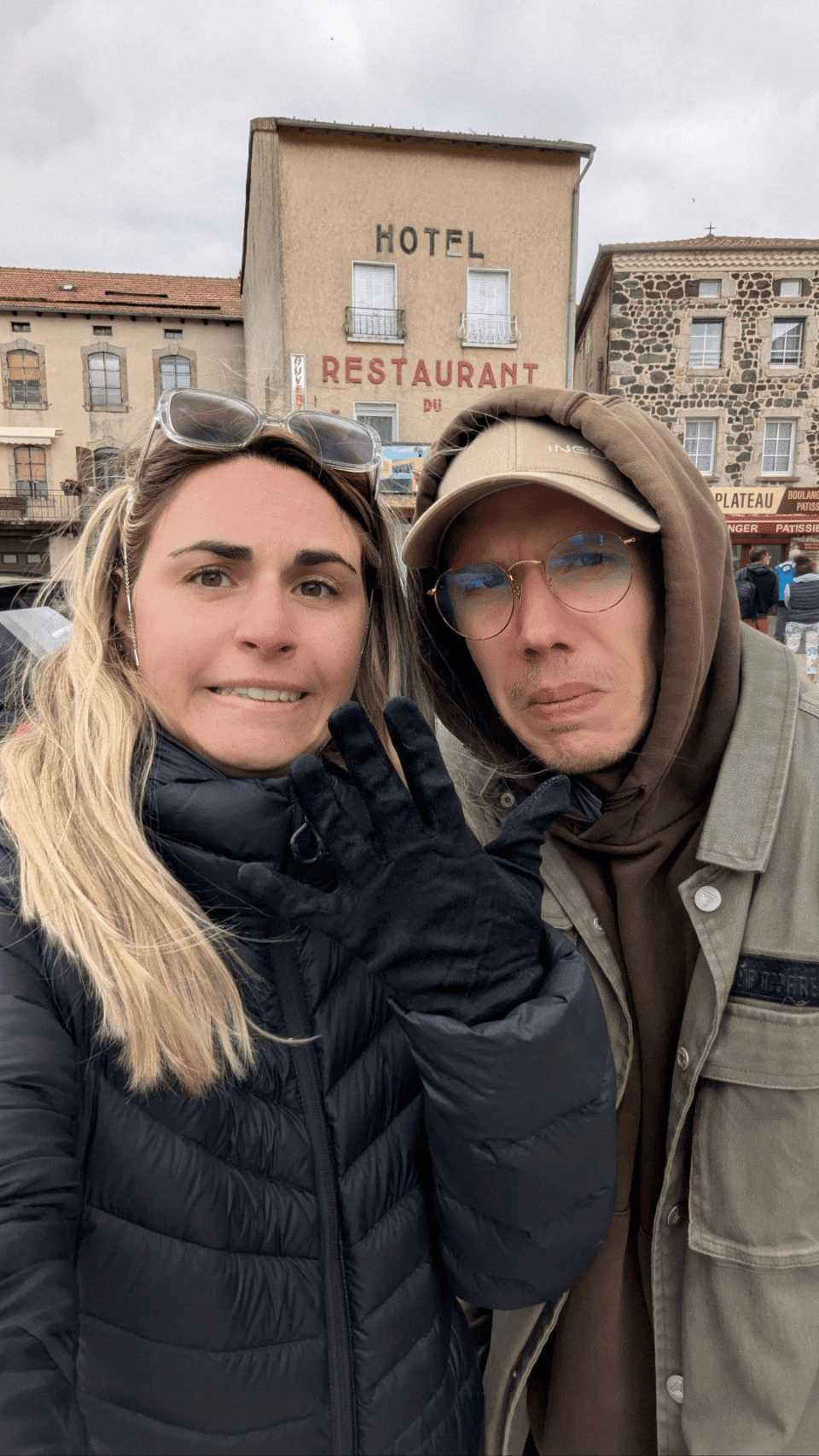
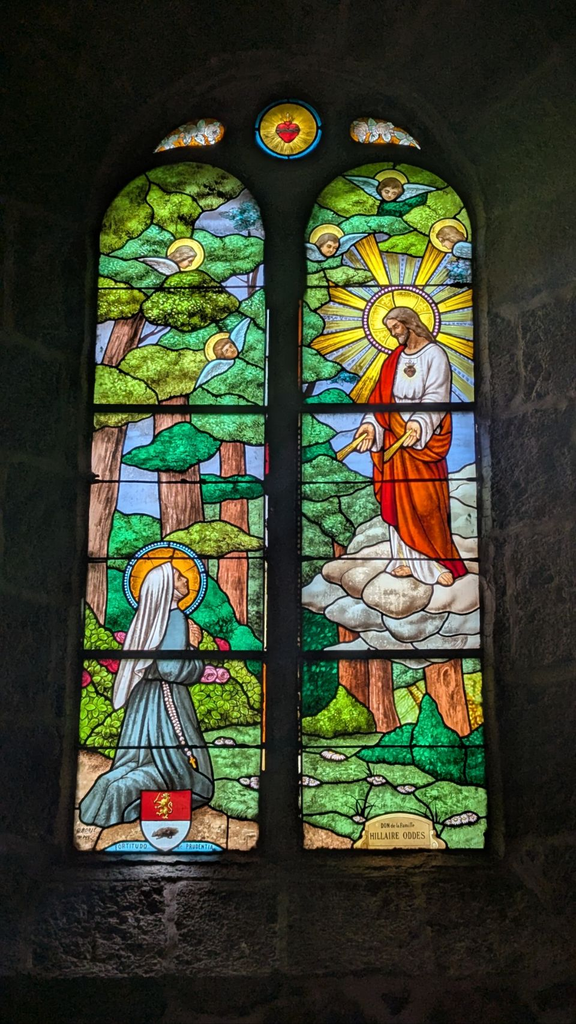
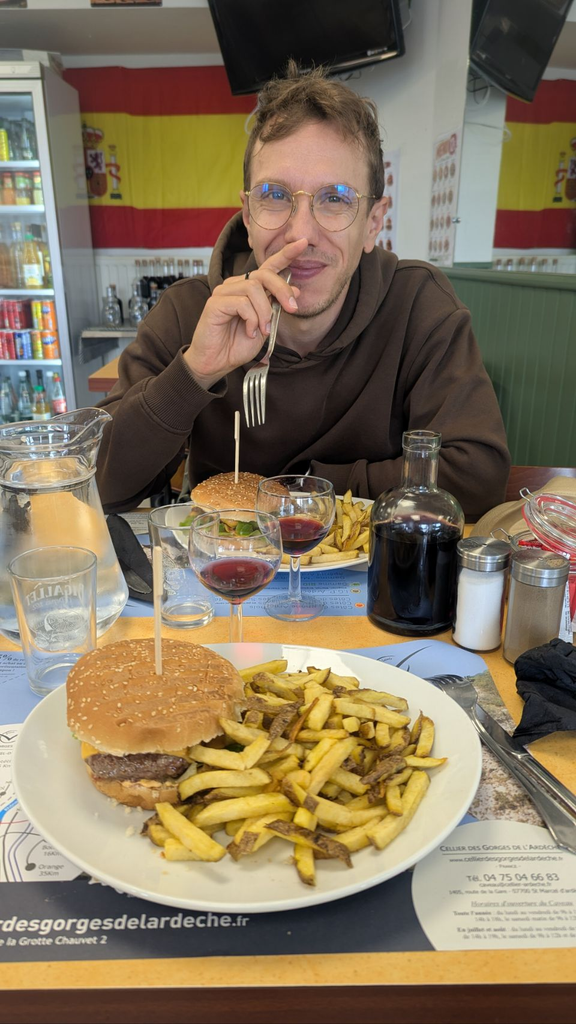
We ended up going into a small restaurant (La pizza di Diego) which, from the outside, didn’t exactly raise our hopes. The set menu at 15 € Yet it includes a starter, an all-you-can-eat dish of the day or a cheeseburger with chips, a cheese platter, dessert, a quarter-litre of wine and coffee. At that price, you’d expect a run-of-the-mill burger served with three frozen chips, but in fact, not at all: the food is really excellent, including homemade chips, even though that wasn’t even mentioned on the menu. We left the restaurant stuffed to the gills and, in the end, very glad we’d made the detour.
A post-meal stroll around Lake Issarlès
After that particularly generous meal, we headed to the Lake Issarlès to walk all the way round it. The loop is just over 3 km long, which is rather handy for helping to digest everything we’ve just eaten. The lake lies within an ancient volcanic crater at an altitude of around 1,000 metres and reaches up to 138 metres deep, making it one of the deepest lakes in France.
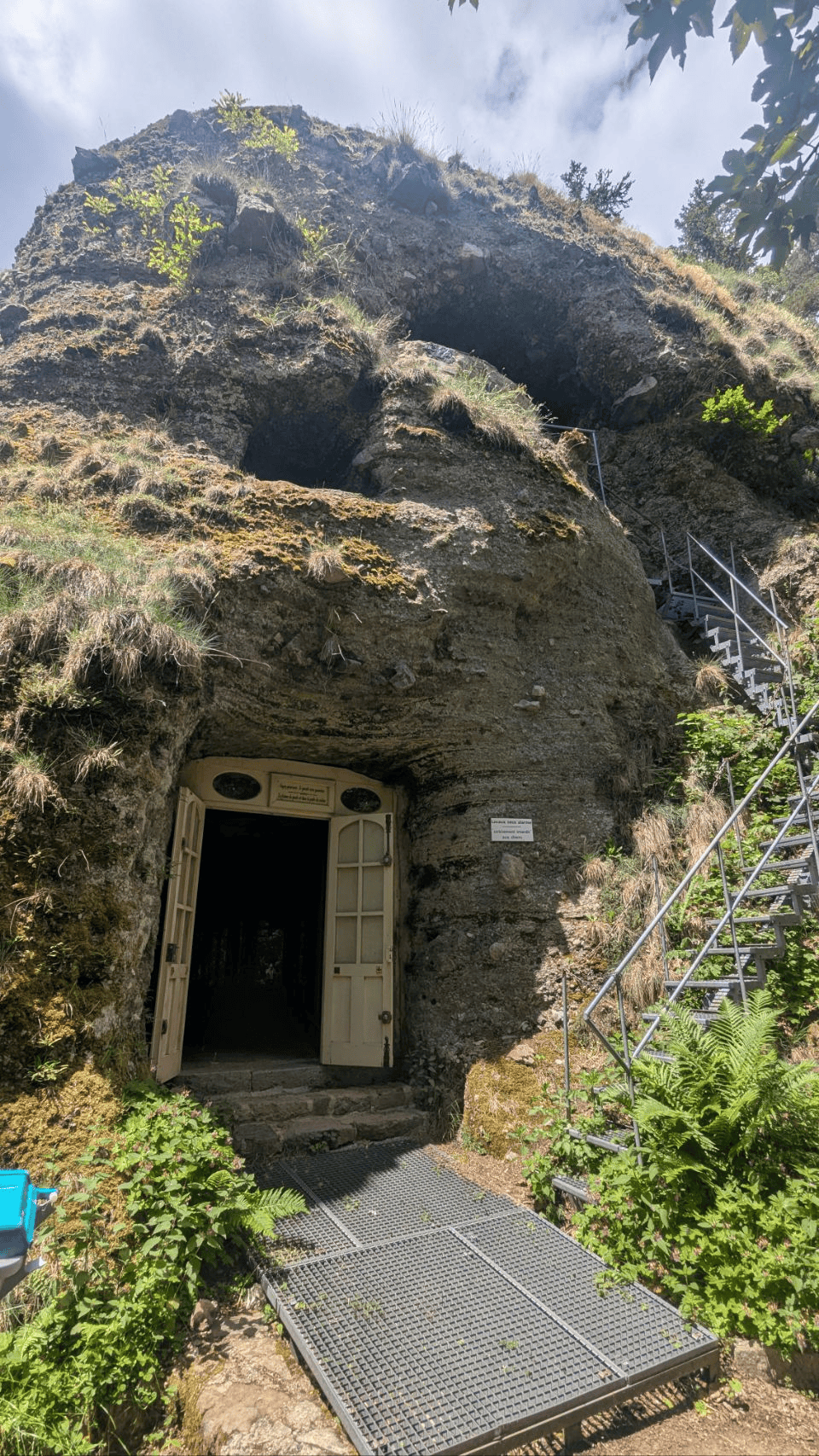
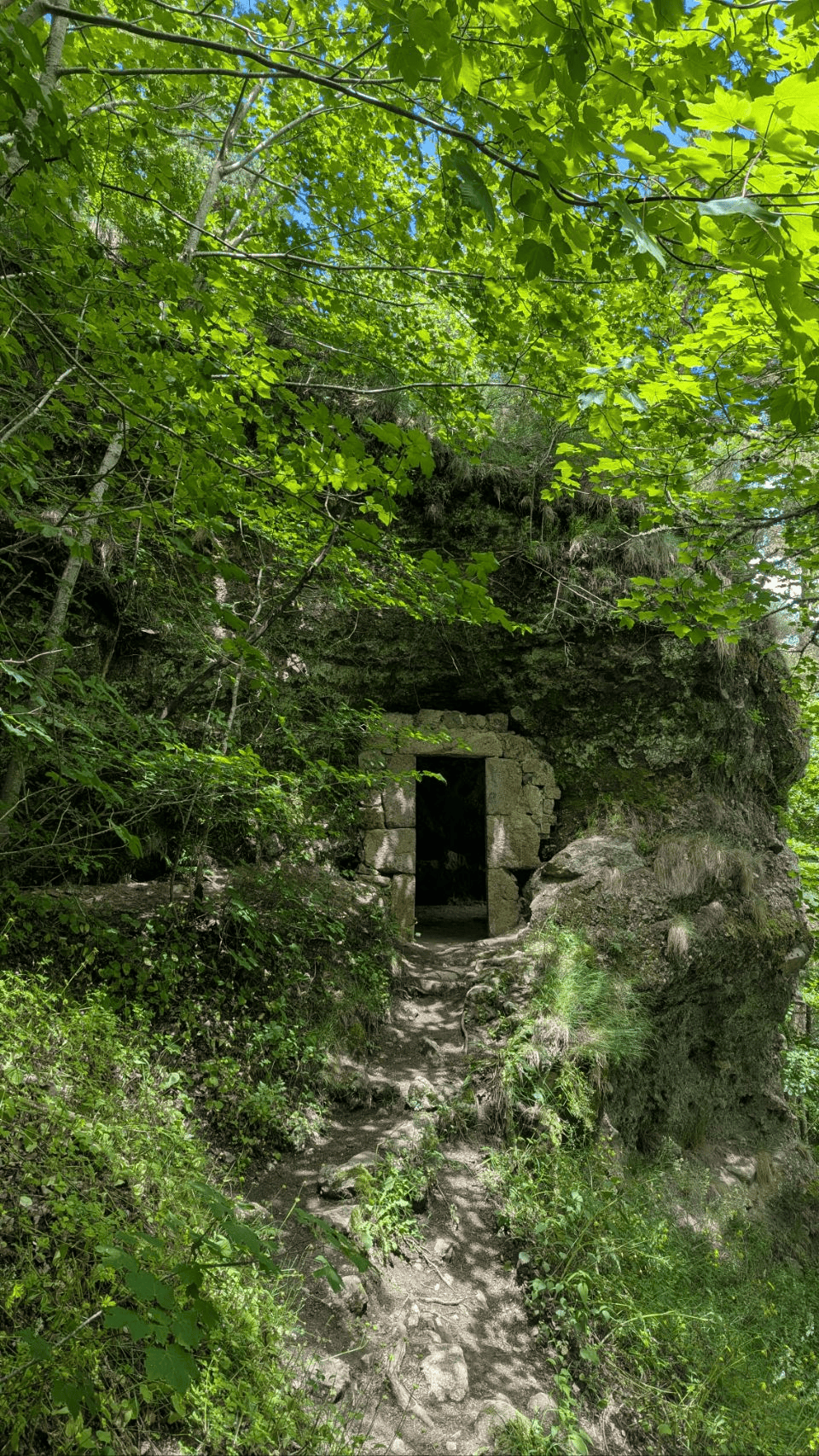
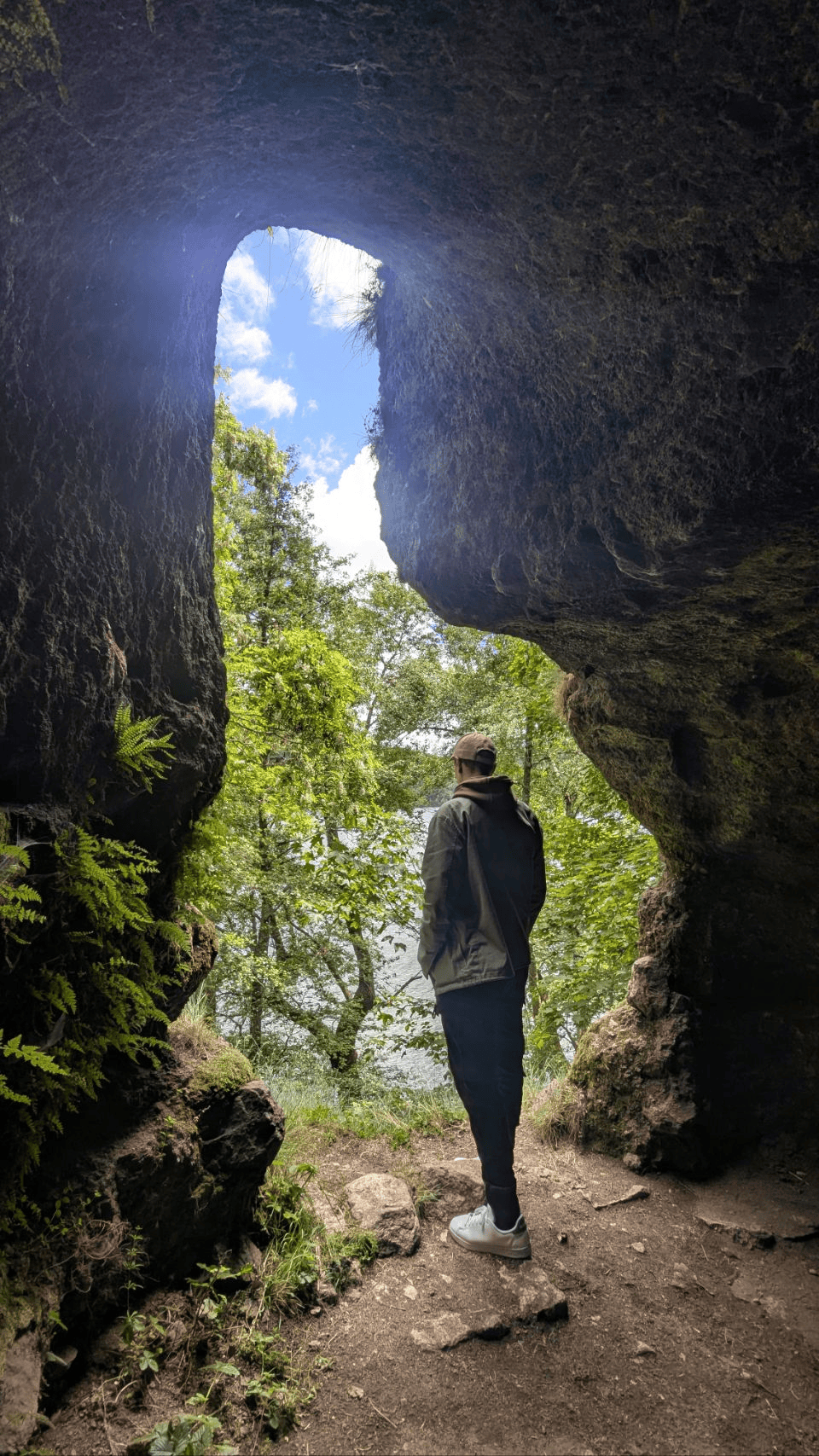
During the walk, you’ll also come across some old cave dwellings carved into the cliff face, one of which served as the lake keeper’s accommodation until the early 20th century. One of the caverns has now been converted into a small exhibition space, and from the outside, one almost hesitates to go in: the door is open but the lights are all off. As soon as you cross the threshold, a motion sensor switches on the light and you discover several information panels dedicated to the history of the site, the lake and the natural formations visible in the area. You also learn that its waters are used for hydroelectric power generation. What was meant to be just a short stroll after a meal turns out to be quite interesting after all, covering volcanic geology, local history and old dwellings.
Mont Gerbier de Jonc: far less peaceful than expected
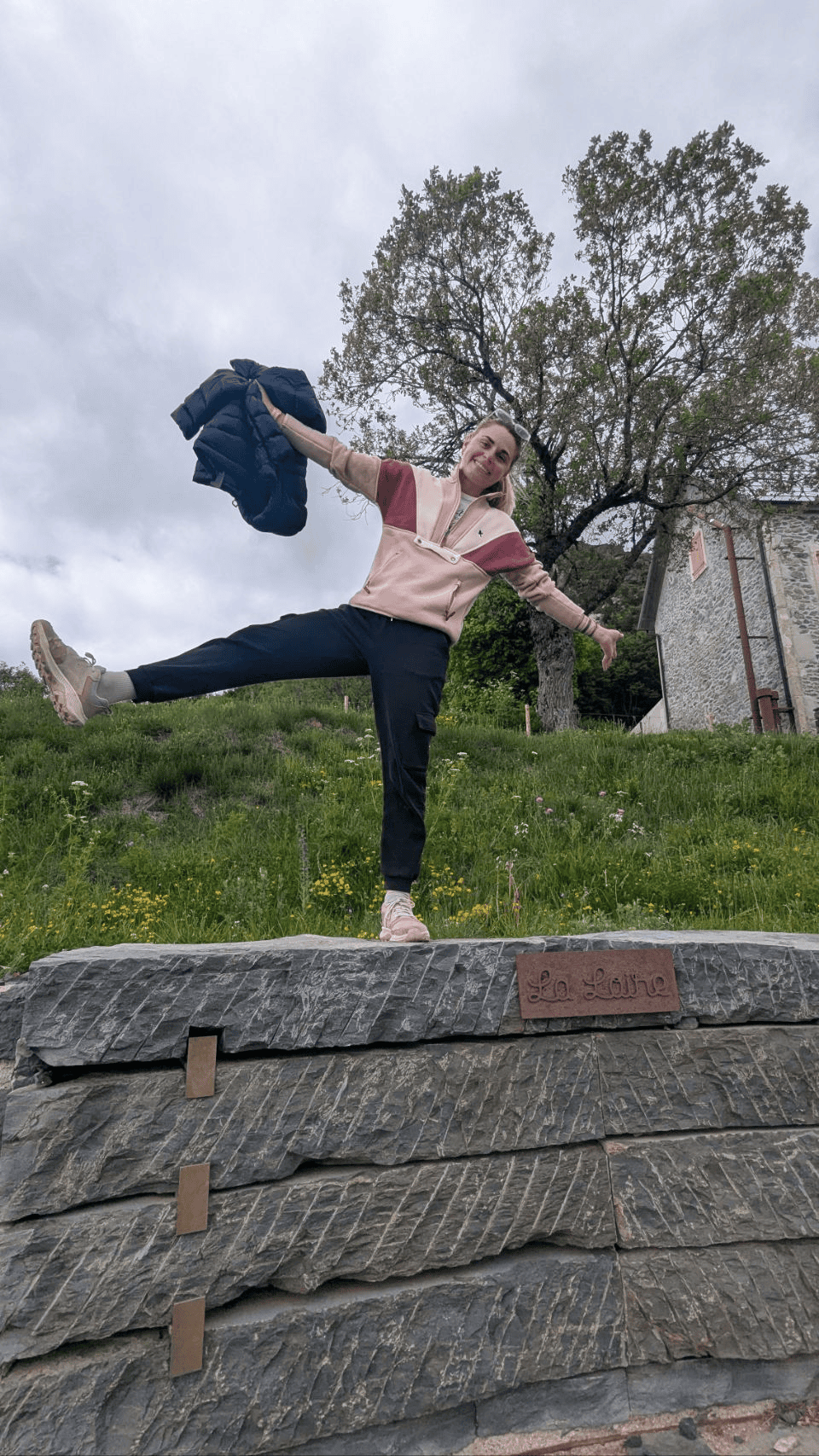
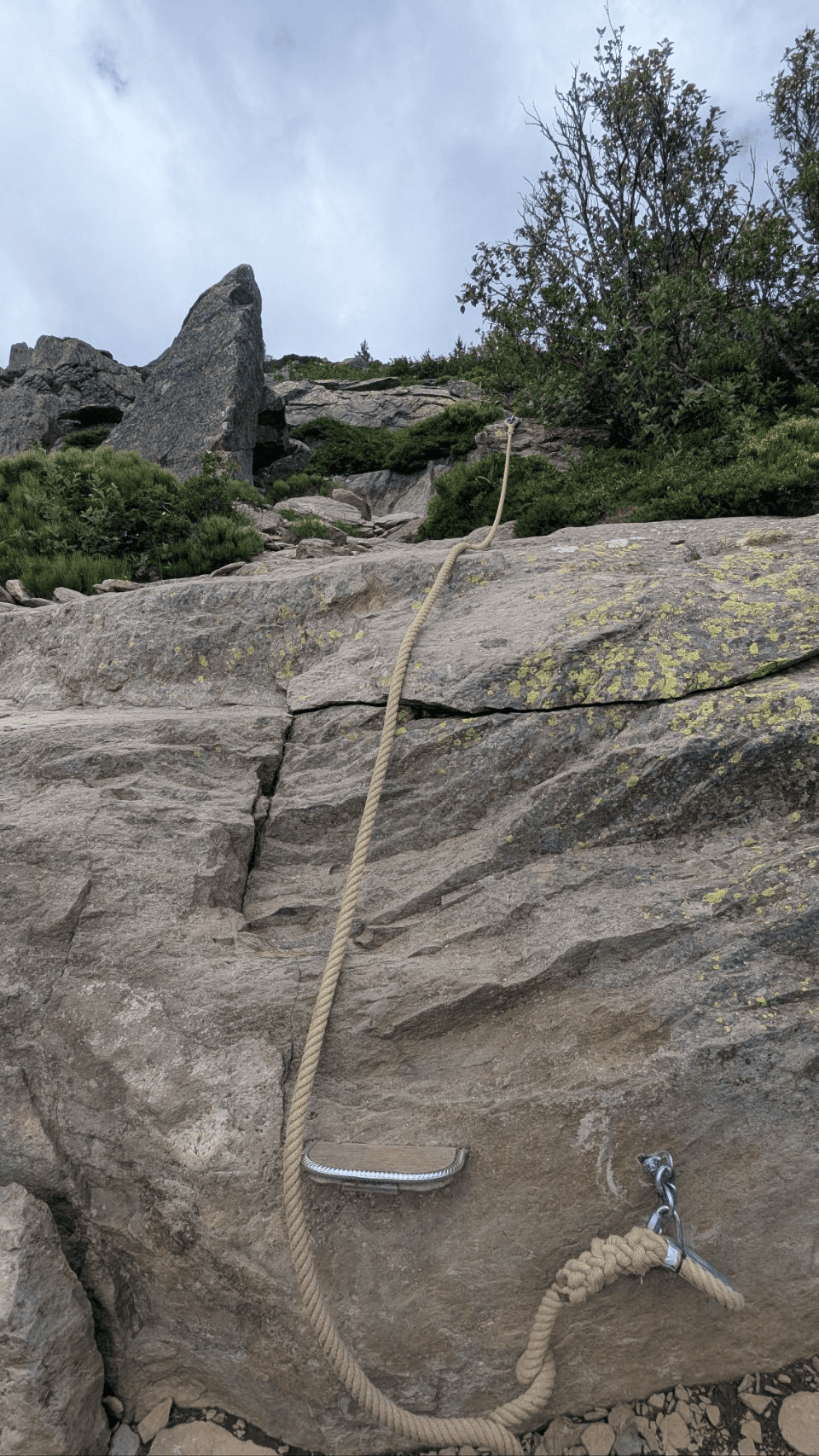
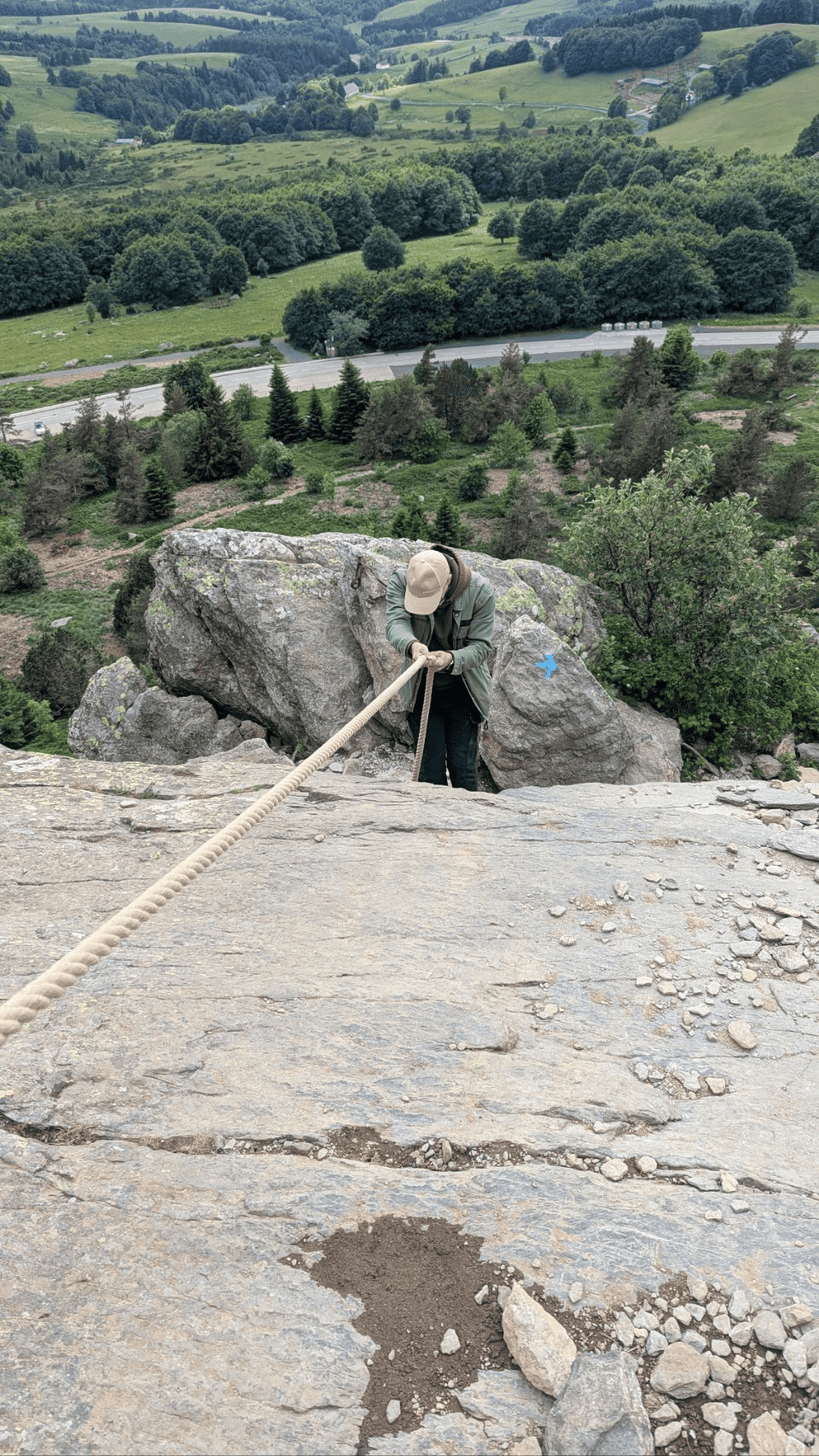
We then set off again towards the Mont Gerbier de Jonc, at the foot of which the various sources of the Loire spring forth. We set off thinking we’d be going for a walk of less than an hour, with an elevation gain of not even 170 metres. On paper, nothing particularly impressive. In practice, however, we’re quickly brought back down to earth: the path becomes quite steep and some sections feel more like a bit of rock climbing than a typical walk. You have to use your hands, scramble over rocks and use ropes on certain sections, both on the way up and on the way down.
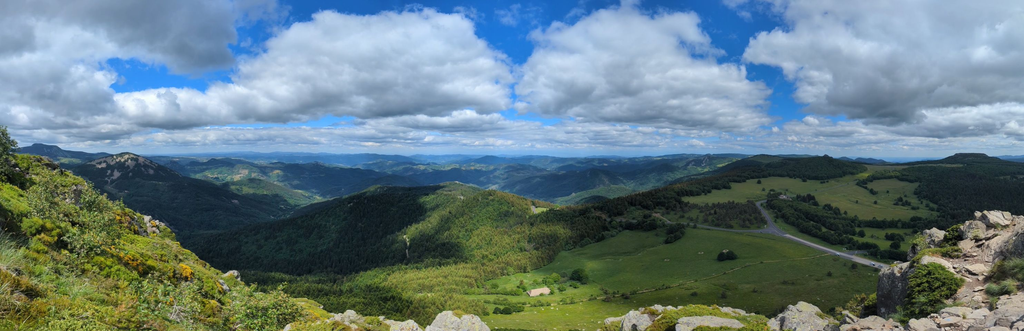
Given the advertised duration and elevation gain, we’d really been expecting something much more manageable. It’s not a long hike, but it does require you to be comfortable on rocky terrain and to have joints that can cope. Once at the summit, the view is superb and, at least, the exertion has finally warmed us up after spending a good part of the day freezing. The downside is that I’d thought I could make do with a quick wipe-down in the evening – but that didn’t work out. Having worked up quite a sweat on the climb, a proper shower becomes essential, even though we’re now at altitude and the temperatures are continuing to drop.
Camp at 1,400 metres
For the evening spot, we’re torn between two options: staying up in the hills around 1,400 metres, or head back down to a small village we’re due to pass through the next day, at an altitude of around 900 metres. The second option would mean making a rather illogical round trip, so Simon decides in favour of the most efficient route. At 5.30 pm, it’s 12 °C outside… and exactly the same temperature inside the van.
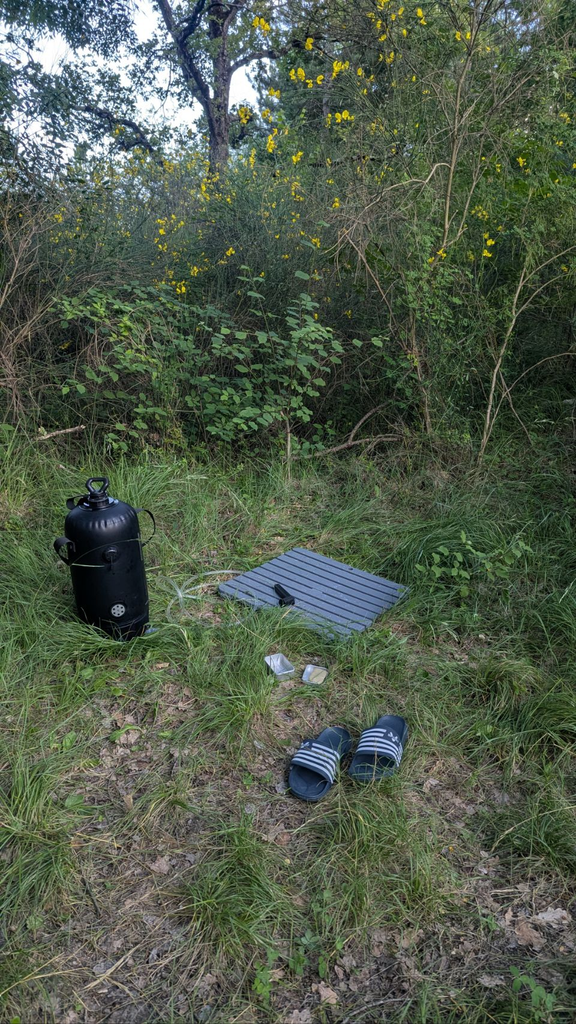
We set up at a little spot we’d spotted on Park4night, on the edge of the forest and slightly set back from the road. As the ground isn’t perfectly flat, we still have to get the levelling blocks out to level the van. Then comes the challenge of having a shower. There’s no way we’re going to pitch the whole shower tent in this cold: we simply lay the grating on the ground and use the outdoor shower straight away. The water’s displayed as 30 °C, which seems perfectly fine until we find ourselves standing wet under the trees in 12 °C weather with a bit of a breeze.
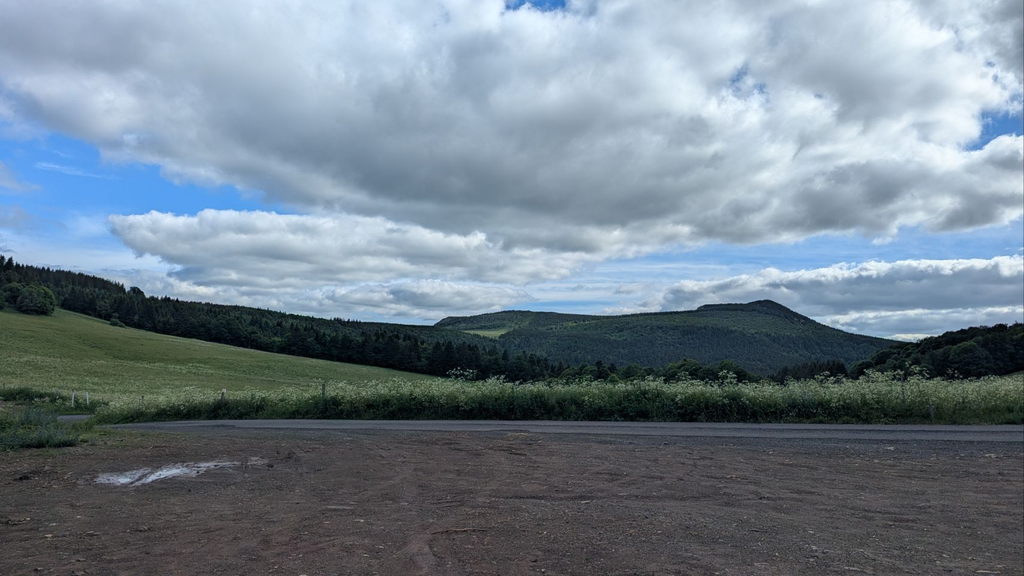
Once we’re dry and dressed again, we completely rethink our plans for the evening. No chilled wine or aperitifs outside: we quickly get back into the van and decide on some hot noodles to warm us up instead. As for me, I’m still wearing four layers: a merino base layer, a technical jumper, a fleece and a down jacket. Luckily, we’ve got our sleeping bags for the night, so we’re not really worried about the cold. But having started the road trip a few days earlier in temperatures of over 30°C, the contrast is quite stark.
Day 9 – From Mont Mézenc to Mirabel: the final day in the Ardèche
On this final full day of sightseeing in the Ardèche, we continue our exploration of the volcanic region that began the day before, before gradually heading southwards. On the agenda: a final hike up Mont Mézenc, the Ray-Pic waterfall, followed by two charming villages before leaving the department for good at the end of the day.
Hike up Mont Mézenc
It’s even cooler this morning than yesterday, with only 8 °C outside the van. As our spot is completely in the shade, we decide not to hang about and to head straight to the car park where the hike starts on the Mount Mézenc. We’ll have breakfast in the van, but at least we’ll already be there and ready to set off. For the past few days, we’ve actually been following a new, rather efficient routine: in the evening, we boil some water and pour it straight into a thermos flask. In the morning, all we have to do is fill our glasses to make our hot drinks, which is honestly very welcome when we wake up to single-digit temperatures.
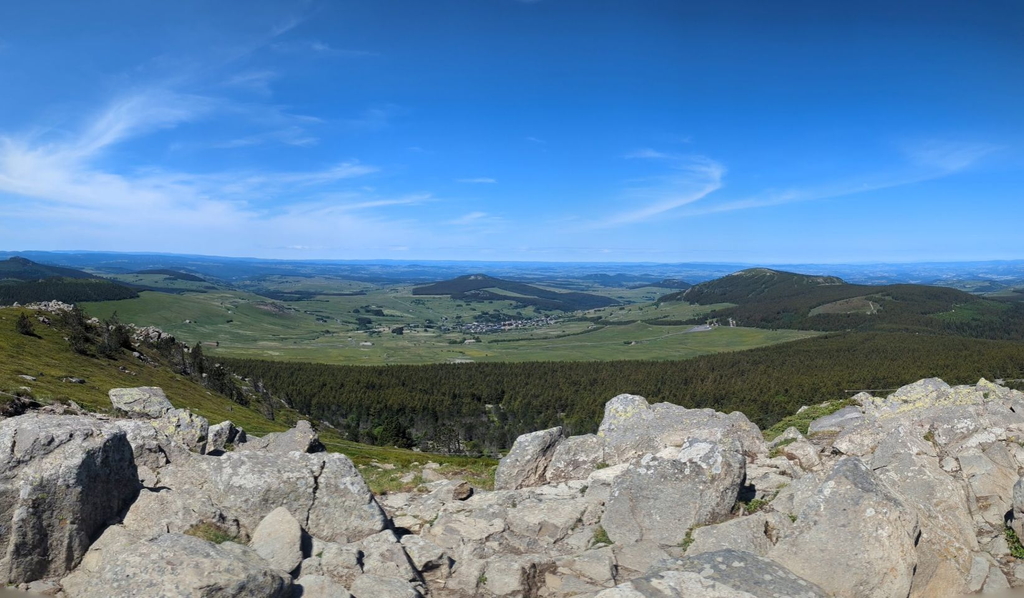
We then set off on a hike lasting about two hours, reaching the summit in roughly an hour. Mont Mézenc has two peaks very close together: the Croix du Mézenc, on the Haute-Loire side, rises to 1,744 metres, whilst the southern peak reaches 1,753 metres and is the highest point in the Ardèche. So we pass by the summit before making a short detour to the cross, then head back down at a leisurely pace. The hike is much less technical than the previous day’s ascent of the Gerbier de Jonc and feels more like a classic mountain walk.
We round off the day with a picnic at a table offering a superb view of the surrounding hills. After waking up to a temperature of 8 °C and having breakfast in the van, we’re clearly glad to finally be able to sit outside in a bit more comfort.
The Ray-Pic Waterfall in the heart of the volcanic Ardèche
We then set off again towards the Ray-Pic Waterfall, accessible via a short walk of less than 2 km. After the Mézenc and the Gerbier de Jonc, we remain firmly on the theme of volcanism, but this time with a very different landscape.
The waterfall plunges into the midst of a thick basalt formation originating from the Ray-Pic volcano. Its lava flow stretched for around 20 kilometres through the valley, and erosion by the river has gradually exposed the rock to reveal the basalt columns visible around the waterfall. These large, almost geometric columns are formed as the lava cools, causing it to contract and fracture into prisms.
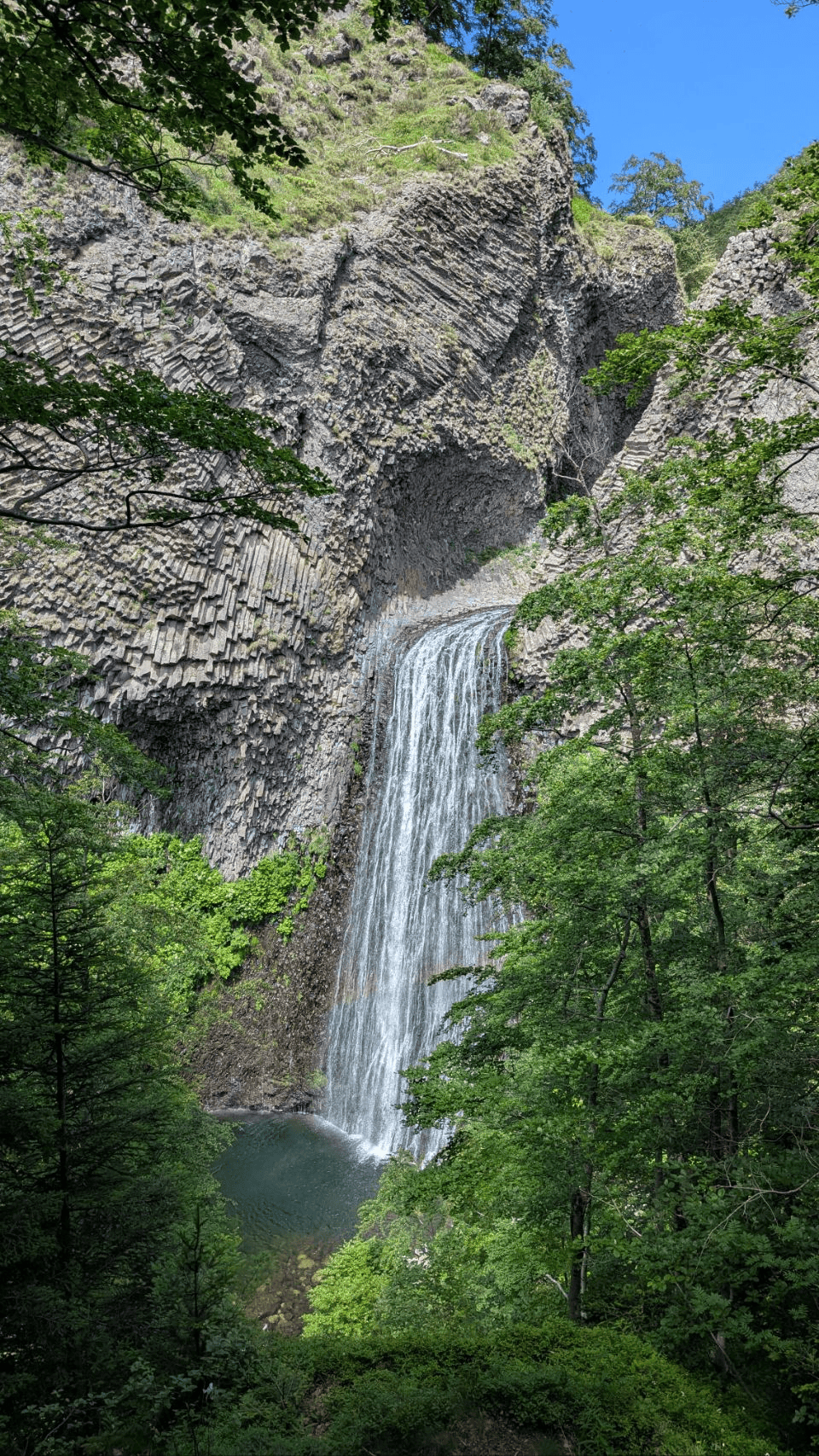
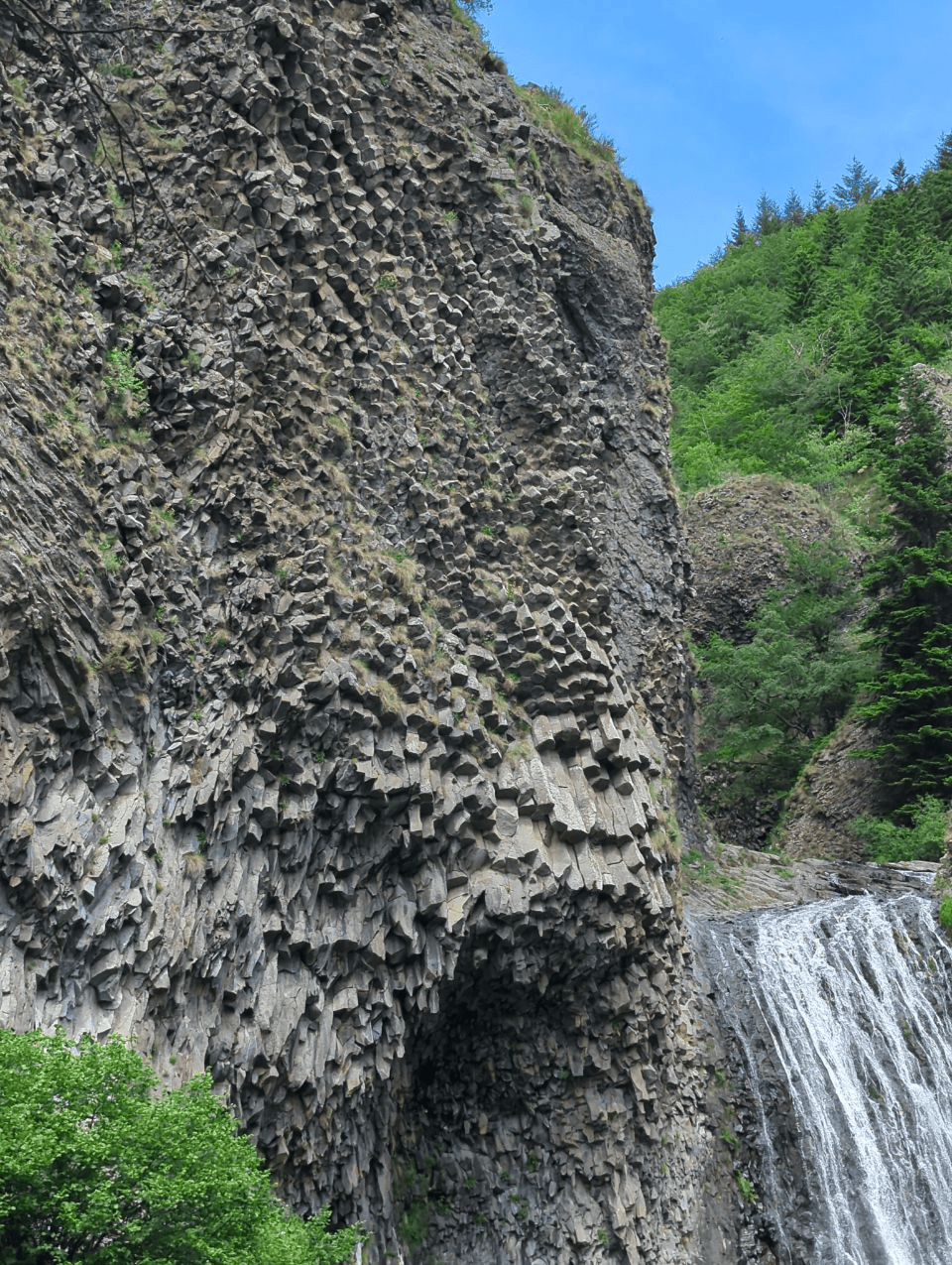
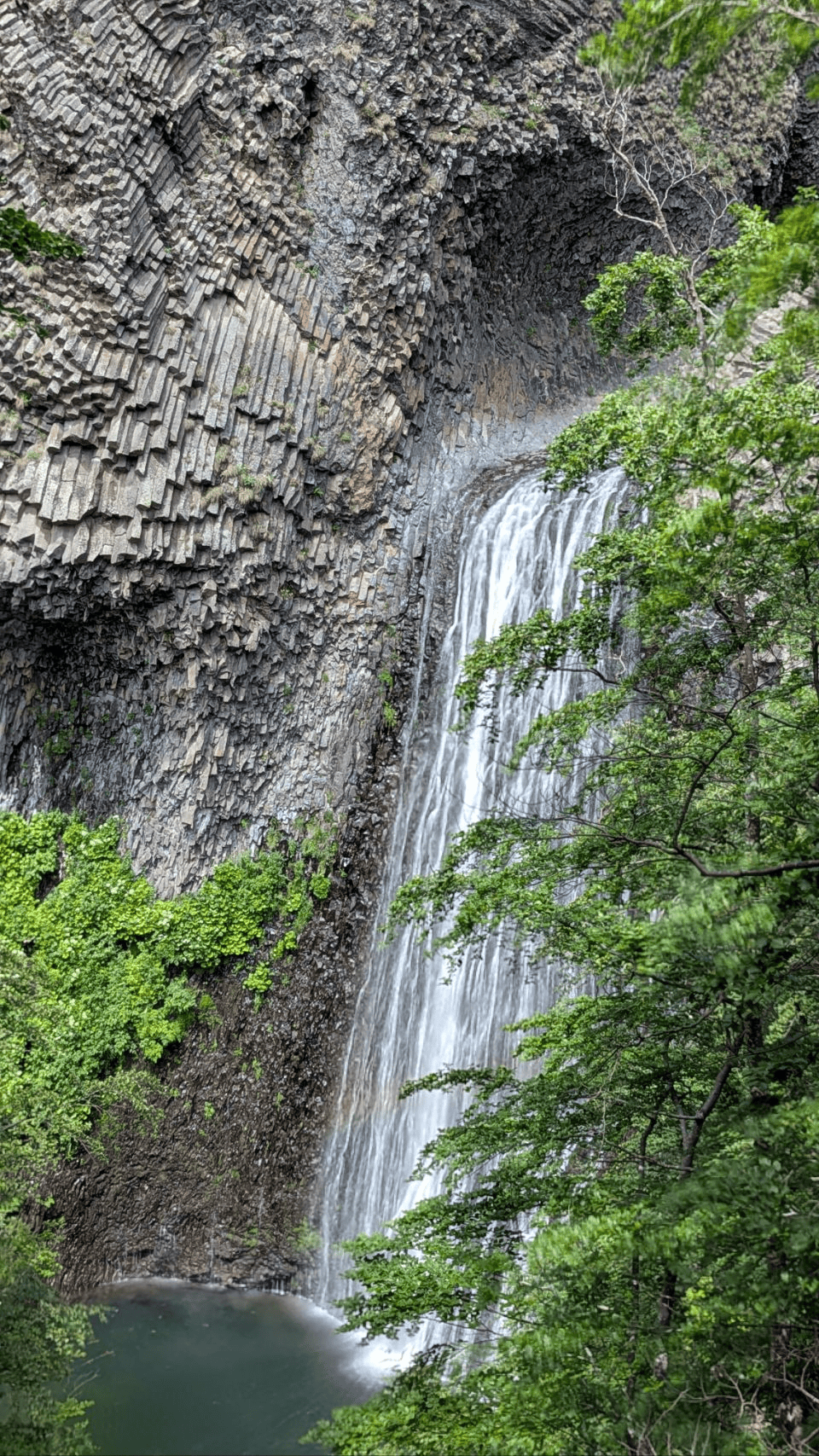
The result is quite impressive: the water plunges straight into the centre of these volcanic formations, as if the rock had been carved to frame the waterfall. The walk is short, but it gives you a very clear understanding of the volcanic landscapes we’ve been passing through since yesterday.
Antraigues-sur-Volane: back to the villages of character
After several hours in the hills, we gradually head south again, stopping off at Antraigues-sur-Volane. The change in temperature is immediate: we leave the Ray-Pic area, where it is around 17 °C, and arrive in the village under 24 °C. After waking up to 8 °C and bundling up in layers upon layers of clothes, this change really does feel good.
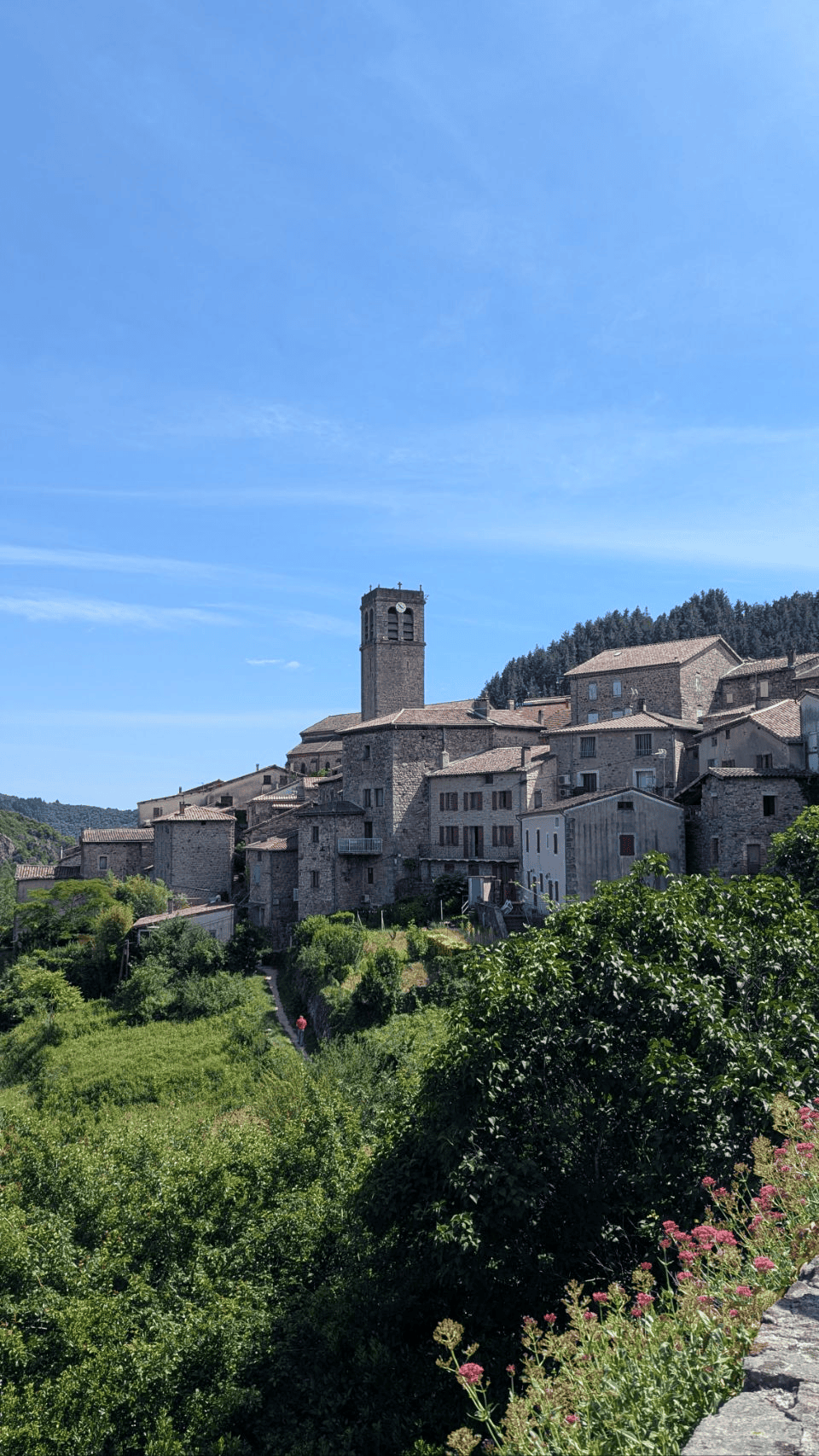
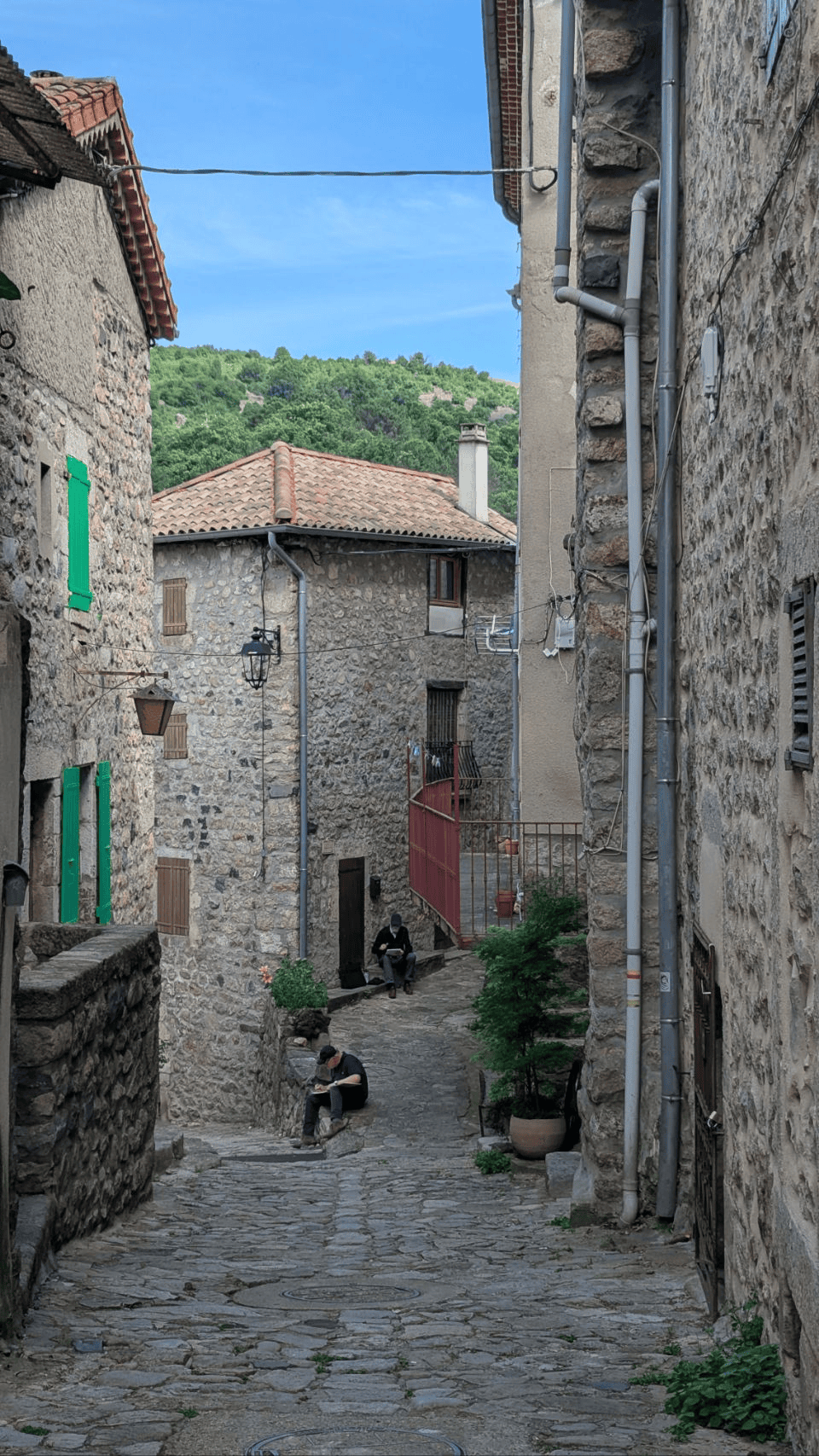
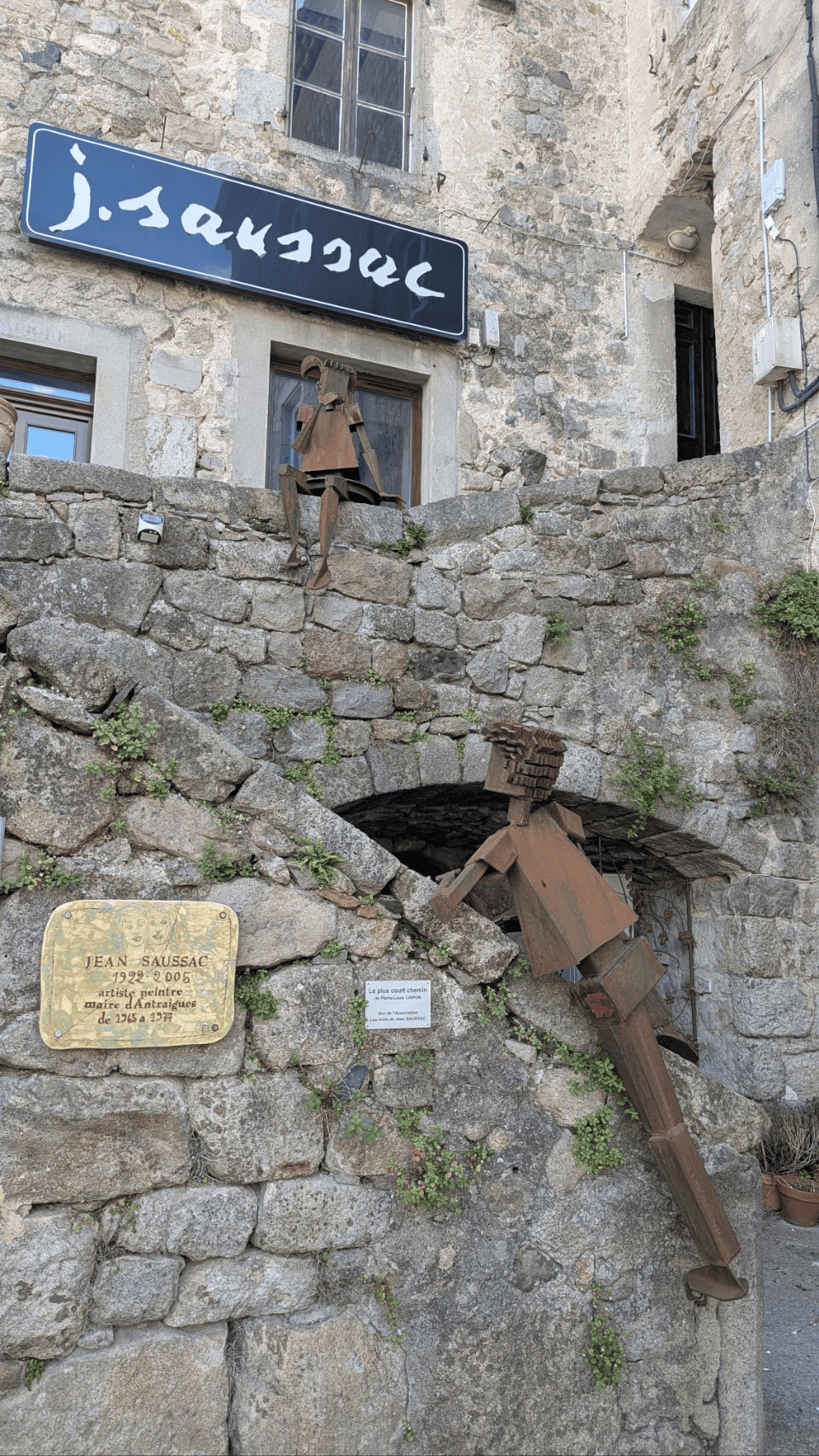
There’s also an atmosphere much more reminiscent of the villages we visited during the first part of the road trip, with old houses, cobbled streets and a village perched on its basalt promontory. But if Antraigues is particularly well known, it is mainly thanks to Jean Ferrat, who first discovered the village in the 1960s before settling in the area. His memory remains very much alive today, particularly through the Maison Jean Ferrat, located on the main square in a former café-hotel.
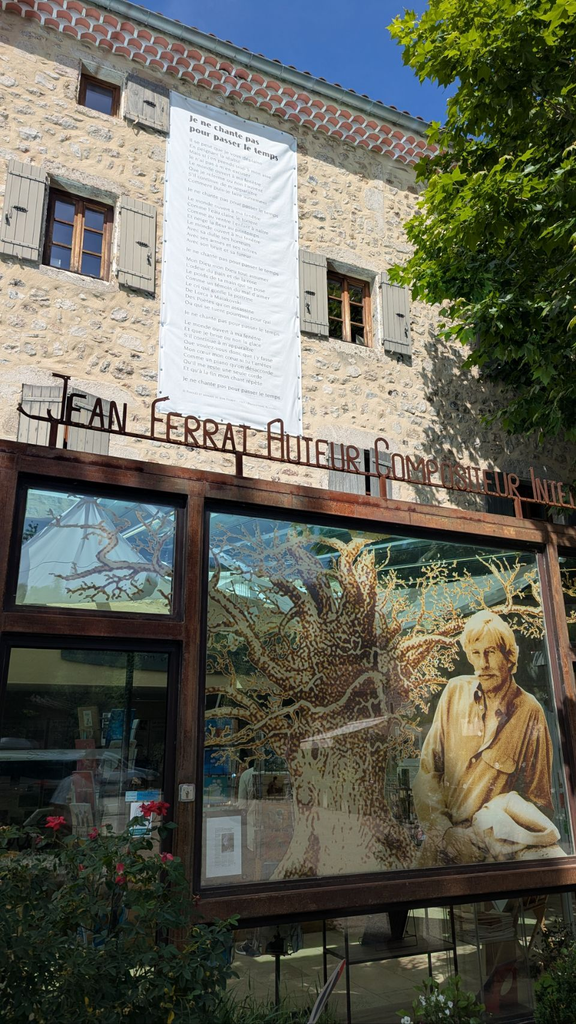
The village is also associated with the painter Jean Saussac, another important figure in local life. We don’t spend much time there, but this stop offers a cultural experience quite different from the villages we’ve passed through so far and, above all, gives us the chance to finally enjoy more pleasant weather.
Mirabel: the postponed visit that eventually made it onto the itinerary
We round off our tour of the Ardèche with Mirabel, which we’d originally planned to visit a few days earlier. We’d eventually decided to skip that stop because it would have meant a detour of over 25 minutes, and we were starting to get seriously tired. As we’re heading back down today, the village is practically on our route, so we’re simply making up for the visit we’d missed out on.
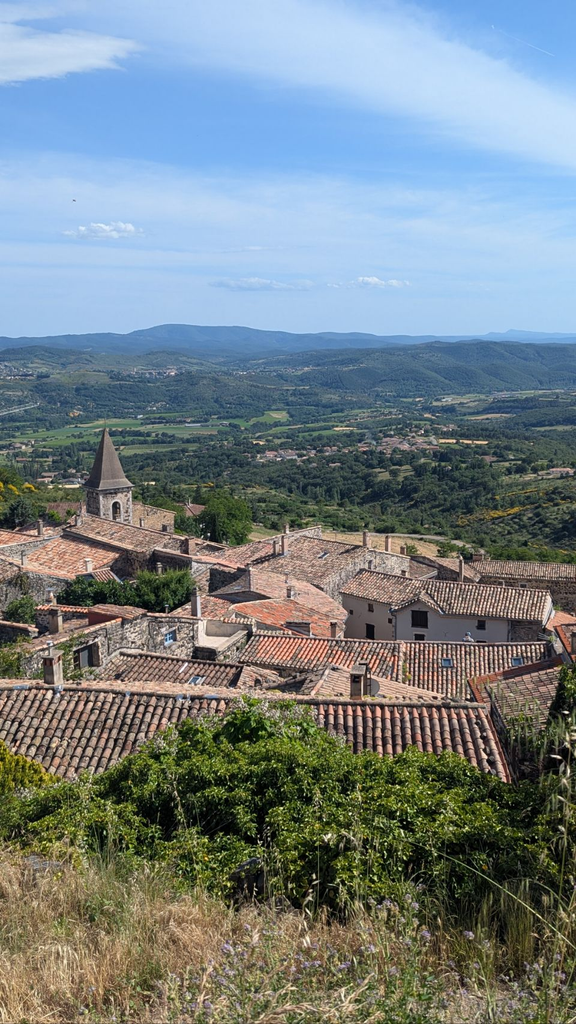
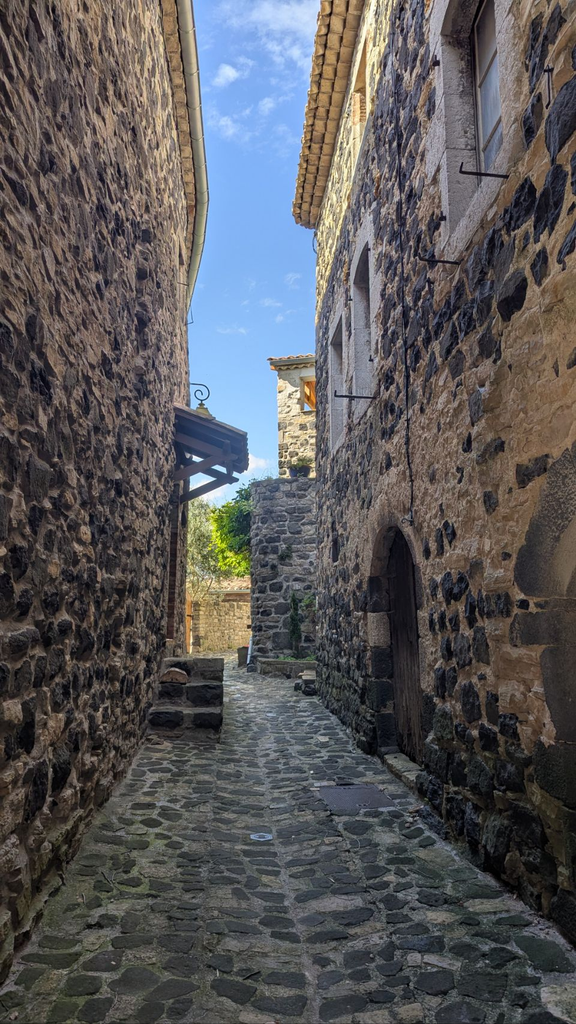
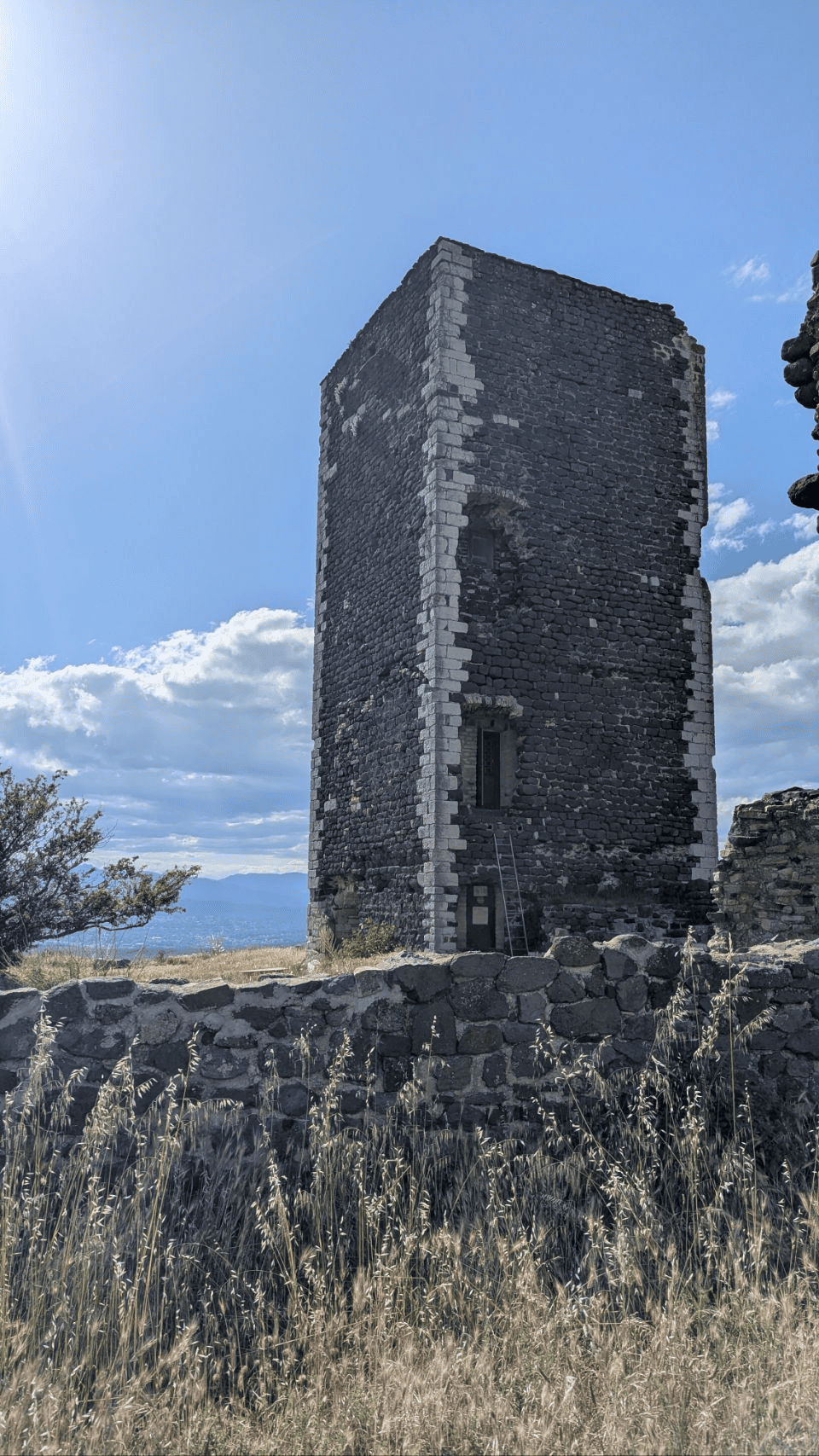
Mirabel is situated at the foot of the the Coiron basalt plateau, whose ancient volcanic flows have profoundly shaped the landscape of the area. In the Middle Ages, the rocky outcrop was home to several fortifications which, amongst other things, enabled the passage between the Lower and Upper Vivarais to be monitored. During the Wars of Religion, the Protestant castle was destroyed in 1628, and today only one tower of the former fortress remains.
The temperature rises by a few degrees as we reach the village, so the walk takes place in a much milder atmosphere than at the start of the day. After several days of alternating between sweltering heat, rain and almost wintry temperatures, we finally complete this Ardèche loop in much more pleasant conditions.
Last camp before heading home
At this stage, we’d seen everything we’d planned to see in the Ardèche. Rather than spending one last night in the department and leaving the whole journey for the following day, we therefore decided to start heading towards the Hautes-Alpes in order to shorten the return journey.
Simon had spotted a spot by a lake that looked really nice. In the photos, with the sun setting over the water, the place had everything it took to round off the trip with a lovely evening. Once we got there, however, we were far less convinced: it seemed to be quite a busy spot, the car park was full of recycling bins, and some of the comments left about the spot weren’t particularly reassuring. So we decided not to spend the night here and set off again.
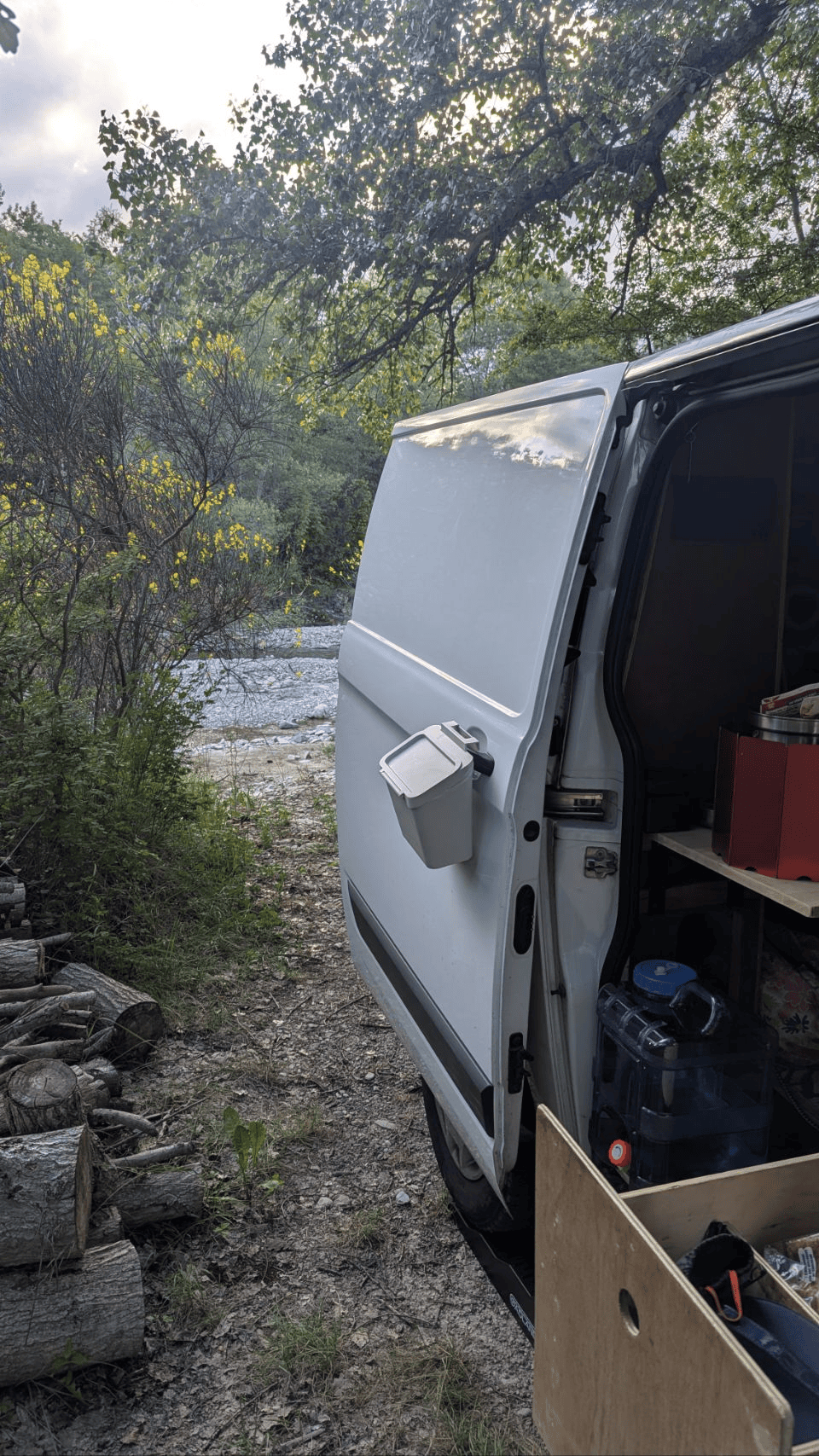
We finally head back towards the area of Our Lady of Consolation, which we’re already familiar with as that’s where we stayed on the first night of our previous Road trip in the Vaucluse. This time, we don’t go quite as high up: we find a spot further down, by the river, quiet enough to spend our last night before setting off for home for good the following day.
Our top tips for the Ardèche
🕳️ Caves: don’t forget about cross-discounts. Several sites offer reduced rates on presentation of a ticket from a previous visit, including at Chauvet 2. If you’re planning to visit several caves, the order in which you visit them can therefore help keep costs down. Also remember to compare prices with the Ardèche Pass.
🛶 Canoeing: ask the hire company if you can stay overnight on site. The owner let us spend the night right in their car park, with access to a small beach. It was very handy to already be there on the morning of our departure.
🌊 If it’s your first time canoeing, you might want to avoid the 24 km route. We did it without any experience and saw it through to the end, but we definitely wouldn’t choose this distance to start with.
🍔 Diego’s Pizza in Coucouron: A lovely surprise when it comes to food. We found a set menu for €15 including a starter, main course, cheese, dessert, wine and coffee, featuring, amongst other things, a burger and homemade chips.
🍕 All about pizza in Mercuer: The only restaurant we visited during our stay, chosen on a night when it was pouring with rain. Good pizzas and a handy spot if you’re passing through the Vals-les-Bains area.
🧀 Make the most of the markets to stock up on supplies. In Joyeuse and Thueyts, we bought cheese, sausage and local produce directly for our picnics.
♨️ Save the Vals-les-Bains thermal baths for a rainy day. We spent almost the whole day there whilst it rained non-stop outside.
🚐 When camping, always have a plan B. A fully equipped service area, an impassable stretch of road, a spot that ultimately didn’t feel very safe, or a lack of mobile coverage: we changed our location several times at the last minute.
How much should you budget for a 10-day road trip in the Ardèche?
In total, we spent €665 for two people for a 10-day road trip in the Ardèche. The biggest expense was clearly the activities, which alone accounted for almost half the budget. Between the caves, Chauvet 2, the canoeing and the thermal baths, we’d planned quite a few paid visits, so it’s not really a surprise.
Apart from that, the rest of the costs were fairly reasonable. We didn’t eat out much; we often had picnics or cooked in the van, and, most importantly, we almost always stayed somewhere for free. Ultimately, what really drives up the cost in the Ardèche isn’t so much the meals or accommodation, but rather all the activities if you really want to make the most of the iconic sights.
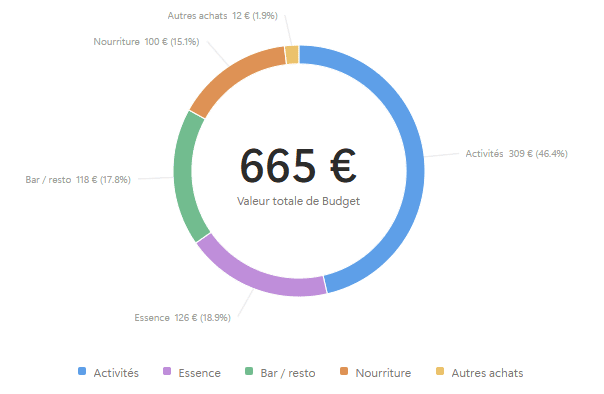
For us, €665 for two people for ten days, with so many visits and without skimping, we still think it’s a pretty reasonable budget.
Conclusion
We're heading out We were really delighted with our ten days in the Ardèche. It was our longest road trip to date – including both the campervan and the roof tent – and, above all, it confirmed that we were perfectly comfortable with this way of travelling over a longer period. Sleeping in the van for ten days, moving on to new spots regularly, cooking on the go and adapting our plans as we went along didn’t cause us any problems at all.
This trip also gave us the chance to really put our new way of organising things to the test with the cool box powered by the Ecoflow portable battery, and clearly, that makes all the difference. Being able to store cheese, fresh produce and meals properly throughout our stay, whilst always having chilled drinks to hand, meant we could be much more self-sufficient. It’s also one of the reasons why we ended up eating out very little during those ten days. For a long road trip in a campervan, this is probably one of the pieces of kit that provided us with the most comfort.
As for the Ardèche itself, we absolutely loved the diversity of the department. In just a few days, we went from medieval villages and the Ardèche Gorges to caves and rivers, and then on to the much more mountainous and volcanic landscapes of the north. We’d planned a fairly varied trip and that’s exactly what we found when we got there, with even more caves than we’d expected in the end, due to the heat and the rain.
Looking back, the last-minute change of plan probably worked in our favour. Visiting in late May and early June rather than in July meant we were able to explore the Ardèche outside the peak season, with far fewer people on the roads, in the villages and at the various tourist attractions. Given how busy the department can get in the height of summer, we definitely think that this played a part in why we enjoyed this road trip so much.
And finally, perhaps the best example of the appeal of the campervan is the way this trip began: the day before, we were still planning to go to Italy. The next day, we were heading for the Ardèche for ten days. With no bookings to cancel and no accommodation to sort out at the last minute, all we had to do was change our itinerary and set off.